
Hebrew Vision News Exclusive
by Miykael Qorbanyahu aka The End Time Scribe
Torah: Deuteronomy 7.12-11.25 Haftarah: Isaiah 49.14-51.3 Witness: John 13.31-15.27
================================================================
A person must show great care in [the observance of the mitzvah of] mezuzah, because it is an obligation which is constantly incumbent upon everyone. [Through its observance,] whenever a person enters or leaves [the house], he will encounter the unity of the name of the Holy One, blessed be He, and remember his love for Him. Thus, he will awake from his sleep and his obsession with the vanities of time, and recognize that there is nothing which lasts for eternity except the knowledge of the Creator of the world. This will motivate him to regain full awareness and follow the paths of the upright. Whoever wears tefillin on his head and arm, wears tzitzit on his garment, and has a mezuzah on his entrance, can be assured that he will not sin, because he has many who will remind him. These are the angels, who will prevent him from sinning, as [Psalms 34:8] states: “The angel of Elohim camps around those who fear Him and protects them.” Blessed be Elohim who offers assistance.
Mishneh Torah. Tefillin, Mezuzah and Sefer Torah – Chapter 6.13
Therefore you are to set these words of Mine in your heart and in your soul. You are to bind them as a sign on your hand, and as frontlets between your eyes. You are to teach them to your children, speaking of them when you sit in your house, when you walk by the way, when you lie down and when you rise up. You are to write them on the doorposts of your house and on your gates, so that your days and the days of your children may be multiplied on the land יהוה swore to give to your fathers, as long as the heavens are above the earth.
Deuteronomy 11.18-22
================================================================
Consciousness is defined as the quality or state of being aware especially of something within oneself. As an internal awareness, consciousness is etymologically comprehended as the state of thoroughly knowing oneself. Essential to the life of spirituality, awareness of the presence of יהוה within our being is what serves as the motivating force to remain both a righteous and set-apart (i.e., holy) individual in accordance with the Torah. As a demonstration of this awareness, the principle of constant mindfulness is a major determinant of consciousness. As we will see within the course of this writing, יהוה in Its supreme wisdom provided measures for us in the Torah that would allow for full our conscious awareness and mindfulness to be activated within each and every member of the children of Israel. Two of these measures will be the focus of this writing, and will prayerfully inspire the readers of this article to embrace the measures, if they have not already, with a righteous zeal and knowledge.
It is important for the sake of this article to now state that the relationship between יהוה and the children of Israel is predicated on the precept of a marriage covenant. Given this information, it is the institution of marriage that the relationship between יהוה and Israel is depicted throughout Scripture for the purpose of providing us with a practical reference on the nature of the interaction. As an institution, we are all aware that marriages between men and women are typically symbolized by the rings that the couple wear on their left ring finger. This ring, in fact, serves two functions for the married couple; one, it is an sign that represents the union that exists between the two who are bonded for life; and, two, it serves as a reminder to its wearer, as the sight of the ring recalls to memory their exchange of vows and keeps them mindful of the special unity that exists between them. This type of symbol and its representation is a matter that is also found present within the covenant relationship between יהוה and Israel, with what are called the tefillin and the mezuzah.
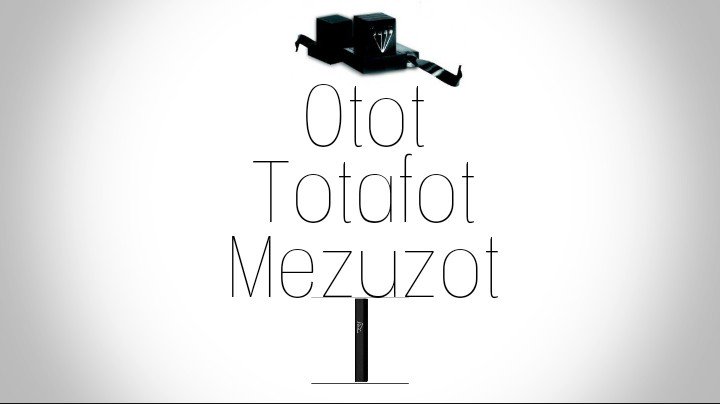
The tefillin comes from the Hebrew words otot and totafot. These are objects which are placed on the head and hand of Israelite men in accordance with the commandment found at Exodus 13.1-10, 11-16; Deuteronomy 6.4-9 and 11.13-21 which are also written on a parchment and placed within them. The word otot is the plural tense of the singular feminine noun ot (אֹות), and is said to mean (in the sense of appearing); a signal (literally or figuratively), as a flag, beacon, monument, omen, prodigy, evidence, etc.: -mark, miracle, (en-)sign, token. This particular sign of the tefiilin is the article that is worn on the head of the wearer. We will discuss its significance shortly. The article that is bound and worn on the arm is called totafot (טֹוטָפֹת) and comes from the word tofafah which has as its meaning to go round or bind. As symbols of the marriage covenant between יהוה and Israel, these two objects are both signifier’s and reminders of the relationship for Israel. The reality of this relationship between יהוה and Israel is best expressed in a reflection that is read after putting on the tefillin which is taken from the scroll of the prophet Hoshea, which reads
And I shall take you as a bride unto Me forever, and take you as a bride unto Me in righteousness, and in right–ruling, and kindness and compassion. And I shall take you as a bride unto Me in trustworthiness, and you shall know יהוה.
Hoshea 2.21-22
This passage is interestingly read as the wearer of the tefillin has come to the last binding of putting them on by wrapping the totafot strap around the middle finger. This is symbolic of the daily donning of a ring that keeps the wedded one centered on their fidelity to the covenant that they have entered. That this act of donning tefillin serves as a powerful stimulator and reminder of the unique relationship that Israel has with our heavenly Father and King. We are able to see this dynamic in the siddur, or the daily prayer book, where a meditation is written about tefillin prior to the wearer donning them, informing us how it is when
I put on tefillin to fulfill the mitzvah (command) of my Creator, as written in the Torah: “Bind (טֹוטָפֹת) them as a sign upon your hand, and set them as a symbol (אֹות) above your eyes.” The tefillin contain four passages from the Torah. They teach us the unity and uniqueness of [Elohim], recall the miracle of the Exodus, declare [Elohim’s] dominion over all that is in the heavens and on earth, and affirm our duty to serve [Elohim] with all our being. We place one tefillah on the arm, pointed toward the heart, that we may recall [Elohim’s] outstretched arm and be reminded to direct our impulses and desires to His service. We place the other tefillah on the head to remind us of the duty to devote all the power of our mind to the service of [Elohim], blessed be He.
Siddur Sir Shalom. Shacharit, pg. 5
Then there is the mezuzah (מְזוּזָה), which is an item that is commanded to be affixed to the doorposts of one’s home and gates. The mezuzah is a rectangular object that, like the tefillin, contains scriptures from the Torah (Deuteronomy 6.4-9 & 11.13-21) inscribed on a parchment and placed within its design. Said to mean doorposts, this word has as its root the masculine noun ziyz (זִיז), a word which contains several meanings, including conspicuous, abundance, fullness of the breast, moving creature and wild beast. The mezuzah is perceived by the sages to emphasize the unity of [Elohim], His providence, and the resulting duty of man toward Him, the mezuzah is an emblematic representation of Israel’s belief and practice. It is also thought to serve as a protective power and was believed to ward of evil spirits from one’s dwelling. When one enters or leaves their dwelling, or other places where there is a mezuzah, it is customary to touch it and then kiss your fingers and recite these words of prayer: may Elohim keep my going out and coming in for life and peace from now on and ever more.
The purpose of these two unique, cultural articles is to keep one’s mind continuously affixed and bound to the thoughts of Elohim and the responsibility of representing the kingdom. The symbolism of the tefillin and mezuzah with the parchments containing passages from the Torah placed within their designs are allusions to the reality of the renewed covenant which the prophet Jeremiah informs us
For this is the covenant I shall make with the house of Yisra’ĕl after those days, declares יהוה: I shall put My Torah in their inward parts, and write it on their hearts. And I shall be their Elohim, and they shall be My people.
Jeremiah 31.33
With the tefillin, the head piece, called shel rosh, is intended to keep its wearer ever mindful of the supremacy of intelligence and reason over emotion. The arm piece, called shel yad, is symbolic of the intent of acting according to a proper and righteous orthopraxy. When this takes place, and an individual is able to control and master their inclinations and propensities, what is identified by Isha Schwaller de Lubicz in her book, The Opening of the Way, as the Spiritual Witness is able to come forth. de Lubicz describes the Spiritual Witness according to the following,
The Spiritual Witness has the spiritual aspect of the incarnate being, his spiritual Name, his highest form of consciousness. It represents his divine soul…throughout the course of his incarnations. It is the [Messianic] element in his evolution, because it desires to liberate him from the karmic chains of becoming by unifying his levels of consciousness.
The Opening of the Way, pg. 35
It is this Spiritual Witness that Israel has been called to be on the stand of existence. As the agents of the Kingdom of Heaven on Earth, it is our duty to first discover and acknowledge the reality of the Self-Existing One who is known as יהוה. Once discovered and acknowledged, it is then our primary duty to manifest the presence of יהוה through the projection of our thoughts, the articulation of our words and the application of our actions according to Torah. This is the reality that Israel has been commissioned to bring into existence so that the world will know that there is a living Elohim in Heaven and on Earth. As such, the mezuzah, like the blood that was placed on the posts and threshold of the door during the Passover when Israel came out of Mitzrayim, is a sign that shows that the house which has it affixed is sealed. This is also what the tefillin come to represent, in that the Israelite who has placed the tefillin on when in prayer. This is a symbol of being sealed with the Word and what the revelator speaks of in the Revelation when he prophecies the following,
After this, I saw four angels standing at the four corners of the earth, holding back the four winds of the earth so that no wind would blow on the earth or on the sea or against any tree. Then I saw another angel coming up from the east, having the seal of the living Elohim. He cried out with a loud voice to the four angels who were permitted to harm the earth and the sea, saying, “Do no harm to the earth or the sea or the trees, until we have put a seal on the foreheads of the servants of our Elohim.”
Revelation 7.1-3
Selah…
Discover more from SHFTNG PRDGMZ
Subscribe to get the latest posts sent to your email.

