
Hebrew Vision News
by Miykael Qorbanyahu aka The End Time Scribe
Torah: Genesis 18.1-22.4 Haftarah: 2 Kings 4.1-37 Witness: Luke 2.1-38
_____________________________________________________________
And יהוה visited Sarah as He had said, and יהוה did for Sarah as He had spoken. So Sarah became pregnant and gave birth to a son for Abraham in his old age, at the appointed time that Elohim had told him.
Genesis 21.1-2
…Abraham was the real reason Heaven and Earth were created, as hinted in the spelling of the word “B’hi ‘baram”, meaning “in his making them” [the Heaven and Earth, which includes the same letters as the name Abraham]. In Genesis 2:4, Isaac, however, was the spiritual equivalent of Adam before his sin, since he was the first person who was conceived and born by parents both of whom had sanctified themselves. The damage Adam had done by sinning, which caused him to acquire a kelipa, husk [symbol of sin] was repaired by the removal of Abraham’s foreskin. Our sages expressed this by saying that Adam pulled, i.e. disguised, the fact that he had no foreskin, as distinct from Isaac, sanctified (from birth) who became the equivalent of [the] first man who had been formed by [Elohim] from holy soil. This may well account for the fact that he was not allowed to leave the holy soil of the land of Israel. (Gen. 27:2)
Isaac, Son of Abraham by Rabbi Horowitz
_____________________________________________________________
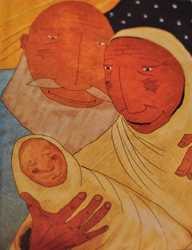 The birth of the patriarch Isaac presents the reader of this week’s parashat with the next rung of consciousness for the Seed of Promise. In the continuum of life from Adam through Abraham, we have now entered the twenty first generation of the household of faith with Isaac. As the promise and fulfillment of the Word given to Abraham by יהוה during last week’s sidrah, Isaac’s introduction to the world provides us with a forecast of the anticipated coming of the ultimate Redeemer of Israel: the Messiah. Isaac’s unexpected birth at such a late stage in the life of Abraham and Sarah represents, as we shall shortly discuss in more detail, the miraculous incarnation of the Messiah who will inevitably (1) redeem Israel and all of willing humanity from their bondage to sin, (2) cause the promised Seed to inherit the promises of the covenant and (3) elevate the consciousness of humanity to its highest level of being. In light of these three matters surrounding Isaac’s birth, theologians have come to identify this most foreshadowing event as the fulfillment of the protoevangelium, or the first announcement of the Good News of the Savior who will come to redeem Israel, first, and then humanity from the curse of sin and death. Of this reality, an article entitled The Messianic Hope of Genesis, tells us of the Promised Seed that
Through examining the future oriented hope found in Genesis, one cannot help but be amazed at the consistency of [Elohim]’s Word. In view of the diverse OT terms related to [Yahoshua]’s position as “[Mashiyach],” it seems best to use the term “anticipatory” as the category into which to group all promises pertaining to this messianic and eschatological hope. While Genesis uses neither the noun מָשִׁיחַ [mashiyach] nor the verb מָשַׁח [mashach] to refer to this coming individual, due to the anticipatory hope found within, Genesis certainly presents the hope of a future “seed” (זֶ֫רַע) who will destroy evil and bring the world back to the Genesis 1–2 state. Just as [Elohim] promised Adam and Eve, [Elohim] likewise promised Abraham that his “seed” will: (1) destroy evil (defeat the serpent through the “seed” of Abraham—22:17b–18); (2) restore creation (bring blessing to all nations—12:3; 22:18); and (3) allow [Elohim] to dwell with his people (dwelling with them forever—17:8). Therefore, in view of the anticipatory nature of the first promise of the Bible as well as the record of how the patriarchs understood this promise, one cannot help but appreciate Genesis 3:15 as the protoevangelium. As the first book of the Bible, Genesis stands as the unique book of beginnings; not only the beginning of humanity, but also the beginning of [Elohim]’s restorative work.
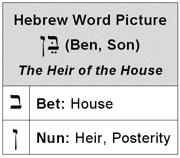 In this article we will touch upon how the generational process of evolution through the seed of man is intended to improve upon both the genetic and spiritual stock of the lineage of the human family which is made manifest with the appearance of the child brought into the world. Given this process of evolution it is, in consequence, the responsibility of the parents to instill into their child all of the previously acquired experiences and knowledge that they have picked up throughout their years. The intent of the transferal of knowledge and experiences are to prepare the offspring to not only continue in the family tradition, given its efficacy, but also to improve and expand the family condition and lot. The ultimate goal of this process is to arrive at the perfection of being, so as guided by the consciousness of the ancestors and elders in Torah who have left behind the blueprints for their descendants. We find this principle elucidated by King Solomon in his proverbs as he wrote
My son, do not forget my Torah, and let your heart watch over my commands; for length of days and long life and peace they add to you.
Proverbs 3.1-2
 For Abraham, the first transferal of experiences and knowledge of Torah unto Isaac was the circumcision of his son which took place on the eighth day of his life. For Isaac, it is anticipated that his level of consciousness and stature would be an upgrade from the initial levels of the original prototype designed by יהוה. His integration of knowledge and wisdom that was imparted unto him by his father was also supported by his extended family who, too, were firmly entrenched in the knowledge and innerstanding of the Torah. At the feast thrown by Abraham for the weaning of Isaac, many of Abraham’s family members were present at the momentous event. We are told by the book of Jasher that
…Shem and Eber and all the great people of the land, and Abimelech king of the Philistines, and his servants, and Phicol, the captain of his host, came to eat and drink and rejoice at the feast which Abraham made upon the day of his son Isaac’s being weaned. Also Terah, the father of Abraham, and Nahor his brother, came from Haran, they and all belonging to them, for they greatly rejoiced on hearing that a son had been born to Sarah. And they came to Abraham, and they ate and drank at the feast which Abraham made upon the day of Isaac’s being weaned. And Terah and Nahor rejoiced with Abraham, and they remained with him many days in the land of the Philistines.
Jasher 21.5-8
The symbolism of the festival thrown in honor of Isaac’s weaning with all of its attendees is a messianic allusion through and through. The appointed times (moedim – מועדים) of יהוה are alluded to in this week’s reading as the promise made to Sarah about bearing and delivering the seed of Abraham surrounds the Feast of Tabernacles so as identified by the Book of Jubilees. Though the weaning of Isaac took place at a later time, his birth is said to have taken place on that exact feast day and appointed time, which coincidentally happens to be the same day that Messiah Yahoshua ben Yoseph was born. This is even alluded to in the Witness of Yochanan which testifies of the matter, stating that
the Word became flesh and pitched His tent among us, and we saw His esteem, esteem as of an only brought-forth of a father, complete in favor and truth.
John 1.14
 The significance of the birth of Isaac, in light of the birth of Yahoshua the Messiah, is nothing short of the fulfillment of the seed of Abraham now having access to the promises of the inheritance of the covenant that was entered into with Abraham. As the Promised Seed of Abraham, we find that the Messiah’s faithful adherence to the Torah, even unto his death and burial, is first demonstrated to us prophetically in the account of the birth and Akedah binding of Abraham’s son Isaac during next week’s reading. This event is mentioned at the end of Vayera as Abraham was summoned by יהוה to Mount Moriyah to make an offering. Through this selfless act Yahoshua was able to to provide humanity with the perfect example of what faithfulness yields, which is an elevated consciousness through an intimate connection with the divine Mind behind all of creation. With this elevation of consciousness, the liberation of humanity’s nature from its bondage to corruption is achieved which then restores humanity back to its original image and likeness after that of its Creator. It is in this consciousness that we are able to experience true freedom and redemption, as we align our wills with that of the Most High and meet with him at the appointed times that have been set aside eternally to experience the rebirth of our being. This is what the birth of Isaac prophetically pronounces to the people of the covenant, and this we can see clearly expressed in the letter of Rav Shaul to the assembly in Galatia when informs them that
…it has been written that Aḇraham had two sons, one by a female servant, the other by a free woman. But he who was of the female servant was born according to the flesh, and he of the free woman through promise. This is allegorical, for these are the two covenants: one indeed from Mount Sinai which brings forth slavery, which is Hag̅ar, for this Hag̅ar is Mount Sinai in Araḇia, and corresponds to Yerushalayim which now is, and is in slavery with her children. But the Yerushalayim above is free, which is the mother of us all. For it has been written, “Rejoice, O barren, you who do not bear! Break forth and shout, you who do not have birth pains! For the deserted one has many more children than she who has a husband.” And we, brothers, as Yitsḥaq was, are children of promise. But, as he who was born according to the flesh then persecuted him born according to the Spirit, so also now. But what does the Scripture say? “Cast out the female servant and her son, for the son of the female servant shall by no means be heir with the son of the free woman.” Therefore, brothers, we are not children of the female servant but of the free woman.
Galatians 4.22-31

Selah…
Discover more from SHFTNG PRDGMZ
Subscribe to get the latest posts sent to your email.

