
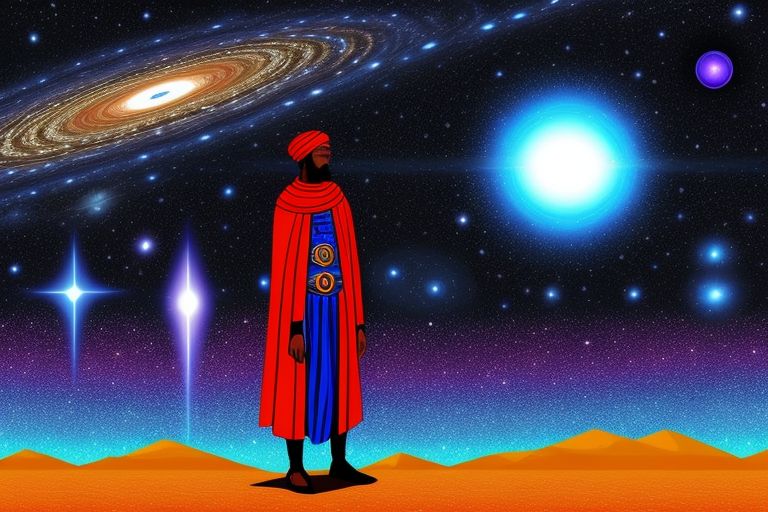
by Miykael Qorbanyahu aka the End Time Scribe
An ideology is about a comprehensive system of beliefs, values, and practices that shape how individuals and societies interpret their reality. Both a lens and a framework, it informs our understanding and shapes our identity, purpose, and destiny. Considering it from an African anthropological perspective, an ideology is not merely an abstract intellectual exercise but a living force intertwined with culture, history, and community. Cheikh Anta Diop, the eminent Senegalese scholar, articulated this beautifully in *Civilization or Barbarism*, where he highlighted the centrality of ideology in sustaining the collective identity of African civilizations. He argued that the ancient Nile Valley cultures, with their profound emphasis on Ma’at—truth, justice, balance, and harmony—demonstrate how ideology was not only a tool for governance but also a spiritual compass.
What this simply means is that African societies encoded their ideology in oral traditions, rituals, and institutions. Consider the griots of West Africa, the keepers of history and philosophy, whose storytelling, song and poems fused morality with memory. Similarly, the communal practices of Ubuntu emphasize our interconnectedness—“I am because we are”—a guiding principle for unity and mutual responsibility.
Shifting to consciousness, the Israelite mystical tradition offers a multilayered and multidimensional understanding. Consciousness is not merely awareness but a dynamic process of alignment with universal purpose. In Kabbalistic thought, the five levels of the soul (Nefesh, Ruach, Neshamah, Chayah, and Yechidah) articulate this journey. Nefesh is our awareness of the life force, the grounding energy tied to the body. Ruach represents emotional and moral intelligence, while Neshamah is the intellectual and spiritual insight. Chayah signifies intentionally living in harmony with the will of Elohim, and Yechidah, the pinnacle, reflects our being operating in unity with El Elyon Each level corresponds to a deeper engagement of consciousness with the true and living One, urging us to refine our thoughts, emotions, and actions.
The philosophical nature of Israel’s rabbinic tradition reveals a deep wrestling with both ideology and consciousness. Rabbis like Yeshua ben Yoseph (Messiah), Gamliel, Hillel, Shammai, and Maimonides contributed significantly to this intellectual and spiritual dialogue. Rabbi Hillel’s emphasis on ethical reciprocity (“What is hateful to you, do not do to your fellow”) contrasts with Rabbi Shammai’s stricter legal interpretations, showing the dynamic interplay between orthodoxy and orthopraxy. Rabbi Maimonides, in his Guide for the Perplexed, explored the relationship between reason and faith, presenting a model for understanding divine law through a philosophical lens. And Messiah Rabbi Yeshua ben Yoseph encapsulated this tradition by embodying the Torah in both teaching and action, calling for a transformative consciousness rooted in love and justice.
When we bring ideology and consciousness together, we uncover the ideology of consciousness—a fusion of cultural and ancestral ideas and principles, coupled with awareness that directs us toward our individual and collective fulfillment spiritually, emotionally, mentally and physically. In my humble perspctive, it is the Torah that serves as the blueprint for this synthesis. Its mitzvot (commandments) are not mere rules but pathways and bridges that connect us to higher consciousness. Consider the Shema (Deuteronomy 6:4-9), which commands us to love YaH with all our heart, soul, and strength. This is not a passive declaration but a call to embody the unity of ideas and principles (orthodoxy) and action (orthopraxy).
The entire book of Deuteronomy, as I explored in my article *Torah Made Flesh: Parashat Devarim Reflections*, encapsulates this purpose. The Torah made flesh is the embodiment of the Torah’s principles in human action. This union is revealed in John 1:14, where Yeshua ben Yoseph became “the Word became flesh and dwelt among us.” Paul’s letters echo this theme: in Romans 10:4 where he informs us that the goal of the Torah is attaining Messianic Consciosness; in Galatians 3:24-25, the Torah is our tutor to lead us to the Messiah; and in Colossians 1:27, the mystery is “Messiah in you, the hope of esteem.”
But how do we live this? The answer lies in embracing Torah’s spiritual practices—Sabbath rest, dietary laws, and ethical relationships and business—as tools for aligning our consciousness with the Torah’s ideology. Faith is not static; it is a faithful and unfailing dynamic, a continual process of discipline, training and the refining of orthodoxy (right ideas) and orthopraxy (right practice). Our awareness of this cause for our alignment to manifess the Messiah within us, transforming our lives and communities.
To put it into complete view, the ideology of consciousness is both a vision and a method. It calls us to remember our roots, honor our spiritual heritage, and live intentionally on and in purpose. By embodying the principles of Torah, we become vessels for heavenly wisdom and love, answering our call to fulfill our purpose as a Kingdom of Priests anointed to be the Light to the nations. And in doing so, we realize the promise of the Messiah, the Torah made flesh, dwelling among us and within us to manifest the Kingdom of Heaven on Earth.
Selah…
Discover more from SHFTNG PRDGMZ
Subscribe to get the latest posts sent to your email.

