
______________________________________________________________
And she conceived again and bore a son, and said, “Now I praise YaH.” So she called his name Yehuḏah. And she ceased bearing.
Genesis 29.45
Blessed are the people Who know the sound of the festal trumpet-call! They walk, O יהוה, in the light of Your face.
Psalm 89.15
And they were astonished at His teaching, for His word was with power.
Luke 4.32
______________________________________________________________
For me, there’s something about reggae music that just hits my soul different. From high school forward, I vibed heavy with Reggae riddimz; it was their funky and cryptic basslines, the echo of the drum, the wailing horns and the powerful lyrical content intent on chanting Babylon down that did it. The way I feel, reggae isn’t just music, it’s spirit. The messagea are uplifting, the grooves are healing, and the heartbeat of the riddim always attunes my entire being to something higher. Whenever I listen to it, it stirs something in me, something ancient and familiar, something sacred. And over time, I came to realize that it wasn’t just the sound that moved me, it was the praise embedded in the sound; the spiritual intention behind the rhythm.
The Word.
The Sound.
The Power.
Word. Sound. Power.
That phrase rings deep in the heart of Rastafarian culture, but its roots reach far beyond the Caribbean. It’s an echo of ancient Israelite truth. In the Rastafari livity, Word Sound Power isn’t just a slogan, it’s a principle of creation, a spiritual force that reflects the creative utterance of the Most High. As it says in Bereshit,
וַיֹּ֥אמֶר אֱלֹהִ֖ים יְהִ֣י א֑וֹר וַֽיְהִי־אֽוֹר
“And Elohim said, ‘Let there be light,’ and there was light” (Genesis 1:3). The universe itself was spoken into existence. Every vibration carries creative intention; every sound contains creative potential.
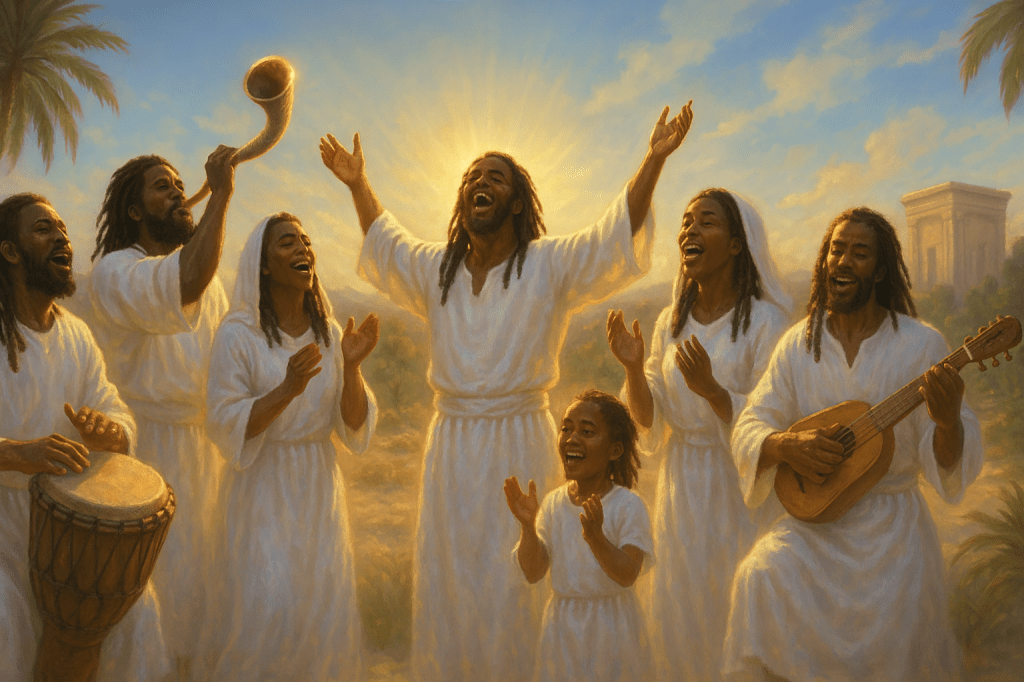
This understanding flows directly from the cultural wellspring of Afro-Asiatic spirituality, especially the Israelite culture, which never separated the sacred from the sonic. For our people, music was never background noise, it was the language of the soul. The Levites were appointed not only to guard the sanctuary but to lead in song. From the shofar blasts of war and worship, to the instruments played in the temple (harps, lyres, cymbals, and trumpets), to the spontaneous songs sung by Miriam and the prophets, Israel’s worship was and continues to be deeply rhythmic, embodied, and powerful.
In ancient Israelite tradition, words weren’t just heard, they were felt. And music wasn’t just art, it was ministry. Songs carried memory. Chants carried covenant. Rhythm carried the people through wilderness, war, and worship. This is why the Psalms are still chanted today, why the Shema is chanted morning and night, and why the Torah itself is chanted with musical cantillation (ta’amim) marks. The voice is an instrument, and when played with kavanah, intentionality, it becomes a vessel of heavenly force.
Our Afro-Asiatic linguistic ancestors deeply resonated with the vibration of the Word. The Hebrews of old understood, just like many of our Rastafari brethren do now, that speech is sacred, and that every syllable spoken in alignment with truth builds or breaks spiritual realities. It’s why Dawid sang with such fire. Why Moshe sang after the sea parted. Why the priests blessed the people not with gestures, but with words which we read of at Numbers 6:23-27.
To praise is to participate in creation, to worship is to speak light into the dark, to sing truth is to shatter lies with melody.
So when we talk about praise and worship, we’re not talking about religious routine. We’re talking about reclaiming an ancient technology of the spirit, embedded in our DNA as the suns and moons of Zion. Sound is not neutral, it’s directional. And when it’s aimed at the Most High with sincerity, it becomes a weapon, a balm, a ladder, a throne.
By saying that sound is directional, this means that sound doesn’t travel the same in every direction. This is because sound is stronger in the direction it’s aimed, just like how a flashlight shines more in front of it than behind. When we speak or sing, especially in worship or prayer, that sound carries energy and intention. If we direct that sound toward the Most High with focus and purpose, it becomes more powerful, just like how the sound of a shofar cuts through the air in a specific direction. This is why our words, praise, and worship matter, because sound, when directed with intention, becomes a spiritual force.
This is why transfiguration and sound are inseparable. Just as you can’t carry light without carrying its frequency, you can’t release sound without releasing its vibration, and that vibration shapes the atmosphere around you. Every sound carries a message, a frequency, and an effect; whether it’s praise or complaint, truth or noise, what you speak creates. So when we lift our voices in worship, we’re not just making noise, we’re releasing a frequency that has the power to align, heal, and transform.
King Dawid of the tribe of Yahudah was a man of higher frequency. He was a warrior, prophet, and poet, but above all, a worshipper. He poured his heart into psalms, danced before the Ark with abandon, and sang praises to YHWH even in the midst of battle, betrayal, and brokenness. The Psalms are more than poetry, they are portals. They are coded frequencies of worship, expressions of love and lament, joy and justice, all pulsing toward the throne of the Most High.
To understand praise and worship is to understand power. In the Torah, the name Yahudah (יהודה), from which the word “Jew” (Yehudi) and the tribe of kings descend, means “praise.” It comes from the root yadah (ידה), which means “to give thanks” or “to lift the hands in confession and surrender.” Embedded in Yahudah is the four-letter Name of YHWH (יהוה) with the addition of the letter dalet (ד), which symbolizes a door. Praise opens the door to the Presence of YaH. It is a divine technology—a spiritual access point that invites the Infinite into the finite.
Praise is not only intimate; it is also weaponized. In 2 Chronicles 20, King Yehoshaphat found himself surrounded by a massive coalition of enemy armies. But instead of sending warriors to the front lines, he sent singers, Levites praising the beauty of qedushah. As they lifted their voices in worship, the Most High confused the enemies, and they destroyed one another. No sword was lifted. No arrow released. Just voices raised in praise. Worship became warfare, and victory was sealed by sound.
So what is praise? What is worship? Let’s break them down with the Hebrew lens.
The Hebrew word for praise is often tehillah (תְּהִלָּה), rooted in halal (הלל), meaning “to shine, to boast, to rave, to celebrate.”
- Tav (ת) – covenant, completion, truth
- Hei (ה) – breath, revelation, surrender
- Lamed (ל) – teaching, authority, shepherd’s staff
- Hei (ה) – again, reinforcing divine inspiration and awe
Tehillah then can be seen as the breath of revelation flowing through a covenantal vessel, exalting the Shepherd’s truth. It’s not just sound, it’s submission. It’s not performance, it’s proclamation.
The Hebrew word for worship is most often shachah (שָׁחָה), which means “to bow down, to prostrate oneself.”
- Shin (ש) – fire, transformation
- Chet (ח) – boundary, inner chamber, life force
- Hei (ה) – breath, awe, Divine Presence
Worship, then, is the act of entering the inner space with fire and reverence, bowing down in breathless awe before the One who gives life. It is intimate surrender. A voluntary burning away of ego to dwell in the radiance of the Most High.
Scripture is saturated with the power of praise.
“YHWH inhabits the praises of Israel” (Psalm 22:3).
“Let everything that has breath praise YHWH” (Psalm 150:6).
“Out of the mouths of babes and sucklings You have ordained strength” (Psalm 8:2), which Yahoshua Himself cites as praise (Matthew 21:16).
The sages of the oral tradition understood that praise is not optional, it is spiritual technology. The Midrash Tehillim teaches that “When Israel sings, the gates of Heaven open.” Praise literally realigns the soul with its Source. It’s the sound of the soul returning home.
In the journey of transfiguration, I submit that praise and worship are the elevation vehicles of the soul. They lift us above our circumstances and root us in the presence of Elohim. When we praise, we shift frequency. When we worship, we draw near. As mentioned in Transfiguration Movement #13: Mastering the Mind with Meditation, stillness is necessary, but so is sound. Meditation is the inhale. Praise is the exhale. Together, they shape and strengthen the vessel for transformation.
And so it is with every breath we take, we unknowingly echo the sacred Name of the Most High: YHWH (יהוה). The inhale begins with the silent opening of the throat, like a Yod (י), subtle and flickering like a flame. As the breath expands into the chest, it forms the open Hei (ה), a breathy sound, soft and spacious. The movement downward, through the diaphragm, carries the vibratory flow of Vav (ו), which is the connector. And the final exhale releases another Hei (ה), gentle, releasing, returning. Breath by breath, we are living expressions of the Name, inhaling Presence and exhaling praise, constantly tethered to the Source who breathed life into Adam and still breathes into us today. And when we praise, we release one of the most powerful forces there is in creation.
Let me be clear, for myself and you dear reader, praise isn’t just for when you “feel it.” Worship isn’t only for the sanctuary or the Shabbat service. They are daily postures. If you praise when you’re low, it’ll lift you. If you worship when you’re weak, it’ll anchor you. Praise in the kitchen, worship in the car, shout in the hallway, dance in the living room. Fill your environment with the vibration of thanksgiving and surrender, and watch how your inner world starts to glow.
This is the play: Raise your frequency. Lift your hands. Sing your soul clean. Bow your heart. Dance like David. Chant like the Levites. Praise like the gates of Heaven are waiting, because they are. And when you do, don’t be surprised when walls fall, enemies scatter, and the light within begins to shine brighter than ever.
Transfiguration is not just what we see, it’s what we sound like when we’ve been in the presence of the King.
Let your praise be loud.
Let your worship be real.
This is the movement.
This is the sound of splendor rising.
Word.
Sound.
Power.
Vehicles of our transfiguration.
Selah…
Discover more from SHFTNG PRDGMZ
Subscribe to get the latest posts sent to your email.


1 Comment