
________________________________________________________________
[Rabbi Gamaliel] used to say: do His will as though it were your will, so that He will do your will as though it were His. Set aside your will in the face of His will, so that he may set aside the will of others for the sake of your will.
Pirke Avot 2.4
Then [Yahoshua] said to them all: ‘Whoever wants to be my disciple must deny themselves and take up their stake daily and follow me.’
Luke 9.23
________________________________________________________________
SELFLESSNESS.
That single word sums up one of the hardest but holiest transitions in my entire spiritual journey.
Coming up as an only child, I didn’t know what it meant to truly share. Everything was mine by default. My world revolved around my wants, my needs, my desires. And as I grew into adulthood, that default programming stayed tucked in my subconscious. In relationships, I had to battle the silent entitlement of always needing to be understood without doing the work of understanding. In parenting, I struggled with the burden of not always being available to my sons, who, because of my life decisions, live in different homes. In ministry, I’ve had to sacrifice comfort, reputation, and even relationships in order to walk in truth.
Everything for me began to change the day after one of my lowest moments, a time I previously wrote about in Repentance is Transformative. That was the night when I went to sleep intoxicated and confused, unsure even of who to pray to. That’s when I woke up the next moring, opened the Scriptures and found myself staring into Ecclesiastes 3, where it says there’s “a time to be born, and a time to die… a time to break down, and a time to build up.” For some reason, that Word pierced through the fog. before then, I had been living a life that was fractured, void, directionless, but in that moment, something in me broke down, and something else began to build up. My act of repentance at that moment wasn’t performative, it was transformative. I didn’t just feel sorry, I died that day. And when I came to Kansas City in April of 1997, I knew that it would also usher in my resurrection. I decided to make ’97 the year that I was going to heaven. No more drifting. That night, I stayed with one of my childhood best friends, Chris Powers, and he gave me a book to read after we finished talking about the life of faith, “Loose That Man and Let Him Go” by T.D. Jakes. I devoured it in one night. It was as if the Ruach of YaH had written every word specifically for me. That night, chains were broken, my mind was cleared, my purpose was awakened.
The beautiful thing is, I wasn’t alone either. My oldest and best friend, Shebaniyah bayn Yahudah, had also come into the knowledge and love of the Messiah. We were both radically changed, no longer chasing the vanity and rebellion of our former lives. We had been bought with a price, and we set out with conviction to share the Good News of the Kingdom with anyone and everyone who would listen. Street corners, church services, soirees, poetry readings, you name it, wherever the Ruach led, we followed. To most people, we were too religious, but for us, it wasn’t about religion, it was about redemption. And it still is.
What is required in this call of redemption and path to life has demanded death to self, again and again and again and again.
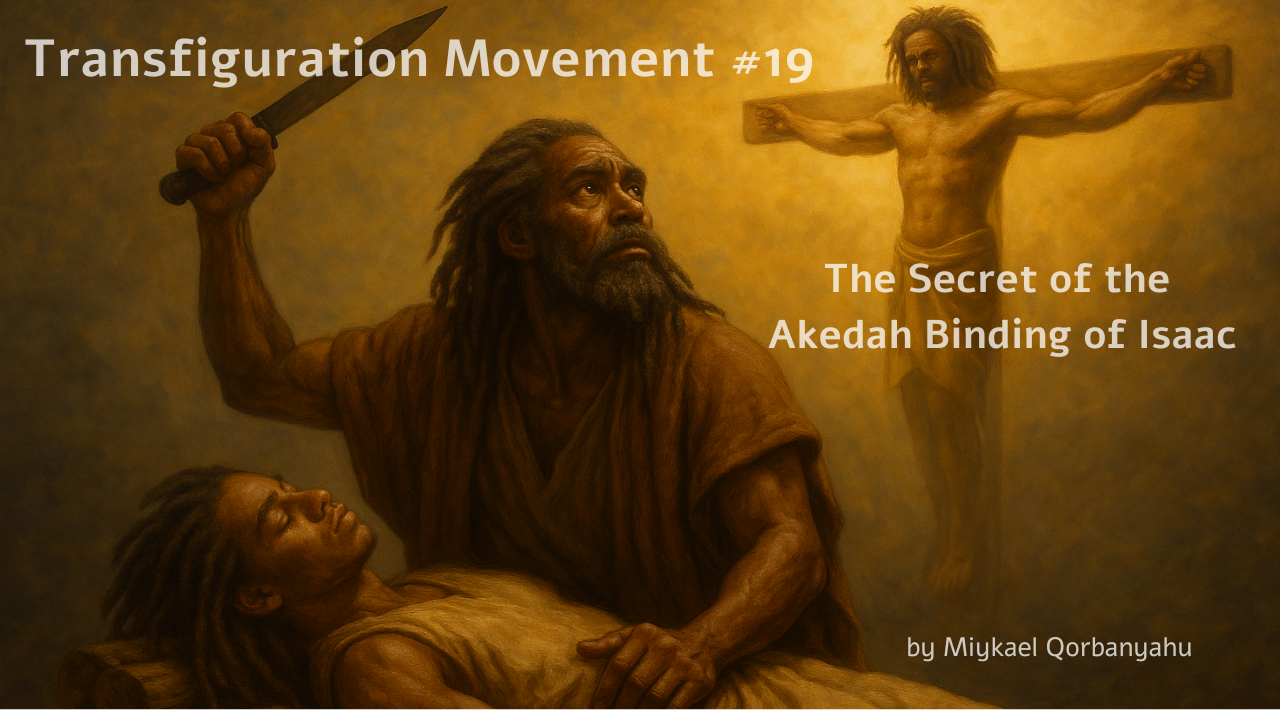
And this is exactly what the Akedah binding of Isaac teaches us.
But before we get to the Akedah, which we will see means to bind, let us first cover how the essence of Torah isn’t just ritual or head knowledge, it’s heart posture. And as we press toward transfiguration, awakening to our identity, purpose, and covenant, it is critical to anchor ourselves in the eternal declaration of allegiance and unity known as the Shema. Found in Deuteronomy 6:4-5, the Shema proclaims:
“Hear, O Israel: YaH is our Elohim, YaH is One. And you shall love YaH your Elohim with all your heart, with all your soul, and with all your strength.”
This pledge of allegiance is not merely a recitation; it’s a call to spiritual alignment. In fact, it is the Shema that binds us to the Kingdom of YaH by commanding total devotion, heart (levevka), soul (nefeshka), and strength (me’odekah). It’s a daily reminder that our transformation is not just internal but kingdom-oriented. When we declare the Shema, we affirm that YaH reigns over every aspect of our being, and that His sovereign will must govern our homes, our communities, and our collective destiny.
To say the Shema is to step into a covenantal consciousness. It is to recognize the unity of Elohim and the unity He demands of His people, a holy nation, indivisible, with the Messiah as its head. This is how we transfigure: not by merely being hearers of the Word, but by becoming echad (one) with the Word, and therefore one with the Kingdom.
Just know that this is a love that costs you, a love that requires your all.
It is in this spirit that the sages say in Pirkei Avot 5:3–5 that Abraham’s love for El Shaddai was tested ten times, and in each, he stood firm. But the test at Mount Moriah, the Akedah, was the most crushing of them all.
In Bereshit (Genesis) 22, we encounter the prophetic moment where Abraham is asked to offer up Isaac. The text is rich with mystery. Isaac, carrying the wood, turns to his father:
“Here is the fire and the wood, but where is the lamb for the burnt offering?”
— Genesis 22:7
Abraham’s answer is one of the most prophetic and Messianic lines in all of Scripture:
“Elohim will provide for Himself the lamb for the burnt offering, my son.”
— Genesis 22:8
In Hebrew, the phrase אֱלֹהִים יִרְאֶה־לּוֹ הַשֶּׂה לְעֹלָה בְּנִי” can be read with a pause that changes everything:
“Elohim will provide the lamb…my son.”
This isn’t just a declaration of trust. It is prophecy. Abraham saw into the future, he saw the Lamb of Elohim, the Messiah, the Redeemer to come.
The Akedah binding of Isaac is one of the most profound and mysterious episodes in all of Torah. It is not merely a story about a test; it is a cosmic revelation about the nature of trust, surrender, covenant, and identity. But to truly grasp its weight, we must look beyond the surface and consider the meainng of each of the word’s letters, the oral tradition and sacred texts like Sefer HaYashar (Book of Jasher) that offer deeper context behind what led to that fateful moment on Mount Moriah.
To begin, the word Akedah (עֲקֵדָה) literally means “binding.” But when we look deeper, the letters themselves reveal the secret:
- Ayin (ע) – Insight, perception
- Qof (ק) – Holiness, separation
- Dalet (ד) – Door, pathway
- Hei (ה) – Revelation, breath of Elohim
These letters combined yield the following idea:
“Binding our selves to the Most High requires us to enter the door of perception that separates the holy for revelation.”
To be bound in obedience is to unlock the door that reveals the Torah’s light. The Akedah is about aligning with the will of Elohim even when it costs everything.
From this field of view, the Akedah is not just a historical event, it is a living pattern encoded within the soul of every child of Elohim. It is the moment when we are asked to lay down everything we hold dear, even what YaH Himself promised, to prove the posture of our trust. For Abraham, it was Isaac. For us, it might be our comfort, our attachments, our plans, our reputation, or even our identity as we once understood it.
To walk in the footsteps of our father Abraham is to ascend our own Moriah, bind the false self on the altar of obedience, and raise the knife of surrender over everything that keeps us from full alignment with the Divine Will.
The sacrifice is not only about what you let go of, it’s about what is born in its place. In giving up Issac, Abraham didn’t lose a son, he inherited a nation. Likewise, when we obey the inner call to sacrifice, we step into a higher frequency of spiritual awareness, maturity, and purpose.
This is not merely allegorical. It’s real. In our own lives, many of us have faced moments when the Ruach beckoned us to give up something we were never meant to carry into the next season. When we resist, we stagnate. When we surrender, we transform. And every time we say “Hineni,” here I am, we move closer to becoming the living sacrifices that manifest the Shekinah Presence of Esteem of Elohim in the earth.
For a broader perspective of how this applies, let us consider the following; according to Jasher 22, the Akedah didn’t begin on the mountain. This incident actually began in a conversation. Isaac and Ishmael, sons of Abraham, were once engaged in a dispute. Ishmael, perhaps attempting to assert superiority as the elder son, boasted of his circumcision at age 13, claiming it as proof of his devotion. Isaac, younger but filled with spiritual insight, countered not with pride but with depth. He said, “You boast in having shed a few drops of blood. If Elohim told me to offer my whole self as a sacrifice, I would do it gladly.”
Big words from the little bro, but this wasn’t just wolf tickets or idle talk. These were living words that ascended into Heaven. As the midrash teaches, the moment Isaac spoke those words, they were recorded in the heavenly scrolls. That utterance prompted the testing of Abraham and the subsequent call for the Akedah.
But even more stirring is what we learn from the close of Jasher 22, that Abraham, following the feast that he threw for Isaac, his son with Sarah, had ceased offering sacrifices. In the narrative, Satan observes this matter of Abraham and presents himself to El Elyon and accuses Abraham of no longer serving the Most High. In fact, he accusses Abraham of entirely forsaking YaH, not knowing that Abraham was now more committed to serving his Elohim in Spirit and Truth. But why did Satan not know this about Abraham? Because Abraham had become the offering. His very life, his obedience, his surrender, and his walk had become a living olah, a whole burnt offering rising up in fragrance before the Most High.
So when the call came,“Take your son, your only son, whom you love…” it wasn’t a test in the typical sense. It was an activation of covenantal destiny, rooted in the love of a father and the faith of a son, both of whom were already walking in profound alignment with Elohim.
This moment on Mount Moriah was not an act of desperation or blind obedience. It was a partnership of trust between father and son, both committed to fulfilling the will of the Most High no matter the cost. Isaac wasn’t a child forced onto the altar, he was a willing participant, a young man prepared to embody his earlier vow. Abraham wasn’t just offering his son, he was offering his entire future, trusting that Elohim was faithful to resurrect what was willingly given.
To confirm this reality, he Book of Jasher 23 tells us that Isaac said to Abraham:
“And when they were going along Isaac said to his father, Behold, I see here the fire and wood, and where then is the lamb that is to be the burnt offering before the Lord? And Abraham answered his son Isaac, saying, The Lord has made choice of thee my son, to be a perfect burnt offering instead of the lamb. And Isaac said unto his father, I will do all that the Lord spoke to thee with joy and cheerfulness of heart. And Abraham again said unto Isaac his son, Is there in thy heart any thought or counsel concerning this, which is not proper? tell me my son, I pray thee, O my son conceal it not from me. And Isaac answered his father Abraham and said unto him, O my father, as the Lord liveth and as thy soul liveth, there is nothing in my heart to cause me to deviate either to the right or to the left from the word that he has spoken to thee.
Genesis 22.10-12 goes on to share with us what took place next,
And Abraham stretched out his hand and took the knife to slay his son. But the Messenger of YaH called to him… ‘Do not lay your hand on the lad… for now I know that you fear Elohim.’
In this moment, the father embodies hesed (loving-kindness) through trust, and the son embodies gevurah (strength) through surrender. And together they mirror the sefirotic balance that defines a transfigured soul: a will aligned with Heaven and a heart submitted in love.
It is no coincidence that the Akedah happened on Mount Moriah, the same mountain where the Temple would later stand, and where Melchizedek earlier met Abraham with bread and wine. As has already been addressed, these elements, the bread, the wine, and the willingness to offer oneself completely, form the very mystery of Messiah and the ultimate path of b’nai Elohim.
Thus, the Akedah is not just a foreshadowing of the ultimate offering of Yahoshua, it is also a template for us all. It is the moment where bread, wine, and oil meet: the bread of obedience, the wine of covenant, and the oil of anointing.
But just on the periphery of this ordeal, the Book of Jasher 23 also records something profound: when Abraham, Isaac, approached Mount Moriah they were accompanied by Ishmael, his son, and Eleazar, his servat. In the distance, Abraham notices the Shekinah Presence of Elohim on the distant mountain and asks his journeymen with him what they perceive on the mountain. Suffice it to say, only Abraham and Isaac saw the Shekinah. The 47th verse of the book says that
Abraham said to Eleazar and Ishmael: remain you two here with the ass, while I and the lad go yonder, and we will worship and return to you…
This was no slight, it was a separation, something that we see take place back in Genesis when Elohim separated light from dark, heaven from earth, water from water. Only those spiritually prepared can perceive the Shekinah Presence. The Akedah was not just a test of obedience, it was an unveiling of higher consciousness, of Hebrew Vision.
And vision is not about seeing with the eyes, it is about perceiving with the soul. We all know what it says in Proverbs 29:18:
“Where there is no vision, the people perish…”
The Hebrew word for vision here is chazon (חָזוֹן): a prophetic insight, a spiritual foresight, a glimpse of what ought to be. Without it, we lose restraint, we lose clarity, and we drift.
Alternatively, to see the Shekinah is to be infused with purpose. And purpose is what compels selflessness. Mosheh was not ambitious, he was obedient. He did not seek platform, he sought Presence. Because once you’ve seen the Shekinah, you can no longer live for yourself. Your life becomes a vessel.
This is why Hebrew Vision is at the core of our identity. The word Ivri (Hebrew) means “one who crosses over.” But what is it that we cross over from? From darkness to light. From blindness to sight. From flesh to spirit. From earth to heaven. We are called to see beyond the surface, to perceive the Kingdom in the midst of chaos and to move forward by faith-fueled vision, not fear-based reaction.
Hebrew vision is not just revelation, it is responsibility. Once you see, you are accountable to walk out what was shown.
This is why Yahoshua said in Luke 12.46-47:
And that servant who knew his master’s desire, and did not prepare, nor did according to his desire, shall be beaten with many stripes. But he who did not know, yet did what deserved flogging, shall be beaten with few. And everyone to whom much is given, from him much shall be demanded. And to whom much has been entrusted, from him much more shall be asked.
This type of responsibility is based on unified vision, the clarity of purpose, the alignment of our heart with Heaven. When our eyes is set on Elohim, when our focus is not split, we become filled with light. We become luminous, transformed, whole, bound to heaven, transfigured.
To see the Shekinah, to behold the Presence, is to awaken to a higher purpose, one that requires sacrifice, devotion, and vision. This is not about ambition, it’s about alignment; it’s not about hype, it’s about qedushah.
Hebrew Vision is the beginning of becoming tamim; whole, undivided, and true. It’s what allows us to remain faithful under pressure, steadfast in adversity, and joyful in affliction. It’s what calls us to transform, not just for ourselves, but for the sake of the world.
Because once you’ve seen the Shekinah, you can never unsee it.
You can never be content with compromise.
You can no longer live as mere b’nai adam.
You must rise as b’nai Elohim, and carry the Light.
Speaking of vision, the ancient Midrash Pesikta Rabbati (Chapter 36) offers this hauntingly beautiful prophetic vision:
[When He created the Messiah,] the Holy One, blessed be He, began to tell him the conditions [of his future mission,] and said to him: ‘Those who are hidden with you [your generation], their sins will in the future force you into an iron yoke, and they will render you like unto this calf whose eyes have grown dim, and they will choke your spirit with the yoke, and because of their sins your tongue will cleave to the roof of your mouth. Do you accept this?’ The Messiah said before the Holy One, blessed be He: ‘Master of the World! Will that suffering last many years?’ The Holy One, blessed be He, said to him: ‘By your life and the life of my head, it is a septenary of it that I decreed upon you. But if your soul is troubled, I shall banish them as from this moment.’ He said before Him: ‘Master of the Worlds! With gladness in my soul and with joy in my heart I accept it, so that not a single one of Israel should perish; and not only those who will be alive should be saved in my days, but even the dead who have died from the days of Adam the first man until now. And not only they, but even the stillborn should be saved in my days; and not only the stillborn, but even those to whose creation You gave thought but who were not created. This is what I want, this is what I accept!’
This Messiah is none other than the one prophesied in Daniel 9, the “anointed one who shall be cut off, but not for Himself.” This is the Lamb of Elohim, who, like Isaac, willingly and joyfully submits to be bound for the sake of the redemption of his people.
This is self-offering in its highest form, a shadow of Yahoshua who would later lay down His life voluntarily. And as we digest this lechem, the instruction that reshapes the soul, we are ushered into a deeper awareness of what it means to follow in the path of the Messiah. For Yahoshua is not only the Bread of Life; He is also the Lamb who was willing, the One whose submission to the will of YaH perfected the path we are called to walk as revealed in the Torah.
As it is for us, receiving and internalizing Torah is not merely about acquiring knowledge. It’s about being shaped into a vessel that is willing; willing to trust, to yield, to suffer, and still obey. Just as the bread must be kneaded, pressed, and baked before it can nourish, so too the Lamb of Elohim was pressed and afflicted for the sake of a greater light to come forth.
The idea of a willing lamb speaks to more than innocence or meekness, it points to intentional submission. Yahoshua was not captured unwillingly or overcome by force. He offered Himself with full awareness and commitment, becoming the ultimate example of conscious surrender. The prophet Isaiah declares this with striking clarity:
“He was led like a lamb to the slaughter, and as a sheep before its shearers is silent, so He did not open His mouth.”
Isaiah 53:7
But more than just the image of silence or passivity, this speaks to resolve. Yahoshua’s will was one with the will of the Father which is why He could say that He and the Father were achad/one. He knew what was before Him, and He embraced it, not for Himself alone, but that many might follow and also become sons and daughters of the Most High. And even though He knew of the excruciating pain that he would have to bear, He was able to nullify His will in light of the greater mission of redemption that lay before. The witness of Luke 22.42 shares these most profound words of Yahoshua at His most critical hour,
Father, if it be Your counsel, remove this cup from Me. Yet not My desire, but let Yours be done.
This statement contains the hidden flame at the heart of the Akedah. Here we see not just submission, but self-offering. Yahoshua, the true Lamb, willingly binds Himself to the altar of obedience. This is not a moment of escape, but of embodiment: of trust, of surrender, of covenantal faithfulness.
With His acceptance of His lot, we can hear echoes of Isaac, bound in silence, trusting his father Abraham. But now the Son speaks, not to Abraham, but to our Father in the heavens, revealing the mystery behind the Akedah: It was never about the ram; it was always about the Lamb. Yahoshua becomes the fulfillment of what Isaac foreshadowed: a beloved son, offered by his father, yet with a will aligned so deeply that obedience transcended fear, and trust overcame agony.
Taking this from the page into real life, the application for us is staggering: our own spiritual maturity is measured by our willingness to say, “Not my will, but Yours be done.” And this is not about blind submission or superstitition, but intimate agreement with the will of our Abba. We do not lose ourselves in obedience, we essentially find our true self when we align with His purpose.
The writer of Hebrews gives us one of the clearest explanations of the inner dynamic behind this:
“Though He was a Son, He learned obedience by the things which He suffered.”
Hebrews 5:8
This verse invites us into the real heart of transformation. Even Yahoshua, the Firstborn of all creation, had to learn obedience, not because He lacked purity, but because He took on flesh, and in doing so, had to endure and overcome the same suffering we face. His obedience wasn’t automatic, it was proven in the crucible of pressure. This is the blueprint for the transfigured life.
To be a willing lamb in the image of Messiah means that we are not only willing to believe, but we are willing to be made into living sacrifices, laid down in love, in service, in faithfulness even when it costs us comfort, status, or control.
The Transfiguration Movement invites us to follow that same path:
- To eat the bread of discipline
- To drink the wine of insight
- And to carry the oil of surrender
Through these elements, we are conformed to the nature of Messiah, the Willing Lamb, who calls us to carry our own execution stake, not with dread, but with joyful resolve, knowing that transformation and exaltation follow obedience.
And in that obedience, we too become vessels of transfigured splendor.
The sages have long taught that Isaac died and was resurrected. According to Bet Emunah and the teachings of the Sages, this event prefigures the resurrection of the dead (techiyat hametim).
The Zohar says that the ashes of Isaac remained on the altar, though he returned alive, because in Heaven, the offering was received as complete.
This connects to Romans 6:5:
“If we have been united with Him in a death like His, we shall certainly also be united with Him in a resurrection like His.”
The Akedah is a template for our own transformation, dying to self, being bound to the will of Elohim, and rising as new creations.
So how do we live the Akedah?
- Surrender your plans. Let go of control. Trust the path even when you don’t understand.
- Offer your Isaac. Whatever is most dear, yield it to YHWH’s purpose.
- Climb your mountain. Don’t stay in the valley of comfort.
- See the Shekinah. Cultivate spiritual eyes through prayer, study, and fasting.
- Trust the Lamb. Know that Elohim has already made provision.
- Expect resurrection. Whatever you lose for Him will rise with power.
When we fulfill these steps individually, we become part of a greater collective. As such, we become the Body of Messiah as we are also called to be a nation of priests (Exodus 19:6), and priests offer sacrifices—not just animals, but our lives, our will, ourr ego. As b’nai Elohim, we are to walk as living sacrifices, transfigured daily through the renewing of our minds.
This step taken is both singular and collective, it is Messiah, and it is us, the b’nai Elohim in Messiah.
This is because the Akedah is also a national blueprint. Israel is not just a people group, it is a prophetic people born from the fire of the altar. In Genesis 22:18, Elohim says to Avraham:
“In your seed all the nations of the earth shall be blessed, because you have obeyed My voice.”
We, as a holy nation of Messianic people, are called to live sacrificially, not in the sense of self-punishment, but as living conduits of Torah purpose. Our qedushah is not about separation for the sake of pride, it’s about consecration for the sake of international impact, for the redemption of humanity.
The Akedah shows us that there must be a death before there can be a birth. Nationally, we have walked through the wilderness of dispersion, colonization, captivity, and crisis. But in every generation, YaH is raising up remnants who choose obedience over self-preservation. These are the sons and daughters of the promise, the ones who say yes when the altar calls, the ones through whom YaH will fulfill His promise to bless all nations through us.
What Avraham didn’t know as he climbed that mountain was that the ram had already been provided. The sacrifice was waiting; the test was the transformation. The Akedah foreshadows the greatest revelation in all of redemptive history, that the Lamb slain before the foundation of the world (Revelation 13:8) would be the ultimate substitute, the final Word, the embodiment of mercy and truth.
The resurrection of the Lamb is not just an end to the story, it’s the beginning of ours.
In the merit of Yahoshua, our Master and Messiah, we now carry the mantle that Avraham passed down: to walk in fearless obedience, to be ready for the altar, to trust that what we give up, YaH will either resurrect or replace. His resurrection power is alive in us, but it only activates after the binding.
And now that we draw to a close with this article, it becomes most necessary to as you, beloved readers, what are you still clutching on to that needs to be bound? What has the Ruach told you to place on the altar but you’ve hesitated to release? I ask because the movement of transfiguration begins with the fire of sacrifice. Yet, be assured, that on the other side of the fire is the light of resurrection.
Now is the time. If we are truly going to be the light of the world and the salt of the earth, if we are truly going to fulfill the call of a royal priesthood in a generation of spiritual drought, then we must rise as an Akedah people, bound by love, loosed by truth, and risen in power.
Offer the false. Embrace the truth. And walk in the resurrection life of the Lamb. And remember,
I can do all things through Messiah who strengthens me.
Philippians 4:13
Those who belong to Messiah have crucified the flesh with its passions and desires. Galatians 5:24
So let us be like Abraham. Like Isaac. Like Yahoshua.
Let us be bound to the will of Heaven. Let us become the offering.
Let us rise from the altar, not as who we were, but as who we were always called to be; a Messianic people.
This is the movement.
This is the Akedah in us.
This is transfiguration.
Selah…
Discover more from SHFTNG PRDGMZ
Subscribe to get the latest posts sent to your email.

