
___________________________________________________________
The love of [Elohim] is a degree than which there is none higher, and a person can not attain it unless he has reached the highest degree of fear, as we have explained. Abraham did not get the title “My friend,” until the end of his life and after the incident of Isaac’s sacrifice, when he was told: “Now I know that you are an El-fearing man.”
Sefer HaIkkarim, Maamar 3 35:2
Let me be a seal upon your heart,
Like the seal upon your hand.
For love is fierce as death,
Passion is mighty as Sheol;
Its darts are darts of fire,
A blazing flame.
Song of Songs 8.6
_____________________________________________________________
I’ve always believed in love. I’ve spoken about it, written about it, defended it, and even fought for it. But for many years, I didn’t understand love and confused it for self with self-indulgence. I justified pleasure without accountability, calling it self-care. I claimed to love others while manipulating them to fill the voids I refused to confront within myself. I thought that my passion was love. I felt like convenience was love. I held on to the idea that possession was love. But the fruit that I bore proved otherwise; the whole time I was abusing myself and others in the name of a love that was not rooted in reverence and appreciation for the Source of love.
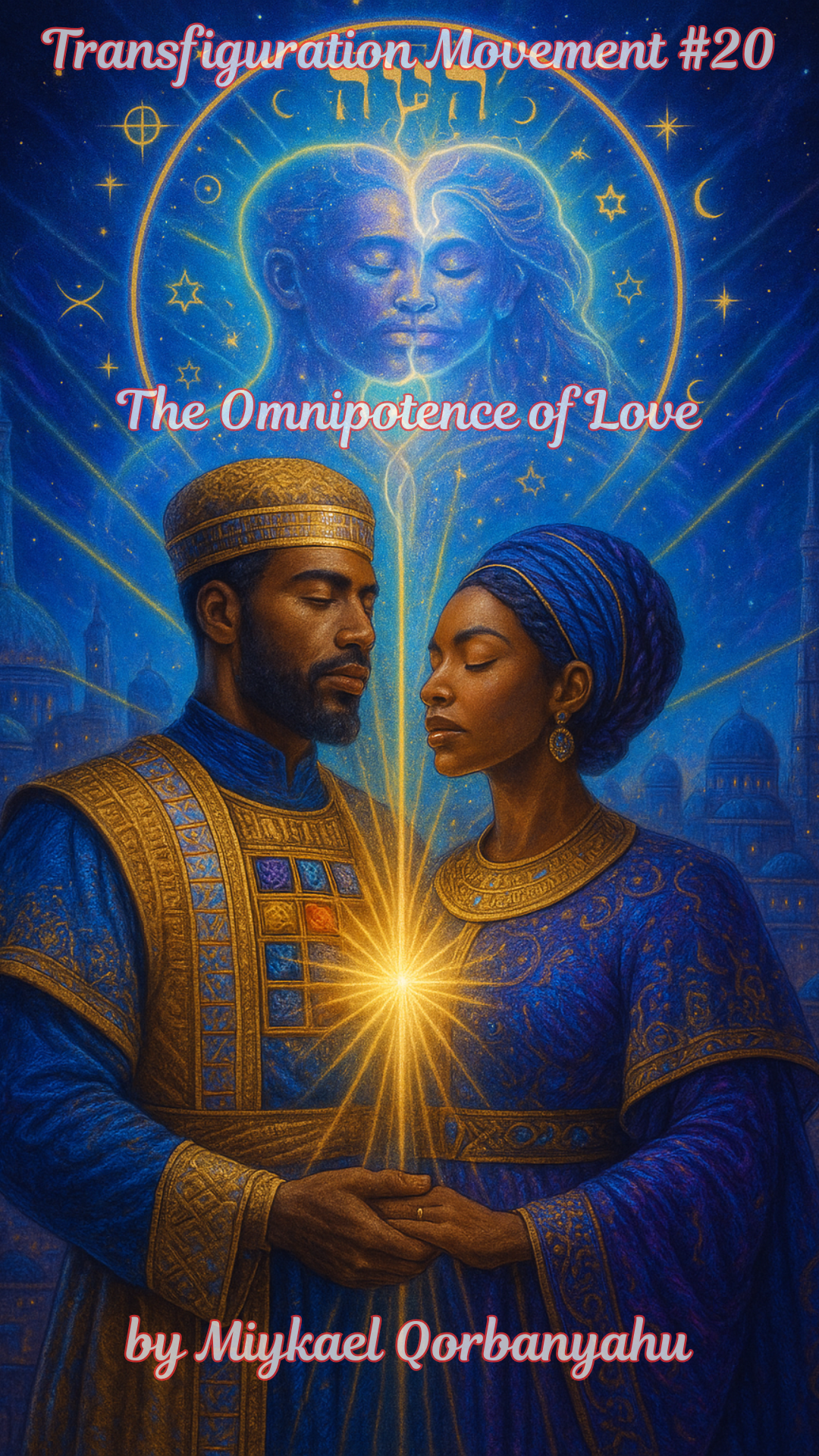
It wasn’t until sometime in 2018, while sitting alone in my house on Agnes Ave in KCMO, that my thoughts about love began to shift. I wrote a poem entitled Acceptance, which I’ll read shortly, which allowed me to write out the reorientation of my internal compass in relation to love. I realized that the Most High wasn’t just asking me to be “in love,” It was calling me to become love; to extend a love that doesn’t take, but a love that gives. To share a love that reflects and a love that sacrifices. Since then, the lessons have continued, sometimes tender, still often painful, but always powerful, impacting and transforming. And that, oh my beloved reader, is the essence of the Transfiguration Movement: here, we’re not just about mere evolution, but eerything that we do is for elevation. Yes indeed, it’s not about just improvement, but moreso about alignment. And not just about acquiring, but more so about acceptance. And now, a few words from Davar the Poet.

When I wrote Acceptance, it wasn’t just a poem; it was a mirror. My thoughts and words that issued forced me to confront the fact that I had not truly prioritized love for the Most High. I had not sought to become love, I was still striving to be in love, addicted to the feeling without honoring the function. That poem began to reorient my heart and reestablish the proper order: Love YaH first, because from there, everything else flows. The lesson of acceptance is still unfolding in my life, reminding me that becoming love means accepting spiritual alignment over personal appetite, and yielding to a greater order that brings healing, clarity, and purpose.
So what is the purpose of love? To answer this question, let’s go back to the Shema, the heart of Torah consciousness and Kingdom citizenship. Found in Deuteronomy 6:4-5, the Word says:
“Shema Yisrael, YaH Eloheinu, YaH Echad. And you shall love YaH your Elohim with all your heart, with all your soul, and with all your might.”
What we are going to discover in this writing is that the purpose of love is to align our entire being, heart, soul, and strength, with the oneness and authority of YaH. The Shema isn’t just a prayer; it’s an attunement, a binding, a calling, a command. It declares that YaH ie Eloheinu, OUR Elohim, and that YaH is Echad, One and Indivisible.
Furthermore, and to be sure, the Shema is not a suggestion, it’s a covenantal requirement; a commandment. Also, Shema doesn’t just mean “hear,” it means listen with the intent to obey. And the love that’s described here isn’t romantic, it’s not emotional fluff, instead, it’s active, whole and consuming, and as such, love is like a fire in that it ignites our hearts with devotion to YaH, burning away selfishness, and illuminating the path of righteous oneness.. And once we accept that reality, then it become evident that our love for YaH must too be unified and total. Love, in this sense, is about loyalty, obedience, and intimate devotion. It’s how we anchor ourselves in covenant and demonstrate true Kingdom citizenship. So when we truly consider what love is all about, we will quickly notice that it’s not passive emotion, and that it’s actually active alignment with the Living Will of our Creator.
The Hebrew word for love here is אַהֲבָה (ahavah), and according to the Dictionary of Torah Names and Words, idiomatically, love is thought of as affection, fondness, and the emanation of the Life Force unto a formative state.
The word further breaks down letter by letter as follows:
Aleph (א) – symbolic of YaH, the One, the Source.
Hey (ה) – a window or breath; revelation.
Bet (ב) – a house; a dwelling or foundation.
Hey (ה) – again, reinforcing the idea of revelation or Spirit.
So love, ahavah, can be redefined as the revelation of the Oneness of YaH dwelling within.
This is why true love is not possessive, not ego-driven, but a revelation. True love is a sanctuary built between souls, and unless the Source is present, it is not love, rather, it’s mimicry; flesh parading as spirit. I know, that hurts!
So when the Master Yahoshua was asked what was the greatest commandment, He didn’t hesitate to respond with a clear and definite answer of which we read in Matthew 22:37–39:
You shall love YaH your Elohim with all your heart, with all your soul, and with all your strength. This is the first and great commandment. And the second is like it: You shall love your neighbor as yourself.
Now we often gloss over this, but for the sake of this article, take a moment to let those words resonate and selah…
Yahoshua wasn’t just offering a theological summary, some deep interpretation of biblical text rooted in some systematic construct that only skims the surface of the waters. What was He was doing was bringing Heaven to Earth and giving a framework and working model for Kingdom citizenship and living.
First, He said, love YaH, the Source and standard. Second, love your neighbor, and this is going to ruffle a few feathers, but this is NOT just anybody.
As we clearly know that Ecclesiastes 3 gives a discernment of the time and season for everything under the sun, it only makes sense that our love must be measured in the season and time that it is to appear or vanish. In fact, in the 139th Psalm King David makes a most pronounced declaration,
O YaH, do I not hate them, who hate You? And do I not loathe those who rise up against You? With a complete hatred I hate them; They have become my enemies.
So clearly, there are definitive and categorical expressions of love, and hate, that we are to exhibit at the right time and for the right soul.
Even when Yahoshua was told that His mother and brothers were outside, according to Matthew 12:48–50 He reply demonstrated the priority of his love as he told the messenger,
“Who is My mother and who are My brothers? … Whoever does the will of My Father in heaven is My brother and sister and mother.”
So in the covenantal context, your neighbor is the one walking in the same agreement. Loving your neighbor means loving the covenant community, loving those you labor with, struggle with, correct, forgive, and build with. It’s a national love, not just a personal one.
And last but not least, He said, love yourself. This we are to do, not in the way the world promotes, through vanity, indulgence, or endless affirmation, but through alignment. To love yourself is to see yourself as YaH sees you: formed in Its image, born for a purpose, destined for righteousness and worthy of love. It means honoring your temple, guarding your mind, healing your wounds, and walking in truth. Yahoshua understood that you cannot truly love your neighbor or serve the Most High from a place of self-hatred or fragmentation. Don’t I know that all too well. So when we love ourselves righteously, we forgive ourselves, we discipline ourselves, and we commit ourselves to growth.
That’s the love that heals.
That’s the love that transforms.
That’s the love that we all need.
So now, we turn to 1 Corinthians 13, where Rav Shaul of Tarsus, aka the apostle Paul, gives a dissertation on love that still humbles me every time I read it. He breaks down what love is and what love isn’t. And let’s be really real, Rav Shaul wasn’t writing a Hallmark card for his boo, he wrote one of the most powerful perspectives about and insights of love as a correction to a spiritually gifted but emotionally bankrupt community.
When you considere who the Corinthians were, you’ll find that they were heavy hitters in charisma, speaking in tongues, prophesying, casting out demons and reprobates, but they were light in character. They had the gifts of the Ruach but lacked the key of the Kingdom, which is love.
Shaul’s message?
If you don’t have love, you don’t have anything.
You can speak mysteries, move mountains with your faith, give everything you possess away to the poor, even burn your body as a martyr, but without love, it don’t mean a thing if you don’t love yourself, your neighbor or your King!
Do-wop, do-wop, do-wop, do-wop, do-wop!
And why is this?
Because in the Kingdom, love isn’t a side dish.
It’s the main course.
It’s the substance of Torah.
It’s the heart of the Covenant.
It’s the expression of Elohim’s nature.
In fact, the Revelator Yohanan ben Zebedee goes so far as to say in 1 John 4.8 that
The one who does not love does not know Elohim, for Elohim is love.
How’s that for an ultimatum?
But considering all of this, and for the sake of fulfillmet, we have to continuously ask ourselves what does that love look like?
Fortunate for us, Rav Shaul doesn’t give us a vague feeling or some spotty concept. He does, most inspirationally, give us a blueprint for how to know and see what love is and looks like.
So let’s go on ‘head and break it down and build our new love infused lifestyle from what he forever broke down in 1 Corinthians 13.
“Love is patient” — Savlanut (סַבְלָנוּת). Delay your reaction. Breathe before you respond. Give people room to grow. When you feel your frustration rising, silently say, “Be still, my soul.” Wait 3–5 seconds before replying in tense moments.
“Love is kind” — Chesed (חֶסֶד). Take initiative in showing compassion. Kindness is not passive—it’s active. Text someone just to encourage them. Hold space for someone else’s struggle without making it about you. Do the unrequired good thing.
“Love does not envy” — Ayin Tovah (עַיִן טוֹבָה – good eye). Celebrate others without comparison. Their win doesn’t mean your loss. Every time jealousy surfaces, name something YaH has done for you aloud, and then practice contentment with gratitude.
“Love does not boast, it is not proud” — Anavah (עֲנָוָה – humility). Let others speak highly of you; don’t be your own hype man. Move quietly in strength. Resist the urge to “one-up” others in conversation. Let your life speak louder than your words, and if you do give praise, ensure that all praises are given to the Most High!
“Love is not rude” — Derekh Eretz (דֶּרֶךְ אֶרֶץ – proper conduct). Be mindful of your tone, timing, and treatment. Honor everyone, even those who don’t honor you. Rehearse what love sounds like. Before speaking, ask yourself: “Is this necessary, kind, and true?”
“Love is not self-seeking” — Ahavah shel brit (Love of the covenant, not of convenience). Serve without keeping score, and don’t manipulate with your giving. Volunteer for something that gives you nothing back but growth in discipline and compassion.
“Love is not easily angered” — Erech Apayim (אֶרֶךְ אַפַּיִם – slow to anger). In moments of tension, learn to discern between your triggers and the truth. Anger is a signal, not a strategy. Journal your emotional patterns and know what provokes you so you can unlearn it consciously.
“Love keeps no record of wrongs” — Mechilah (מְחִילָה – forgiveness). Forgiveness doesn’t mean forgetting, it means releasing, letting the weight go. To accomplish this, write down past grievances and then destroy the list as a symbolic release. Don’t relive what you’ve already buried.
“Love does not delight in evil but rejoices with the truth – emet.”Love brings accountability. It doesn’t cosign on sin to keep peace. When we move in love, we tell the truth in love. And we address wrongdoing not to punish, but to restore.
“Love always protects, always trusts, always hopes, always perseveres.” Love is a force field. So when we truly love, and we move in love, we’re willing to stand in front of others when the fire hits. We pray for them when they’re weak. We expect the best even when they fall short. When we are in living and moving and breathing in love, we will be the one who covers, not exposes others’ vulnerabilities. Ultimately, we refuse to act out of denial, but in hope.
Even after listing all of the qualities of love, its patience, its kindness, its truth-telling, its lack of envy and arrogance, he concludes with a triumphant declaration: “Love never fails.” (1 Corinthians 13:8). Though they may sound like, his words aren’t poetry, they’re prophecy. They’re not sentiment, They’re structure. His assessment is of love identifies it as the foundational element that undergirds the Kingdom of Elohim. And in a world where all else is guaranteed to decay, perish, or pass away, as he says that prophecies will cease, tongues will be stilled, and knowledge will vanish, love is the one eternal construct that transcends time and matter.
Why? Because Elohim is love (1 John 4:8). And Elohim never fails.
To say that “love never fails” is not to say that human relationships never fracture or that every kind word will be reciprocated. No, that’s not the point. The love that Shaul speaks of, as was mentioned earlier in this writing, is not transactional, it’s transformational. And the truth of the matter is that love transforms the giver even more than the receiver. It rewrites DNA, it recalibrates reality, and it resurrects dead things.
Even as crazy as it sounds, to say that “love never fails” means that it always accomplishes what it’s sent to do. It always witnesses, it always convicts it always heals, even if slowly, and it always, and will forever leave its mark. And when we walk in righteous love, meaning when we’re aligned with Torah, infused with Ruach, and modeled after the Messiah, we become channels of the unfailing force of the Most High.
Shaul’s thesis is not about momentary acts, it’s about becoming a manifestation of supernal love in the earth. And this is especially needed today as we live in a society built on failure, failed systems, failed relationships, failed leadership, failed promises, love remains undefeated. Of this, I know!
So given these highly effective principles, what are some strategies that we can implement to walk in this unfailing love?
- Start in the Secret Place.
Commune daily with Abba in prayer, Scripture, and meditation. Let your cup overflow before you try to pour into others. - Practice the Fruit, not the Feel.
Love is not about waiting to feel connected or emotionally stirred. Love is action. Make it your discipline—feed someone, encourage someone, pray for someone. - Receive Correction Without Offense.
Righteous love includes rebuke. When you’re loved enough to be corrected, don’t harden your heart. Receive it, reflect, and repent. - Forgive and Forgive Again.
There’s no love without forgiveness. And no one who truly walks in love keeps a long record of wrongs. Let it go. Heal. Move forward. - See People Through Prophetic Eyes.
Don’t just see who they are—see who they’re becoming. Speak to the light in them even when the darkness seems to dominate. That’s what love does. It calls the dead out of the grave. - Stay Rooted in Torah.
Love detached from the commandments is just humanism with warm fuzzies. Love that fulfills Torah is real love. It knows boundaries, honors covenant, and promotes justice. - Speak the Truth. Even When It’s Uncomfortable.
Love never lies. It speaks the truth—but it does so in a way that builds, not breaks. - Be Consistent in Love.
Anyone can love for a season. The challenge is to love when it’s not reciprocated, when it’s inconvenient, when it costs you. That’s the kind of love that never fails—because it never quits.
This kind of love, the kind that mirrors Messiah’s cross-bound commitment, the kind that lifts people out of sin and shame, the kind that abides in truth and mercy, is the heart of the Transfiguration Movement. It is the energy of our becoming. And as we continue to grow from glory to glory, we must remember that love is the only force capable of transfiguring darkness into light.
Because it never fails.
And neither will we, if we walk in it.
And this point I hear you say, how Sway?
Nothing’s ever promised tomorrow today!
Ok, anyway.
My response, oh yeah, we got the answer; and it’s one word!
Transfiguration.
With this movement, we’re not just learning to love, we’re learning to become love, to be transformed into the image of Yahoshua who loved us unto death and rose in power to make us new.
Love, in this way, is not just a spiritual gift. It is the evidence of a renewed heart, and a daily offering on the altar of self.
“Be imitators of Elohim, as dearly loved children, and walk in love, as Messiah loved us and gave Himself for us—a fragrant offering and sacrifice to Elohim.”
Ephesians 5:1–2
To love righteously means to:
Surrender ego
Accept responsibility
Serve sacrificially
Speak truthfully
Forgive completely
Endure consistently
This isn’t romantic idealism, it’s the realest work.
In other words:
If your love isn’t patient, it’s not love.
If your love can’t correct without dishonoring, it’s not love.
If your love disappears when there’s nothing to gain, it was never love to begin with.
In a time when haters and haterisms abound, there’s an urgent need for our generation to reignite the fire, not just by doing loving things, but by being love itself.
In Matthew 24, speaking of the signs that foretell of the אחרית הימים, or the end of days, Yahoshua prophesied plainly:
“Because lawlessness will abound, the love of many will wax cold.”
Matthew 24:12
There is a deep and prophetic connection between lawlessness and lovelessness. Yahoshua didn’t say the love would vanish. He said it would wax cold, which means it was once warm, once vibrant, once real, but over time, through exposure to an environment void of truth and discipline, it became frozen, numb, and ultimately dead.
The Greek word for lawlessness here is anomia, literally without Torah (nomos being the word for law, instruction, order). In Hebrew, this correlates with Torahlessness, a life outside of Elohim’s instruction.
Let me be absolutely clear:
When we operate outside of Torah, when there is no spiritual constitution, no moral compass, no covenantal framework, our souls starts to deform; not in appearance, but in essence.
And just what happens when we abandon Torah and love?
We become shells of ourselves, functioning but not flourishing.
We develop performance-based identities—only loved when we produce, post, or perform.
Our relationships become transactional, built on need, not covenant.
We find ourselves addicted to distractions, because silence reminds us of our disconnection.
Our emotions become dysregulated—either hypersensitive or completely numb.
The mind spirals into paranoia because when there is no trust in Elohim’s order, everyone is a threat.
The body begins to break down, because stress and bitterness calcify the spirit.
The spirit loses sight and sensitivity, because it no longer has a Source to reflect.
It’s not just that love is absent, it’s that what remains becomes a counterfeit; lust masquerading as intimacy, convenience dressed up as commitment, tolerance mistaken for care.
Unfortunately for us today, this is the world we now live in:
Artists celebrate apathy.
Influencers profit off of pain.
Youth are numbed with narcotics and bombarded with hypersexual images before they can spell their own names correctly.
Marriages collapse over minor offenses because we were never taught to suffer well in love.
Community disappears because we forgot that being with people is different than being near people.
We now value things, and use people.
We now love materials, and disregard ourselves.
This lawlessness is not just criminal, it’s spiritual rebellion. It is the conscious or unconscious rejection of Yah’s instruction, and thus a severance from life-giving love.
“Torah is light,” says Proverbs 6:23.
And without it? Darkness reigns.
They grope in darkness without light; He makes them stagger like drunkards.
(Iyov / Job 12:25)
In darkness, beings are reactive, not reflective.
They live by impulse, not insight.
They become vulnerable to deception, because they have no anchor in truth.
They chase false lights, fame, fortune, attention, thinking they’ve found direction, only to find emptiness at the end.
This is not living. This is wandering. And let’s just call it what it is: this is Babylon.
And in Babylon, the heart becomes cold. The hands no longer reach out in compassion. The mouth no longer speaks edification. The eyes no longer see the Elohim in others. And the ears no longer recognize the Voice of YaH.
We are living in Babylon right now, and we see the waxing cold of love in the news, in our families, in our streets, in our congregations.
- Children killing parents and parents abandoning children.
- Mass shootings and meaningless deaths in cities and schools.
- Political tribalism masquerading as righteousness.
- Desensitized music, media, and memes promoting lust, violence, and spiritual apathy.
Lawlessness isn’t just breaking rules, it’s the absence of Torah, the absence of instruction, the absence of lechem. Where there is no law, love cannot live.
It becomes frozen.
Callous.
Hollow.
Transactional.
I know, because I’ve been there before.
This movement is about returning to the original image. The tzelem Elohim. The likeness of Love. The omnipotence of Love is that it never fails. Not because it wins every fight, but because it outlasts every lie, it survives betrayal, it transcends fear, it overcomes the grave.
According to the sacred science of Israel, Kabbalah, love flows from the Sefirah of Chesed, lovingkindness. It’s the first emanation of supernal relational energy, pouring outward from the Infinite (Ein Sof). But it must be balanced by Gevurah, discipline, justice. That balance is what Yahoshua embodied. That balance is what we must cultivate.
Beloved, it’s time to reorder love.
Love YaH first, with all your being.
Love your neighbor, the ones doing this narrow walk with you.
Love yourself, not indulgently, but righteously.
Don’t just say you have love, rather become love.
That’s the call.
That’s the challenge.
That’s the transfiguration in action.
As much as you love yourself, love your fellow, for in this the Torah is fulfilled.
Rabbi Akiva, Pirkei Avot
Let that be the movement. Let that be the measure.
Become love. Transfigure the world.

Discover more from SHFTNG PRDGMZ
Subscribe to get the latest posts sent to your email.


1 Comment