
____________________________________________________________
A man is not one who possesses high levels of male hormones, but one who knows how to control them. Not possessing the ability to control oneself is called being a “male,” as well as specimens of same sex in other species of living beings. Men are not born, males are born. It is possible to become a man only as a result of self-education and working on oneself. There are some people who live all their life as a male, never becoming a man.
Tikkun haBerit
When I was a child, I spoke like a child, I thought like a child, I reasoned like a child. When I became a man, I gave up childish ways.
1 Corinthains 13.11
____________________________________________________________
So yeah, this is an article I’ve been meaning to write for a while now. The idea first came to me about five or six years ago, around the time when the conversation about toxic masculinity was spreading like wildfire. The term was being thrown out from pulpits to podcasts and barbershops to bedrooms. And now that society is flooded with conversations about alpha males, sigma males, and high-value men, I felt the urgency to return to this topic with clarity, depth, and a Kingdom-centered perspective.
One of the dynamics I want to present in this conversation is that of righteous masculinity, a spiritual, emotional, psychological, and physical embodiment of maleness that aligns with the Torah, the Prophets, the Writings, and the teachings of our Master Yahoshua ben Yoseph. This is not a masculinity defined by domination or detachment, but by devotion, discipline, discernment, and deep love for YaH, His people, and Its creation.
For good measure and continued transparency, my own journey into manhood has been both glorious and gut-wrenching. I’ve had moments where I stood tall, led well, loved deeply, provided faithfully, and worshiped wholeheartedly. I’ve also had seasons where I failed miserably; where my leadership turned into passivity, my self-control crashed into indulgence, where I hesitated as a husband, faltered as a father, prolapsed my ability to provide, and even suffered from self-induced spiritual droughts in my relationship with Elohim.
But along this journey of highs and lows, what I’ve come to know is this; true manhood is not defined by perfection. And while I do believe we are able to achieve perfection, or become tamim, the journey into manhood is truly marked by progression. And progress looks like a continual surrender to the Ruach HaQodesh, a refusal to remain in a fallen state, and a resolve to return, again and again, to the image and likeness of Elohim. And for me, I can honestly say that as many times as I’ve fallen, I’ve gotten up, dusted myself off and continued to walk on the Way with determination and devotion. Of this, Proverbs 24.16 tells us that
though the righteous fall seven times, they rise again, but the wicked stumble when calamity strikes.
As a man with melanin, the matter of manhood has weighed heavy on my heart for years, personally and collectively. For those of us born as so-called African American men in the Western world, our journey into righteous manhood has been violently interrupted by the emasculating machinations of colonialism and chattel enslavement. We were torn from our language, land, lineage, and legacy. Our righteous masculinity, rooted in qodesh responsibility and group centered, Torah based leadership, was desecrated by systems that sought to reduce us to brute labor and deny us divine purpose.
Deuteronomy 28 paints the prophetic portrait of our plight. We would be led into captivity again in ships (v. 68), become “a byword among all nations” (v. 37), and watch as “the tender and delicate man among you” became hostile and disconnected (v. 54). We were stripped of the dignity of fatherhood, shackled from providing, protecting, and presiding with purpose. Our spiritual fire was suppressed under centuries of generational trauma, systemic racism, and false religious programming that distorted our divine identity.
Yet, the wickedness of the oppressor has never been greater than the righteousness of our Redeemer. The way forward is not through mimicking the aggression of Babylon but through repentance, teshuvah, and transfiguration. We must return to the covenant, remember the instructions given to our fathers Abraham, Isaac, and Jacob, and reimagine our manhood through the lens of Torah and Messiah.
Through Messiah Yahoshua, we reclaim our fire from Heaven. We are not the emasculated caricatures produced by Western media nor the violent distortions produced by systemic poverty. We are the seed of Avraham, spiritual beings wrapped in flesh, chosen to ignite the earth with the knowledge of the Most High. As we humble ourselves, turn from wickedness, and return to the commandments (2 Chronicles 7:14), we are transfigured from broken men into builders of legacy, kings of righteousness, and shepherds of sacred order.
The time of being passive pawns in the enemy’s matrix is over. We are called to rise. With clean hands, circumcised hearts, and minds renewed in Truth, we embody the righteous manhood the world desperately needs to see. We no longer walk in reaction to oppression but in reflection of the Most High’s image.
As it is written in Isaiah 60:1–3, “Arise, shine; for thy light is come, and the glory of YHWH is risen upon thee… Gentiles shall come to thy light, and kings to the brightness of thy rising.” Our time is now. Let us become the righteous men we were always created to be.
From the beginning, the Torah lays the foundation for manhood. The Patriarchs, Abraham, Isaac, and Jacob, provide distinct aspects of what it means to walk as a man in covenant.
Avraham Avinu (Abraham our father) was called to challenge, confront, leave, believe, and build. He left the comfort of familiarity, believed Elohim against all odds, and built altars of worship in foreign lands. He modeled faith and hospitality but also struggled with decisions like his handling of Hagar and Ishmael. Yet he remained faithful to the voice of YaH.
Yitzchak (Isaac) demonstrated stability, submission, and generational continuity. His quiet strength, his digging of wells (Genesis 26), and his willingness to be bound on the altar all reflect aspects of surrender and the ability to maintain spiritual infrastructure.
Yaakov (Jacob) wrestled, both literally and figuratively. He faced his own deception, wrestled with angels and with his past, and ultimately became Yisrael, the one who struggles with Elohim and prevails. His manhood was not static, it evolved. That’s the testimony of true masculinity: transformation.
Then we have Moshe Rabbenu (Moses our teacher), strong, but not invincible. He was mighty in word and deed, but he battled with self-doubt and frustration. His strength was his intimacy with Elohim, speaking with Him face to face (Exodus 33:11), but his challenge was his temper. Still, he poured himself into Yehoshua ben Nun (Joshua son of Nun), imparting courage and conviction.
To Joshua he said, “Chazak ve’ematz!/Be strong and courageous!” (Deuteronomy 31:6). Joshua had the heart to lead because he stayed close to the Tent of Meeting; even when Moshe and the elders left , he stayed posted in the Shekinah Presence(Exodus 33:11). By doing so, Joshua inherited the vision, possessed the promise, and led the people into what Moses could only see from afar.
Dawid HaMelech (King David) embodied the full spectrum of masculine complexity. He was a warrior, worshiper, shepherd, and king. He danced before the Ark, wrote psalms of anguish and adoration, and faced personal failures and national triumphs. Yet, he was called “a man after Elohim’s own heart” (1 Samuel 13:14). Why? Because he always returned.
Before his transition, Dawid told his son Solomon: “Be strong, and show yourself a man. And keep the charge of YaH your Elohim, to walk in His ways, to keep His statutes, His commandments, His judgments, and His testimonies” (1 Kings 2:2–3). He left his son with the blueprint for righteous masculinity, and the keys to the Kingdom, something we all have access to IF we embrace our calling as men and stick to the Script.
But even Solomon, with all his wisdom, fell prey to excess, sensuality, and idolatry. The wisest man still needed wisdom and fortitude to remain. This tells us that righteousness, not intelligence or influence, not power or access, not being an alpha or high value man is the key to enduring masculinity.
Now, let’s drill down deeper into the Torah standard for manhood. In our tongue, we find that the Hebrew word for man is ish (אִישׁ). Taken from the word in Hebrew that means fire, esh (אִשׁ) this word for man connotes the following ideas; a husband; the fire aspect [of man] that ignites and perpetuates the flame; a spiritual being…used in reference both to men and to angels, and to YHWH; it signifies not man as mortal flesh, but as the activity of spirit/fire.
This definition of man is rich with layered spiritual, relational, and metaphysical connotations that reaches far beyond the common understanding of a male human being. It captures the pattern and functional essence of man according to Hebraic and Torah worldview.
First, the designation of man as “a husband” immediately places him within the covenantal framework of relationship. In Hebrew, the word often used is ish (אִישׁ), which in its marital context signifies the male counterpart in a sacred union; ishah (אִשָּׁה) being the woman. A husband is not merely a mate, but one who is responsible for initiating, cultivating, and covering covenant through love, provision, and protection. This reflects the image of Elohim in the role of Bridegroom over His people Israel. This is our highest calling as men, and something that we, collectively, have to step our game with and righteously fulfill. Speaking for myself, it’s an area that I desire and have entered a few times, and still learning to meet all the righteous requirements a man of Elohim.
Secondly, the definition describes man as “the fire aspect that ignites and perpetuates the flame.” This refers to the energetic and catalytic dimension of masculinity. As we’ve mentioned, the Hebrew word ish (man) shares the same letters as the word for fire (esh, אֵשׁ), with the addition of the letter yod (י) symbolizing supernal spark or active hand. Interestingly, the Hebrew word for woman is ishah, which includes the letter hei (ה), representing breath, revelation, or the Shekinah presence. With this combination as man and woman unite in covenant, YaH (יה), the covenant Name of our heavenly Father and King, is formed between them (yod from ish, hei from ishah). Conversely, if that Shekinah Presence and name of YaH is not present in that union and is removed, only esh (fire) remains, leading to destruction rather than sanctification. Thus, man is defined not just by passion or heat, but by his capacity to steward the fire of heaven, to inspire vision, discipline, and love within the household and society.
Thirdly, identifying man as a spiritual being used in reference to both humans, angels, and even YaH elevates the role of man beyond flesh. It connects man to the unseen realms and indicates that he is meant to operate as an agent of supernal energy. In Scripture, the Hebrew word ish is sometimes used to describe angels (e.g., Genesis 32:24, when Jacob wrestles with a “man”) or even appearances of Elohim in human form (e.g., Judges 13). This understanding defines man not merely by his physicality but by his function as a carrier of Heaven’s fire, order, and revelation.
So, rather than interpreting “man” as mere mortal, this definition declares man to be a living flame, a being who embodies spiritual purpose, initiates sacred relationship, and ignites movement and transformation in the world around him.
The idiom for man in Hebrew is found in the phrase “geber” (גֶּבֶר), a term that connotes strength, might, and mastery. It implies one who is valiant, a warrior, and one who prevails. The root gabar (גבר) means “to be strong, to prevail, to be mighty.” When used idiomatically, a man is one who “rises up in strength to fulfill his purpose.” Another profound idiom is “ben adam” (בֶּן אָדָם), “son of Adam,” which implies not only descent from the first man but a moral and spiritual responsibility to walk as a representative of humanity’s heavenly potential.
In sum, the idiom of man in Hebrew speaks not only to his form but to his function: he is fire, strength, and spirit, designed to reflect, protect, and project the image of Elohim into the earth.
Thus, a righteous man is one who channels supernal strength (Aleph) through purposeful action (Yod) and refines his inner fire (Shin) to manifest the will of Elohim. Not to destroy, but to build. Not to control, but to cover.
When we reverse the letters of ish, we get shei (שיא), meaning peak or summit. From creation, ish was created to be the pinnacle of spiritual maturity and responsibility, reflecting Elohim’s image in the earth. Psalm 8.5-7 testifies to this reality,
…what is man that You have been mindful of him,mortal man that You have taken note of him, that You have made him little less than divine, and adorned him with glory and majesty; You have made him master over Your handiwork, laying the world at his feet…
This powerful Psalm invites us to pause and reflect on the worth, purpose, and positioning of man, in this verse identified as enosh, within creation. Here, the Psalmist is in awe of YaH’s deep regard for humanity despite our mortality and fragility. And yet, the verse affirms that man was made just a little lower than Elohim and crowned with kavod (esteem) and hadar (honor), a royal charge of heavenly stewardship.
Let’s now seek to comprehend the Hebrew word Enosh (אֱנוֹשׁ), used here for man, as we do what we do by breaking it down letter by letter,
- Aleph (א) – Represents the supernal spark, oneness, and leadership.
- Nun (נ) – Symbolizes life, offspring, and continual motion; also humility.
- Vav (ו) – Connects heaven and earth, a hook or nail representing connection.
- Shin (ש) – Fire, transformation, cosmic consumption, or sharpness.
We arrive with the insight from this that Enosh (אֱנוֹשׁ) is the mortal man, the initiated masculine force within the earth who, though frail and limited, is imbued with the supernal spark of Elohim (Aleph) and is destined to carry out a sacred function: to activate (Shin) the fullness of connection (Vav) between heaven and earth through the humility and humanity (Nun) of heavenly stewardship. In his weakness, Enosh is made strong by dependence upon Elohim.
According to the Dictionary of Torah Names and Words, enosh speaks of: Mortal benevolence, desiring and displaying wisdom. A masculine force, not in domination, but in benevolent elevation of the earth’s purpose. Initiatory wisdom, capable of activating divine fullness through kindness and principled stewardship. The utilization of truth in purposes and goals, positioning man as one who treasures, who names, and who stewards energy like Pharaoh giving to Abram. Thus, enosh is not merely a man in flesh but a vessel of elevation, a mortal crowned with the potential of immortality through wisdom and benevolence.
The Psalmist is not shorting man by calling him enosh, rather, he is revealing the cosmic paradox: that the most frail and flawed of all creatures has been entrusted with the most powerful mission, to rule, serve, and uplift the creation under the authority of Elohim.
As men walking in righteous manhood, we must awaken to our identity as enosh. We must be umble, yet crowned, mortal, yet mighty through Elohim. We are called to discipline and to have dominion, not to dominate, but to subdue, tend, to serve, and to treasure as Adam did in the garden.
We are not to despise our limitations, but rather to lean on our Creator who saw fit to place everything under our feet. As enosh, we must live as stewards of truth, pillars of wisdom, and carriers of the masculine force that upholds life and sanctifies the earth.
In this time of confusion about masculinity, may we be reminded that righteous manhood begins not with asserting power, but with aligning purpose, that even in our weakness, YaH is mindful of us, and has called us to reflect His glory by being kings, priests, and servants in the earth.
“Master the earth not through might, but through meaning. Rule not by fear, but by faithfulness. Be enosh, a man crowned in humility and clothed in divine purpose.”
Today, masculinity in the West has been stripped of its divine blueprint. Men are often reduced to wallets, warriors, or womanizers. The culture oscillates between hyper-masculinity and emasculation. The spiritual compass is missing.
But the Torah gives us clarity. Mishnah Avot 2:1 says,
“Be as careful with a minor mitzvah as with a major one, for you do not know the reward for each mitzvah.”
This reminds us that the righteous man lives with intention. Every act matters—how we speak to our wives, how we discipline our children, how we conduct business, how we worship in secret.
Zohar 1:25a states:
“Woe to the man whose children say, ‘He left us with nothing.’ But blessed is the man whose children say, ‘He left us the Name of the Holy One.'”
This is our call. Not to just provide money, but to transfer meaning. Not just leave possessions, but to pass down purpose.
In his book War Cry: The Battle for Our Identity, Family, and Future, Jason Williams declares:
Men must become spiritual warriors who fight for their homes, their communities, and their souls.
He goes on in the book to introduce the concept of the comprehensive man as one who has the courage to confront, the strength to stand firm, and the humility to weep (p. 21). This vision is deeply connected to the Scriptural call to be a righteous man, one who is not fragmented, double-minded, or performative, but whole, healed, and holy. A righteous man, like the comprehensive man, doesn’t compartmentalize his masculinity; rather, he integrates the lion and the lamb, the warrior and the worshiper. On page 27, Wilson writes that a comprehensive man is one “who embodies emotional intelligence, spiritual maturity, and moral integrity,” which aligns with the Biblical admonition in Micah 6:8 to “act justly, love mercy, and walk humbly with your Elohim.” To be righteous is to be rooted in YaH’s order, leading with love, reigning through restraint, and standing as a living sacrifice, ready for war, but always governed by wisdom.
As righteous men, that war cry is ours. We must embody both lion and lamb, ferocious when needed, gentle when required. As Proverbs 16:32 says, “He that is slow to anger is better than the mighty; and he that rules his spirit than he that takes a city.”
As righteous men, ready to respond to any and every situation that presents, we must pursue the following:
- Consistency
- Discipline
- Commitment
- Self-control
- Humility
- Love
- Leadership
- Wisdom
- Balance
When we as men walk in these principles we dynamically align ourselves with the very design and desire of the Most High for authentic masculine stewardship. The outcome of such a life is not just personal success or spiritual maturity, but the restoration of order in our families, communities, and nations. We become dependable anchors in unstable times, able to hold spiritual ground and transfer legacy. We cultivate an environment where those around us can thrive because we have first submitted ourselves to the ways of Elohim. We are no longer tossed by emotions, societal trends, or prideful ambition. Instead, we become living testimonies of the power of Yah’s Ruach dwelling in mortal vessels, manifesting the Kingdom in character and conduct. Through this, the image of the Second Adam, Messiah Yahusha, is revealed in us as righteous men who both rule and serve, who both guard and give, and who both lead and love.
To become such righteous men, we must walk a path of intentional transformation as outlined by the principles that were identified above. The Scriptures give us a clear order and rhythm to this walk, as we now side these principles with Scriptural textual support:
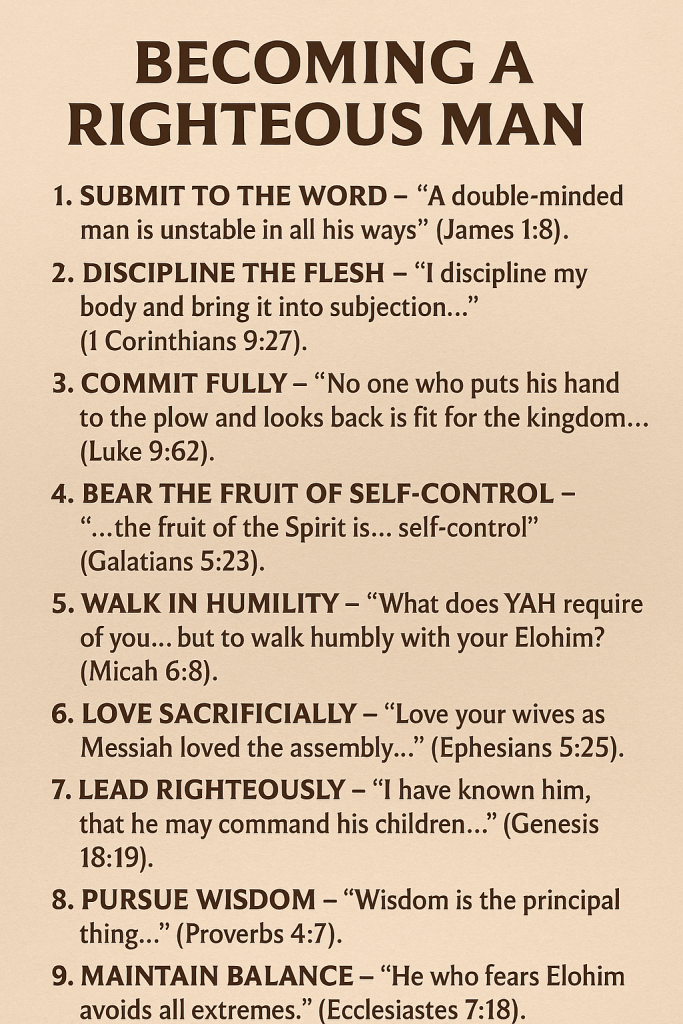
- Submit to the Word – “A double-minded man is unstable in all his ways” (James 1:8). Consistency begins with anchoring ourselves in the Word daily. We must determine to be one-minded, no longer wavering between the ways of the world and the wisdom of Torah.
- Discipline the Flesh – “I discipline my body and bring it into subjection…” (1 Corinthians 9:27). The battle is spiritual, but it’s won in the body. Train yourself in prayer, fasting, and righteous habits that keep your soul in alignment with the Ruach.
- Commit Fully – “No one who puts his hand to the plow and looks back is fit for the Kingdom…” (Luke 9:62). True righteousness requires unwavering devotion. Burn the bridges behind you. Commit fully to the walk, regardless of difficulty.
- Bear the Fruit of Self-Control – “…the fruit of the Spirit is… self-control” (Galatians 5:23). Yielding to the Spirit brings restraint over words, actions, and appetites. This is not suppression but sanctification—learning to respond rather than react.
- Walk in Humility – “What does YaH require of you… but to walk humbly with your Elohim?” (Micah 6:8). Humility is not weakness—it is strength under control. A humble man is teachable, accountable, and guided—not by ego, but by reverence.
- Love Sacrificially – “Love your wives as Messiah loved the assembly…” (Ephesians 5:25). Love is not lust or convenience. It is sacrificial service. Practice loving your spouse, family, and community with the same patience and passion Yahusha showed.
- Lead Righteously – “I have known him, that he may command his children…” (Genesis 18:19). Leadership is more than influence—it is responsibility. Be intentional in setting vision, enforcing righteous boundaries, and establishing your home in truth.
- Pursue Wisdom – “Wisdom is the principal thing…” (Proverbs 4:7). Study Torah. Seek counsel. Honor elders. Righteous men build their lives on wisdom, not impulse. Make decisions based on purpose, not preference.
- Maintain Balance – “He who fears Elohim avoids all extremes.” (Ecclesiastes 7:18). Do not be overly rigid or overly passive. Learn to live in the tension between justice and mercy, work and rest, faith and works.
By following these scriptural steps, a man does not merely become “better,” he becomes whole. He embodies tsedeq (righteousness), he walks in covenant authority, and he shines as a reflection of the King. This is the path of righteous manhood. This is the transfiguration of the masculine soul.
Becoming a righteous man is a process, not a personality, and especially not a status. It doesn’t happen overnight, nor is it based on appearance, accolades, or public performance. It is the fruit of an intentional inward journey, one that begins with reverence for Elohim and continues with consistent, daily decisions to walk in His ways. Its end result is fervant love for Elohim which transforms us into the unstoppable force of love. In this light, we are able to see that righteousness isn’t about being perfect, but is about our pursuit of it, as well as our ability to remain blameless. It’s the posture of the heart that says, “I will follow, I will grow, and I will align.” We become righteous men through choice, one decision at a time; we grow through obedience, one step at a time. We reflect righteousness by consistency, not charisma. And ultimately, the strength of a man is measured not by how loud he roars, but by how faithfully he walks. As it is written at Psalm 37:23, “The steps of a good man are ordered by YHWH, and He delights in his way.” In that delight, we find our purpose, our peace, and our power to lead in righteousness.
So zaqaynim (elders), banim (sons) ahkim (bredren), ahkyanim (nephews), chaverim (friends), let us return to righteousness. Let us seek the face of YaH with the zeal of Dawid, the perseverance of Jacob, the intimacy of Moses, the faith of Abraham, the discipline of Joshua, and the wisdom of Solomon and the unfailing love of our Messiah. Let us wash our wives with the water of the Word, raise sons who carry the Torah on their tongues and guide our daughters so that they know what it looks like to be led in love and covered in truth.
The Transfiguration Movement is about becoming the image and likeness of Elohim in every area of life. And righteous manhood is not optional, for us, for our families, for our communities, for the world, it;s essential.
Let us rise.
Let us return.
Let us be revealed.
Let us be righteous.
Let us be men.
Let us be tranfigured.
Selah…

Discover more from SHFTNG PRDGMZ
Subscribe to get the latest posts sent to your email.


1 Comment