

What do you think of when you hear the word joy?
Maybe you think of that moment at your family reunion when the grill is cooling down and the elders call everyone to gather, not just to eat, but to remember. Somebody shares a story about a relative you’ve only seen in faded photographs, and suddenly you feel connected to something deeper than yourself. Maybe your mind goes to the sound of live instruments in a jazz joint or at with wooden floors, where the finger snaps of the audience keeps time with the band and the voice of the vocalist from a place no microphone can reach. Perhaps joy is the look exchanged between newlyweds at the altar, or the tears that roll silently down a grandmother’s face when her grandbaby is born and placed in her arms. Maybe it’s the keys to your first home, the smell of fresh paint, and a prayer whispered in every room.

There’s a unique kind of joy that pulses through the soul when music fills the room and family gathers, whether it’s a wedding where two stories become one, a newborn’s cry echoing through a hospital hallway, or that first meal in a new home where dreams start to breathe. These moments are the heartbeat of our culture and the breath in our lungs that helps us to know tha we’re alive. We dance, we sing, we embrace each other tightly at family reunions, we pass down stories with rhythm, and we mark transitions with food, laughter, and a good groove. These aren’t just occasions, they are sacred portals. But what we often overlook is that every earthly joy, no matter how vibrant, eventually fades. Every song ends. Every dance slows. Every house needs maintenance. Even love, if not rooted in Spirit, grows cold. And even more, every one of them has a half-life.
Marriages face storms. The laughter from the reunion fades into the rhythm of everyday survival. And please now, this isn’t cynicism, this is wisdoml Ii’s perspective. Because even our most joyful moments, if they’re grounded only in the material, temporal world, will eventually wither under the weight of time and become distant memories.
Our gatherings, as beautiful as they are, can’t hold us forever. The food gets eaten. The pictures fade. The laughter echoes into memory. Solomon, in all his wisdom, reminds us: “I have seen all the works that are done under the sun; and behold, all is vanity and striving after the wind” (Ecclesiastes 1:14). That’s not a call to despair, but a heavenly push to look beyond.
The Transfiguration Movement teaches us not to cling to the shadow, but to embody the light. True joy is not found in the fading moment but in the eternal Presence. It’s not rooted in outward conditions, but in inward transformation. The joy I speak of, the joy I live for, is called in Hebrew, simcha (שִׂמְחָה), the sacred rhythm of a soul being transfigured by alignment with the will of the Most High. When we are centered in purpose, saturated in Torah, and flowing with Ruach, joy is not seasonal, it becomes sustainable, it becomes our strength, it becomes evidence of transformation.
The sages said the Shekinah does not dwell where there is no joy (Shabbat 30b). And that makes sense, since the Shekinah cannot rest where gratitude is absent. How can Light enter where despair is entertained? That’s why simcha is more than emotion; it is an atmosphere, a spiritual climate, a frequency of heavenly order. Let’s go deeper.
As we addressed in Time and Seasons, the writer of Ecclesiastes captures this truth with sobering clarity:
“To everything there is a season, and a time to every purpose under the heaven.”
— Ecclesiastes 3:1
This lets us know, unequivocally, that everything under the sun has a season, and that includes joy. Earthly joy, cultural joy, emotional joy, they all have an expiration date. Not only that, they can also bring grief and misery at the other end of the spectrum.
“I said of laughter, ‘It is mad,’ and of mirth, ‘What does it accomplish?’”
— Ecclesiastes 2:2
“Even in laughter the heart may sorrow, and the end of mirth may be grief.”
— Proverbs 14:13
This doesn’t mean we stop rejoicing. It merely means we learn to locate our simcha in what is eternal. That’s the shift. That’s the invitation of the Spirit. Because if simcha is only found in outcomes, like weddings, births, or new beginnings, then our simcha is subject to decay. But when simcha is rooted in the presence and purpose of Elohim, it becomes imperishable.
“I perceived that whatever Elohim does endures forever; nothing can be added to it, nor anything taken from it.”
— Ecclesiastes 3:14
This is the simcha that does not expire. It is the simcha of knowing who you are and whose you are. It is the simcha of serving in your purpose, living in truth, and walking in Spirit. It is the simcha that endures even in the presence of grief, because it is not circumstantial, it is covenantal.
So while we celebrate our culture, our music, our milestones, our legacy, we also learn to seek a simcha that transcends the temporary. A simcha that isn’t tied to events, but to essence. That simcha is what Scripture calls simcha, a joy that is rooted in righteousness, aligned with the will of Heaven, and empowered by the presence of YaH.
Because everything else has a half-life, but the joy of YaH is eternal.
This is because the highest simcha, the kind that lifts your soul and sets you free being in alignment with the will of El Elyon, the Most High. Personally, there is no greater pleasure I know than when I am rooted in my purpose, when I am immersed in Torah, writing words that carry weight, speaking truth with clarity, and sharing the Word of Elohim with others. Whether I’m standing at a podium, sitting at a kitchen table, online with Beit Mashiyach, meeting with my bredren, talking Torah with my cubs, or catching revelation mid-conversation from a random convo, simcha flows through me like a current. I am never more at peace, never more myself, than when I am reasoning about life, its heights and its valleys, its depths and dimensions, with those who are hungry for understanding.
I find deep simcha in fatherhood too. My three cubs aren’t just extensions of me, they are sacred assignments and walking reminders of covenant. The laughter of my cubs, the wisdom in their questions, their presence alone makes life worth the struggle. I also find simcha in love, the kind of love that’s rooted in Spirit, truth, accountability, and vision. But I must testify, the most profound, life-altering simcha I have ever known has been in the Shekinah Presence of the Most High. When the veil is pulled back and I feel the weight of the Presence settle in, nothing compares. As the psalmist says, “In Your presence is fullness of simcha, and at Your right hand are pleasures forevermore” (Psalm 16:11).
In this light, I want to bring your attention, beloved reader, to a profound insight from Karen Berg’s article, The Secret of Joy, which encapsulates the essence of the Transfiguration Movement:
…the secret of joy is knowing that you are receiving exactly what you need to at each moment. Your life is the most perfect system possible, designed especially for you…
This perspective aligns seamlessly with the core principles of the Transfiguration Movement, which emphasizes that true simcha arises from recognizing the orchestration of heaven’s Host in every facet of our lives. By understanding that each experience, whether joyful or challenging, is tailored for our spiritual growth, we shift from a mindset of resistance to one of acceptance and gratitude.
In the essence of the Transfiguration Movement, this realization is transformative. It encourages us to see beyond immediate circumstances and to trust in the heavenly plan that guides our journey. Such a shift in consciousness fosters a deeper connection with the Most High, leading to a liberation that is both spiritual and emotional.
By embracing this truth, we not only find simcha in our current circumstances but also align ourselves with a higher purpose, embodying the very essence of the Transfiguration Movement’s call to spiritual awakening and transformation.
So now, let’s go ahead unpack this thing called simcha. The sages of the oral tradition remind us that simcha is not just a feeling, instead it’s a spiritual force. That’s a notion deep, because it means that simcha is not just a reaction to a good moment, it’s more a part of the atmosphere that makes holy encounters possible. The absence of simcha, conversely, blocks the flow of revelation. That’s why Deuteronomy 28:47 warns us that if we do not serve Yah with simcha and gladness of heart, even in abundance, we risk falling into bondage. Simcha, therefore, is liberation, pure and unbridled.
Now let’s look at the word simcha letter by letter:
- Shin (ש) – Symbol of fire and transformation, representing divine change and holy passion
- Mem (מ) – Water, wisdom, the flow of understanding and hidden mysteries
- Chet (ח) – Life, inner chambers, a fence of protection and the sacred space of the heart
- Heh (ה) – Breath, revelation, and the very presence of YaH
Together, the letters paint a powerful picture: Simcha is the holy fire of transformation flowing with wisdom, giving life within sacred boundaries, and breathing revelation into the soul. In essence, simcha is the holy rhythm of life when you are walking in Spirit and Truth.
In this light, simcha becomes more than just a word, it becomes a living rhythm, a sacred dance between fire and water, structure and breath. It is the beat we move to when we are in sync with the Ruach, when we are attuned to heaven’s frequency and walking in Spirit and Truth. Simcha, for all intents and purposes, is the heartbeat of the Transfiguration Movement, a force that is not escapism, but empowerment, a resonance that breaks generational curses, heals traumas, restores dignity, and calls forth the holy image and likeness of Elohim within us.
In this Movement, we don’t pursue simcha as an escape from reality, to the contrary, we generate simcha as a weapon to transform it. Simcha is our sound, our frequency, our power. It’s our soul’s affirmation that no matter what the world throws at us, we were created not just to survive, but to sing, to dance, to testify, and to transform. It is the holy soundtrack to our collective rising.
Let’s look at some scriptural witnesses of joy:
In the Torah, during Sukkot, the Feast of Tabernacles, the people are commanded to rejoice: “You shall rejoice in your feast… and be altogether joyful” (Deuteronomy 16:14–15). This is not a suggestion, it’s a holy mandate.
In the Prophets, Isaiah says, “With simcha you will draw water from the wells of salvation” (Isaiah 12:3). Here, simcha is the bucket by which we pull up revelation.
In the Writings, Nehemiah reminds a weary people, “do not grieve, for the simchaof the Most High is your strength” (Nehemiah 8:10). When strength runs low, s imchasteps in.
In the Messianic Scriptures, Messiah Yeshua declares, “These things I have spoken to you so that My simcha may be in you, and that your simcha may be full” (John 15:11). Messiah’s simcha in us is meant to overflow.
Now, if you’re wondering how to cultivate this kind of simcha, Scripture gives us a blueprint:
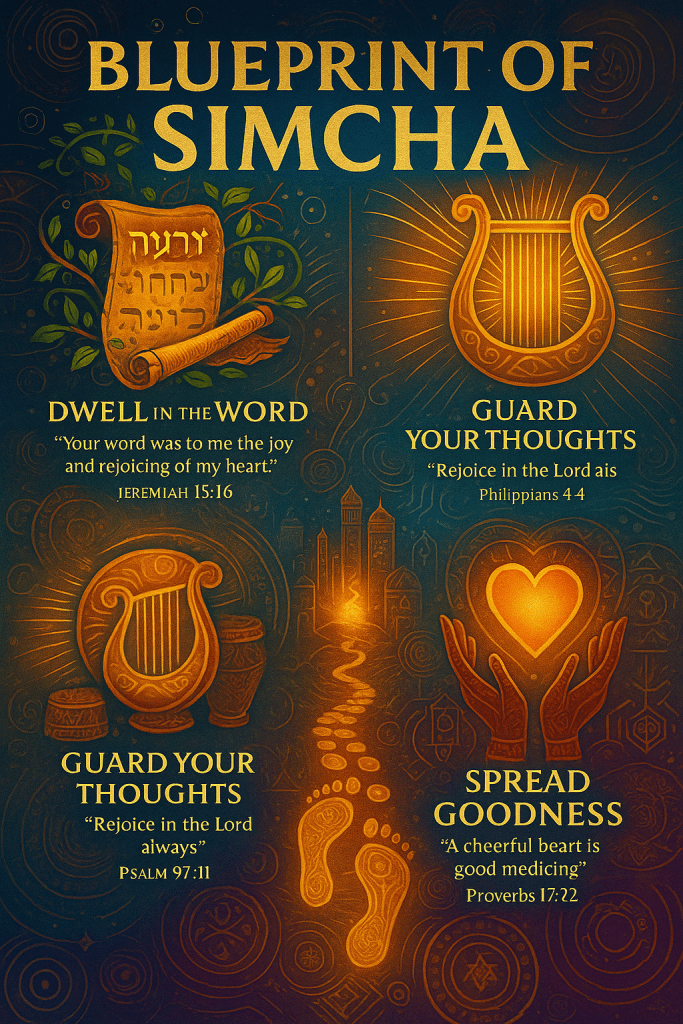
- Dwell in the Word – “Your word was to me the simcha and rejoicing of my heart” (Jeremiah 15:16). Let Scripture speak life to you daily.
- Sing with purpose – “Sing to the Most High, bless His name” (Psalm 96:2). As we discussed in article 14, praise and worship ushers in the Shekinah Presence.
- Guard your thoughts – “Rejoice in the the Most Highalways” (Philippians 4:4). Even in suffering, the focus of your mind can shape the state of your spirit.
- Walk uprightly – “Light is sown for the righteous and simcha for the upright in heart” (Psalm 97:11). simcha grows where righteousness is rooted.
- Spread goodness – “A cheerful heart is good medicine” (Proverbs 17:22). Simcha is contagious and medicinal.
Now I won’t front like every day we’re gonna feel simcha. I know that you know that I know what it is to sit in the dark with doubt whispering lies to ourselves. I also know that you know that I know what it is to wrestle with depression, to feel like simcha is for other people and not for you. I know that you know that I know what it is to walk through discouragement and feel disqualified from happiness. But hear me twice the first time, family, simcha is not a luxury, it’s a lifeline. And it’s not something you earn, it’s something you access through your faithful and consistent walk.
I need you to feel me, family, because if you’re in a valley season right season right now like I am, start small. Breathe. Speak one truth. Recall one blessing. Play one song. Smile one time because just one spark is all it takes to start a holy fire. As it says in Psalm 30:5, “Weeping may endure for a night, but simcha comes in the morning.” And sometimes, morning is a mindset, not a moment, a breakthrough of light through darkness in which we find ourselves. Selah on that!
So I bring this reflection here to a close, here’s my challenge for us: For the next seven days, begin your day with gratitude. Every morning that I open my eyes, there’s a prayer from the siddur that I say,
I give thanks before You, Living and Eternal King, for You have returned my soul to me with compassion; great is Your faithfulness
Speak this aloud and then say three things you’re thankful for before you pick up your phone or turn on the TV. Then take one intentional step to spread simcha, text somebody a word of encouragement, send a voice note, buy a stranger coffee, or hug your cub a little longer. Whatever it is, be simcha in action.
And this call to action is simple: Be a light in your neighborhood. Be the one whose presence brings peace, whose words build bridges, whose laughter breaks chains. Don’t wait for simcha to find you, create it, release it, live it. The simcha of YaH is not a personality trait, It is a prophetic presence, something we have to consciously and intentionally fulfill. And when we do, it liberates, uplifts, and transforms us. If you don’t believe, taste and see that YaH is good!
Because simcha, real simcha, is our strength, and it’s time for us to walk in it.
So whether you’re at a family reunion, a funeral, a feast day, going through a storm, coming out of one, getting ready to go in one, on your front porch, or whatever it is you’re going through, good, bad, ugly or indifferent, choose simcha. Not because life is easy, but because simcha is holy, and in simcha, we access the fire of transformation. And in the fire of transformation, we are refined.
So dance like Dawid, praise like Miriam, stand like Moshe, speak like Mashiyach.
Because transfigured simcha isn’t just your inheritance, it’s also your weapon.
Selah…
Discover more from SHFTNG PRDGMZ
Subscribe to get the latest posts sent to your email.

