
____________________________________________________________
…Israel’s structure was never designed to survive without a sovereign, a king, a melek in Hebrew, whose authority flowed from Torah and was overseen by the Levites. In Hebrew understanding, the role of a king wasn’t just political, it was deeply prophetic. The king was the visible standard bearer of the Torah’s Truth, the embodiment of righteousness, justice and covenantal order. Where there is no melek, there is no Truth, and when there’s no Truth, people are governed by emotion, impulse, and ego. Hence we find the Proverb found in chapter 29 verse 18 to be apropos: Where there is no vision, the people are let loose, but blessed is he who guards the Torah.
Transfigure with Triumphant Truth
But the Judgement shall sit, and they shall take away its rule, to cut off and to destroy, until the end. And the reign, and the rulership, and the greatness of the reigns under all the heavens, shall be given to the people, the set-apart ones of the Most High. His reign is an everlasting reign, and all rulerships shall serve and obey Him.’
Daniel 7.26-27
____________________________________________________________
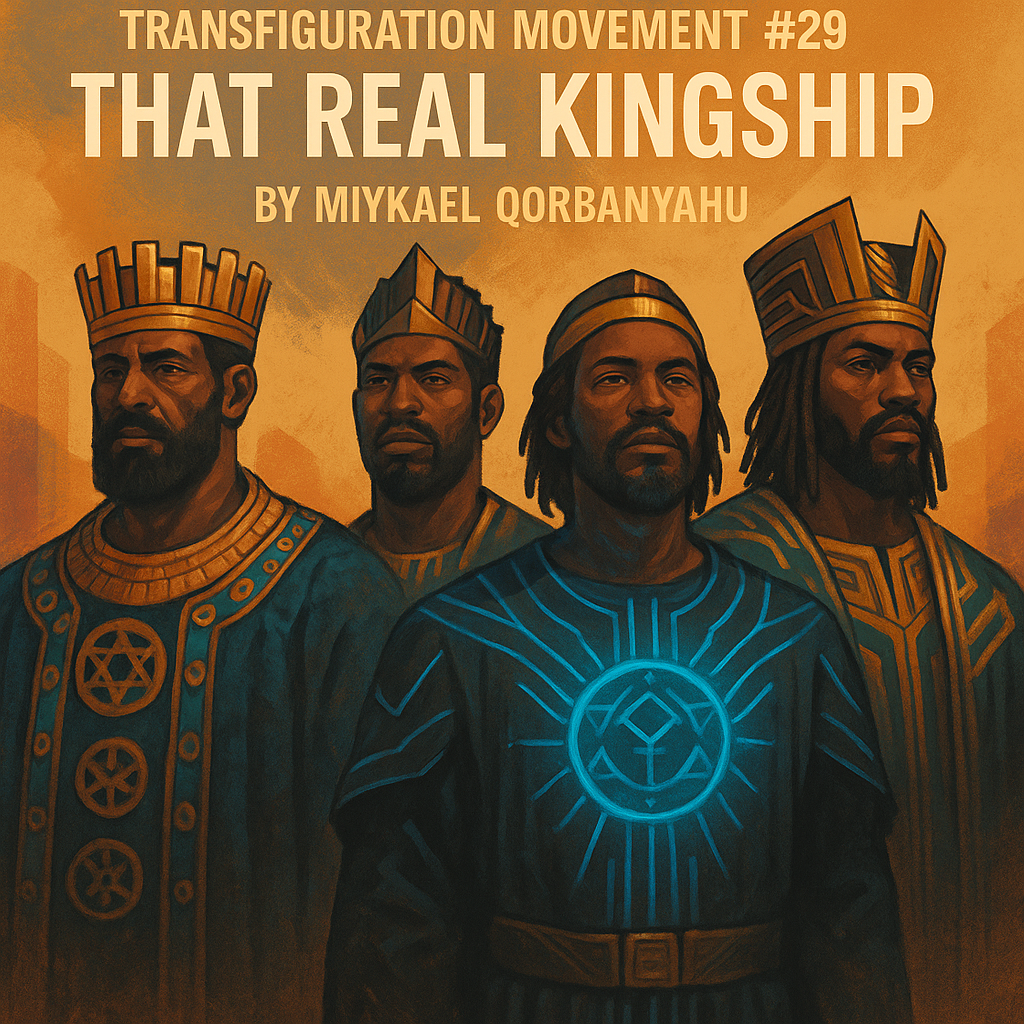
Alright, let’s keep it 100 right here and right now. In our day and age, the idea and word king is being tossed around like wet clothes in a dryer (I wanted to keep it kosher so that was the most relevant analogy that I came up with). The idea of a king is an entirely diluted and misconstrued notion in our generation. Worn like fashion, hashtagged for hype, and co-opted by ego, our society, which has never experienced the presence of royalty, has absolutely no clue what it a king is, and even more, what it is to be a king. This is because real kingship is not about popularity, it’s not about how you feel, it’s not about how people think about or you think about yourself; that real kingship is about purpose and straight rulership. And, being a king isn’t based in culture but rooted in covenant. To be a king is not just to be recognized by men, it’s to be anointed by Heaven and transfigured into the image of the Mashiyach, the anointed One. Now tell me, how many kings do you know like that who are truly anointed?

Let’s go even deeper now. The contemporary urban portrayal of kingship is built on aesthetics, bravado, and borrowed royalty; chains, crowns, and captions. It’s a surface-level performance of power, often shaped by survival, hustle, and the desire for recognition in a system designed to marginalize. But biblical theocracy and monarchy demand something completely different, and qadosh (holy) legitimacy. In the Kingdom, kings are not self-proclaimed; they are set apart, called by the Most High, and confirmed through the oil of anointing, which signifies alignment with Heaven’s will. That oil not’s just body fragrance either, it’s covenant. Urban kingship today, on the other hand, celebrates individuality and influence, but biblical kingship calls for intercession and instruction, justice and judgment. It’s not about being the loudest voice in the room, it’s about being the most righteous one before the throne. A real king doesn’t just build empires, he builds altars. He doesn’t just speak for himself, he stands in the gap for his people, carrying both their burdens and their hopes into the presence of YHWH. That right there is that real kingship, that real rule.
Consider this: before Yeshua was ever hailed as “King of the Yahudim” (Jews), He was being prepared, groomed, sanctified, and anointed for His divine mission from the very beginning. His coronation was not sudden; it was sovereign. From the womb of Miryam, through the righteous oversight of Yoseph, Yeshua was raised in the Torah, immersed in the sacred cycles of Temple service, and taught to walk in the fear and favor of YHWH. He was not just a prodigy, He was the promised light wrapped in flesh, something that He became firmly aware of when He approached Yohanan at the Yarden. His upbringing reflected the hidden majesty of the Mashiyach: humble in form, but qadosh in purpose.
In those days, Messianic expectation was burning hot. The people of Yisrael, weary from Roman colonial occupation, longed for national restoration. They were tired of being taxed, watched, and ruled by foreigners who neither knew nor honored their Elohim. This cultural frustration gave rise to a desperate hope; a King like David who would raise the banner of revolution and reclaim the throne of Zion. The streets of Jerusalem echoed with prayers for a warrior king. This is where the motif of Mashiyach ben David (Messiah, son of David) took center stage.
But here’s the revelation: while Israel looked for a king with a sword, Heaven sent a King with a scroll. While many expected a political liberator, the Most High had ordained a spiritual Redeemer. Yeshua’s mission wasn’t dictated by the people’s pain, it was defined by YHWH’s eternal plan which we read of in Daniel 9. The deliverance He came to bring was deeper than Rome. It was deliverance from sin, death, spiritual blindness and generational exile. His was not a kingdom made by hands, but a kingdom forged in the heavens, carried within, and destined to rule without end.
And just when the weight of His identity seemed hidden behind the veil of ordinary humanity, a moment came when the veil was lifted, and the true esteem of the King was revealed.
When Yeshua was transfigured before His disciples (Matthew 17:1–2), His primordial essence radiated outward, His face shining like the sun, His garments white as light. That revelation was not a miracle, it was a model for his disciples to take to heart and emulate. Kingship in the Kingdom is not about rising through hierarchy, but about revealing what’s already been deposited by Heaven. It is the unveiling of the Light and dominion that was hidden in humility.
This is the journey of every true king and queen in Israel, not to mimic Gentile power, but to mirror the Shekinah presence.

Before a king ever rules, he must be anointed. This isn’t ceremonial pageantry, it is a supernatural appointment. In Israelite tradition, oil was poured upon the head of a chosen vessel to set them apart, not just for rule, but for ordination and righteous representation. It was a symbol of the Spirit coming upon them to empower, correct, and sanctify their leadership.
“Then Samuel took the horn of oil and anointed him in the midst of his brothers; and the Spirit of YHWH came upon David from that day forward.”
1 Samuel 16:13
That oil wasn’t just fragrant, it was prophetic. It marked the moment when destiny became duty. And every true king, like David, must be tried in caves before being crowned in courts. Anointing without transformation is dangerous. But anointing with transfiguration is truly celestial.
Many believe that the measure of a king is how much pain he has endured or the trials that he’s experienced. But pain and experience alone doesn’t define a king, character does, culture does, consciousness does, compassion does. Real kingship is not about survival, but about selflessness, stewardship, and sacred knowledge. It’s about knowing the Torah, upholding the law, and embodying righteousness for the people.
“And it shall be, when he sits upon the throne of his kingdom, that he shall write for himself a copy of this Torah… and he shall read in it all the days of his life.”
Deuteronomy 17:18–19
Being that the Torah is the constitution of Heaven, no true king is to rule by instinct or prerogative alone; rather he rules by instruction, discipline, and devotion to Torah.
Considering this dynamic, the Hebrew word for king, melek (מֶלֶךְ), contains the blueprint of supernal leadership. Each letter is pregnant with revelation:
- Mem (מ) – Represents Mashiyach (Messiah), the Anointed One. The source and standard of kingship. A true king is one who reflects the character, covenant, and mission of the Messiah. Without Mashiyach, kingship is corrupted.
- Lamed (ל) – Symbolizes leadership, teaching, and divine authority. The shepherd’s staff. A king must lead with instruction, guiding the people toward Torah and truth.
- Kaf (ך) – Represents the palm or the capacity to receive and release. A king must be a vessel—shaped to carry wisdom and equipped to distribute justice, provision, and peace.
So what is a melek? According to the letters that spell the word, a melek is
one who embodies the Messiah, leads with divine instruction, and stewards the power of Heaven to bless the Earth.
That’s not ego, that’s Elohim’s order.
Taking this idea a step further, we find that the Dictionary for Torah Names and Words provides the following definition,
of you, yourself; to take counsel, consult, consider, determine, take advice; to rule, reign; a
sovereign, ruler, monarch; lit., one who distributes, releases and orders the productivity and branching…nationalism. To be righteous; also: militarism.
This definition offers a profound insight into the multifaceted role of the King, particularly as it foreshadows the ultimate reign of the Messiah. The initial phrases, Of you, yourself; to take counsel, consult, consider, determine, take advice, highlights the Messiah’s inherent wisdom and self-sufficiency, yet also His qadosh humility in perfectly aligning His counsel and determinations with the will of Elohim. This points to a deeply personal and invested leadership, not a distant or impersonal rule.
The core of the Messianic promise is found in phrases like To rule, reign; a sovereign, ruler, monarch. This signifies the Messiah’s universal and eternal sovereignty, establishing a kingdom that transcends earthly limitations and fulfills ancient prophecies concerning the Davidic Kingdom and Elohim’s perfect rule. He is the ultimate King, whose reign is founded on unwavering justice.
As the definition goes on to describe kingship as one who distributes, releases and orders the productivity and branching…nationalism, we find in this context that the Messiah is the conduit for all supernatural blessings, distributing favor, justice, provision, and releasing captives both spiritually and physically. He orders the productivity and branching, enabling spiritual fruitfulness and growth, and extending this to the flourishing of all creation under His benevolent rule. The term nationalism here is critical; it doesn’t imply divisive political nationalism, but rather the Messiah’s role in establishing the nation of Israel as a spiritual beacon, ultimately uniting all nations under His banner through the universal recognition of His celestial authority and truth. This signifies a heavenly order and ultimate reconciliation, a stark contrast to earthly divisions.
Finally, the phrases To be righteous; also: militarism illuminate crucial aspects of the Messiah’s character and power. His rule is fundamentally rooted in perfect righteousness and justice, embodying the Torah’s law and Truth to eradicate corruption. The term militarism, in a Messianic context, does not refer to conventional earthly warfare but rather to the Messiah’s ultimate power and authority to subdue all evil, spiritual forces, and opposition to Elohim’s will. He is the Warrior King who triumphs over sin, death, and darkness, engaging in a spiritual warfare that establishes and defends His righteous kingdom, ultimately bringing true and lasting peace.
But before we go on, let it be clearly perceived that YHWH’s intention wasn’t just to raise individuals as king’s, it was, by design, to raise a nation of kings.
You shall be to Me a kingdom of priests and a qadosh nation.
Exodus 19:6
“You are a chosen generation, a royal priesthood
1 Peter 2:9
These verses clearly demonstrate that Yisrael’s national identity is a fusion of royalty and priesthood. And so with this being the case, we are not chasing crowns, we are returning to them. But this return doesn’t happen through rebellion, it happens through repentance and revelation, through obedience and order.
We are called to transfigure, to allow the light within to be revealed through how we live, love, serve, and lead.
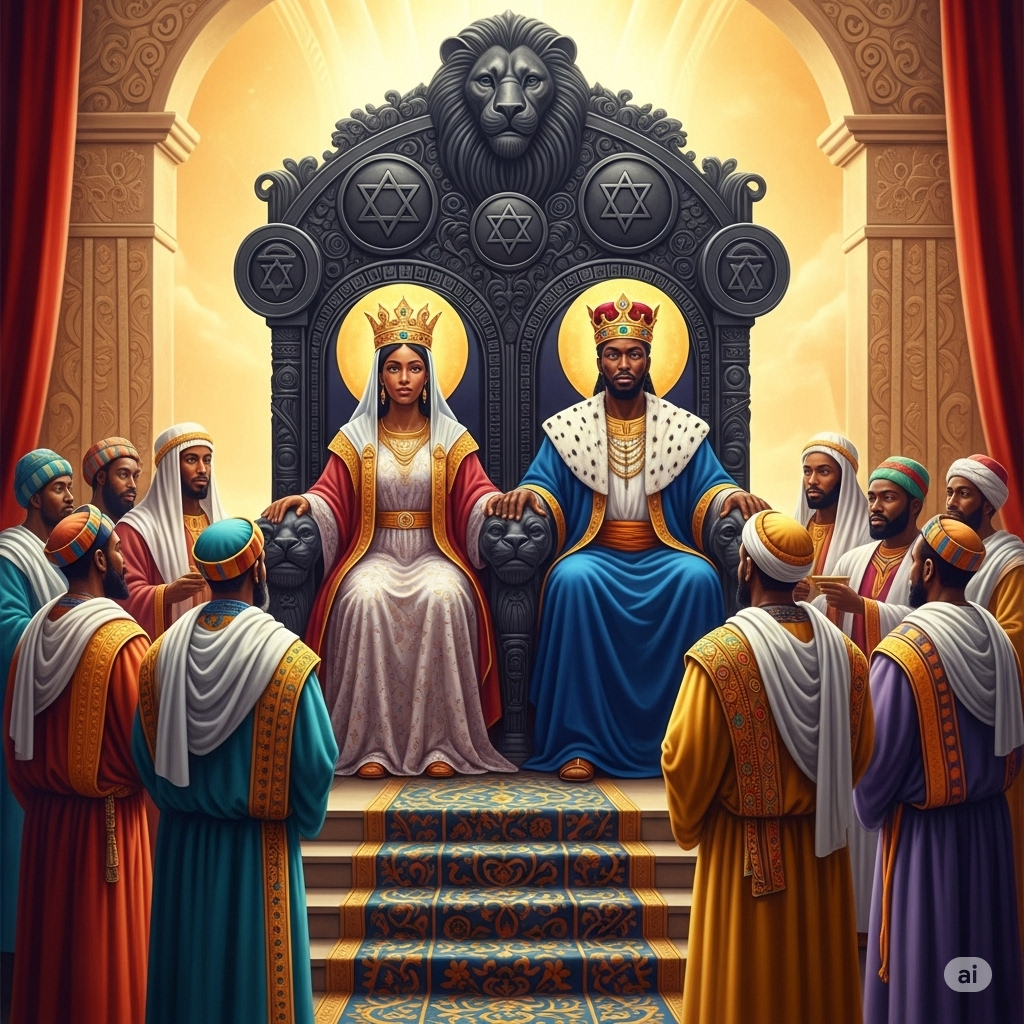
The crown is not just for the men. The Hebrew word malkah (מלכה), queen, is from the same royal root. Our sisters are not background, they are builders, nurturers, and divine defenders. A malkah governs through intuition, intercession, and insight. Like Deborah, she delivers justice. Like Hadassah, or Esther, she saves nations. Like Miriam, she prophesies truth into dry places.
To be a malkah is to be anointed to manifest royalty in rhythm with righteousness.
And so, as our Father and King would have it, becoming a king or queen in the true sense is not about ascending a throne by bloodline or political influence, it’s about aligning oneself with the heart, will, and law of YHWH. According to the totality of Scripture, from the Torah to the Messianic Writings, true royalty is a calling rooted in covenant, cultivated by character, and confirmed through consecration. Here’s how the journey unfolds:
1. Be Chosen and Called by YHWH
The Torah reveals that true kingship is a matter of divine choice. In Deuteronomy 17:15, it is written:
You shall surely set a king over you whom YHWH your Elohim chooses…
This principle still applies: kings and queens are called, not self-appointed. They are chosen to serve, not to be served. If you feel a royal calling, it must first be affirmed by your alignment with YHWH’s will.
2. Submit to the Torah (Instruction)
A king or queen must be under the rule of Torah before they can rule anyone else. The command continues in Deuteronomy 17:18-20, that the king must write for himself a copy of the Torah and read it all his life:
“…that he may learn to fear YHWH his Elohim by keeping all the words of this law… so that his heart is not lifted above his brethren.”
True royalty is founded on humility, not hierarchy. Obedience to Torah, its justice, mercy, and righteousness, is the foundation of a theocratic monarchy.
3. Be Anointed (Mashach) with Purpose
In the Prophets, we see that every true king (and queen) is anointed, physically and spiritually. Samuel anointed Saul and David with oil as a symbol of their divine appointment (1 Samuel 10:1, 16:13).
Anointing (מָשַׁח, mashach) is more than a ritual, it’s the divine empowerment for leadership. In Messianic understanding, this points directly to Yeshua, the Mashiyach (Anointed One), who fulfills all righteousness. To be a king or queen in Israel is to be filled with the Ruach haQodesh (Holy Spirit), equipped for service, truth, and justice.
4. Walk in Justice and Righteousness
The Writings (Ketuvim), particularly Psalms and Proverbs, are rich with wisdom for kingship. Psalm 72, a prayer for the king, pleads:
“Give the king Your judgments, O Elohim, and Your righteousness to the king’s son.”
And Proverbs 16:12 teaches:
It is an abomination for kings to commit wickedness, for a throne is established by righteousness.”
Righteousness (tzedek) and justice (mishpat) are the twin pillars of righteous rule. A king or queen must not be swayed by wealth, ego, or bribes, but must judge fairly, especially for the oppressed and voiceless.
5. Embody the Servant-King Spirit of Messiah
Finally, in the Messianic Writings, Yeshua redefines royalty through humility and sacrifice. He says in Matthew 20:26:
“Whoever wants to be great among you must be your servant.”
His coronation was not with gold, but with thorns; His throne was not a platform, but a tree. Yet He is King of kings.
Yeshua’s transfiguration on the mountain (Matthew 17:1–9) was a foreshadowing of glorified kingship, rooted in obedience, crowned in righteousness, and radiant with the esteem of YHWH. If you want to be royalty in His Kingdom, you must follow His example: serve, suffer righteously, walk in holiness, and govern your life under His rule.
Know that you are not common and that you were never meant to live beneath your spiritual inheritance. The disciple Kepha, aka Peter, informs us that we were born into a royal priesthood, chosen to be sovereign over our soul, responsible for our house and accountable to the Kingdom.
The reason for this is because being royal begins with rulership over self. Before David ruled a nation, he had to learn to rule his emotions, his tongue, his reactions, and his desires. His internal dominion prepared him for external authority. This principle remains true today.
The word “dominion” from Genesis 1:26—“let them have dominion…”—comes from the Hebrew word radah (רָדָה), which means to tread down, to reign, to govern. Dominion is not exploitation, it’s stewardship. You were created to govern your gifts, to guard your garden (your home, mind, and soul), and to grow the good that YHWH has placed in your hands. To be a king or queen is to restore the Edenic mandate, to bring heavenly order into earthly chaos.
To rise into your kingship, you must have vision, and not just any vision, but divine revelation. This is where the Transfiguration comes into prophetic clarity. In Matthew 17, Yeshua takes Peter (Kepha), James, and John to a high mountain and is transfigured before them, His face shining like the sun, His garments radiating glory.
Why does this matter?
Because Yeshua revealed to them what kingship looks like on the other side of obedience. His transfiguration wasn’t merely an event, it was a preview of the glory that comes through submission, sacrifice, and sanctification. He had humbled Himself as the Suffering Servant, and in that moment, Heaven revealed Him as the Glorified King. Likewise, when you walk in obedience to the call of righteousness, the veil lifts, and who you really are is revealed.
Royalty is not built on applause, it is forged in revelation.
Finally, kingship isn’t cosmetic, it’s internal transformation. You don’t become royal by outer performance; you’re transfigured by inner alignment. The Greek word for transfigure in Matthew 17 is metamorphoō (μεταμορφόω), the root of “metamorphosis.” This is a complete change in form and essence.
Paul echoes this in Romans 12:2:
“Be transformed by the renewing of your mind…”
In other words, to rise into your role as king or queen, you must be willing to let the Spirit of Elohim remake you, mind, will, and character. You must detox from the lies of inferiority, servitude to sin, and identity confusion. You must be willing to see yourself the way Heaven sees you: royal, redeemed, responsible, radiant.
So, again, to become a king or queen:
- Accept the call.
- Submit to Torah.
- Be anointed by the Ruach.
- Walk in righteousness and truth.
- Serve with the heart of Messiah.
This is not just about identity, it’s about responsibility. You have to rule well, reign righteously and manifest the Kingdom.
The greatest among you must become like the youngest, and the leader like the servant.
Luke 22:26
We shall be like Him, for we shall see Him as He is.”
1 John 3:2
Contrary to popular opinion, kingship in the Kingdom isn’t about domination, it’s about righteous representation. It’s not about claiming a title, it’s about carrying the weight of esteem with humility, responsibility, and love.
And here’s the bottom line, family, we are not peasants pretending to be royalty. We are royalty recovering from amnesia. As I identified earlier, the Most High has declared from the beginning: “You shall be to Me a kingdom of priests and a qadosh nation” (Exodus 19:6). This isn’t poetic, it’s prophetic. It’s not just identity, it’s inheritance. We, the seed of Israel, are a royal people, set apart by covenant, forged through captivity, and now being awakened by the Spirit to reclaim our sovereignty and sanctity.
This kingship, for sure, is not limited to thrones and temples, because it starts with self-governance. We must have dominion over our appetites, our emotions, our decisions, our desires and our destinies. We are accountable to one another, to our communities, and ultimately to the King of all kings. The household must become a qadosh embassy. The family must become a throne room. And every brother and sister must walk as a plenipotentiary of Heaven, a full representative of YHWH’s righteous reign on Earth.
So this endeavor is not at all about nostalgia – we used to be kings and queens – it’s about now; let us become kings and queens. Also, it’s not about waiting on deliverance, it’s about walking in dominion. The world needs to see the transfigured sons and daughters of Zion stand up, not just in titles, but in truth, not just in garments, but in light, not just in sound, but in substance.
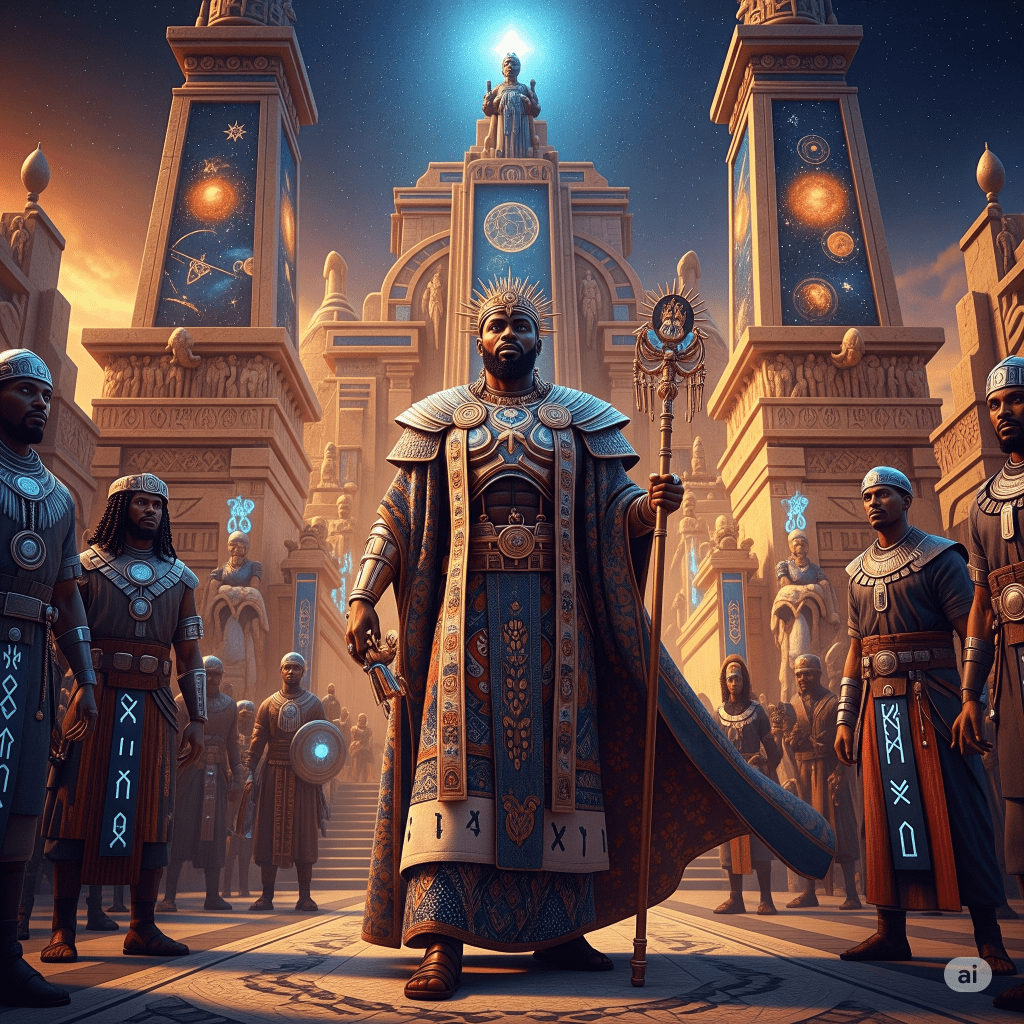
Know that uou are not what the world has called you. You are not just your trauma, your background, your struggle, or your status. You are of royal blood, not because of your genetics, but because of your covenant. You were chosen to reign, not just in heaven someday, but to rule now: over your life, your home, your community, and your calling.
That is how kings and queens are born, by the Word, by the Spirit, and by the unwavering commitment to manifest the Kingdom of Heaven on Earth.
Return to Torah. Receive the anointing. Walk in the light. Rise into transfiguration. Rule with righteousness.
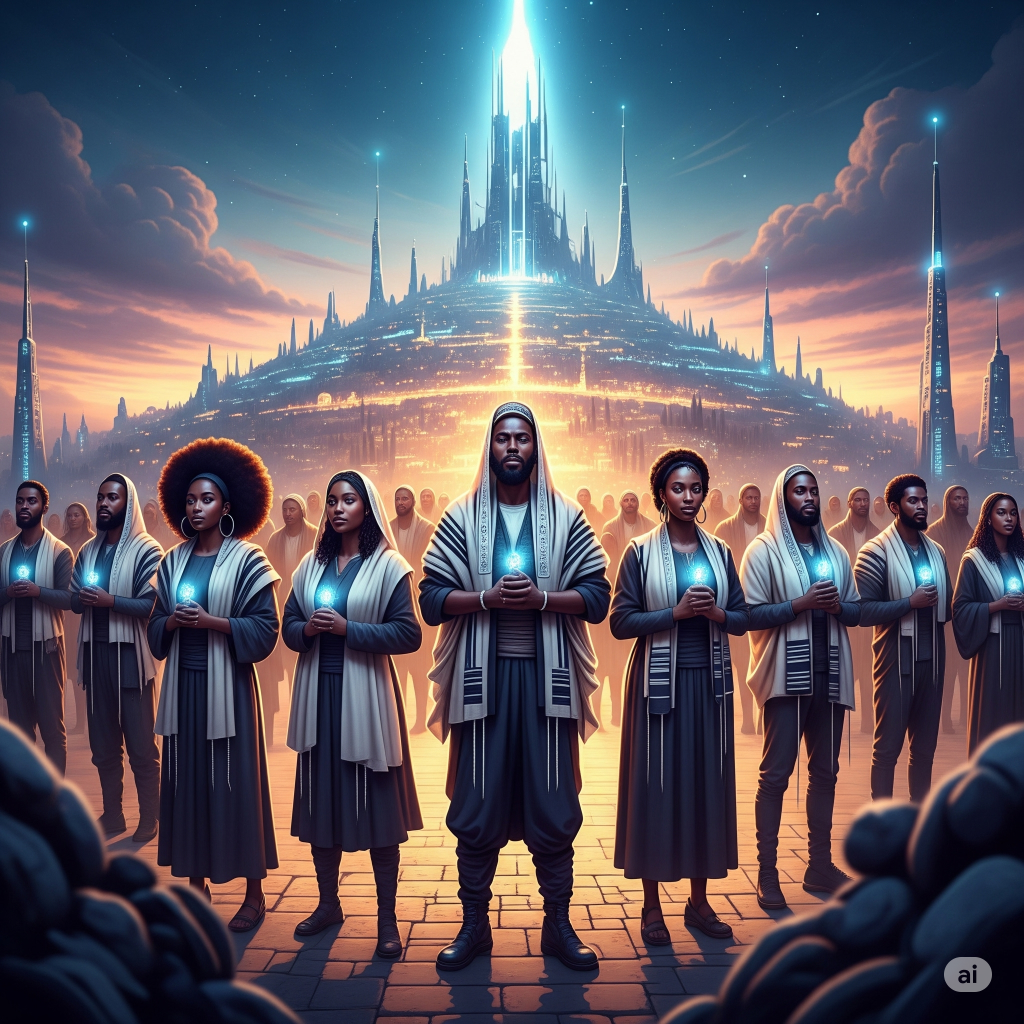
Let us crown ourselves with the knowledge of Torah, robe ourselves in righteousness, and rise as a nation ready to reign.
So rise up, royal one.
Let the Mashiyach be formed in you.
Let the Torah instruct you.
Let the oil consecrate you.
Let the light within shine forth.
This is that real kingship, not a performance, but a prophetic posture.
Not just a crown on your head, but a covenant in your heart.
Not status, but service.
Not hype, but qedushah.
The time is now for us to transfigure and take back the Kingdom.
The crown is calling.
Will you wear it with honor?
Selah.
Discover more from SHFTNG PRDGMZ
Subscribe to get the latest posts sent to your email.


1 Comment