
____________________________________________________
All material human beings are prodigal sons who have left the home of
Omnipresent Holy [Spirit] and have identified themselves with the infinitely smaller
territory of the human body. This Holy [Spirit] is the Great Comforter. Being guided
by the universal, reflected, [Elohim]-Consciousness, it contains the all- coveted bliss of
[Elohim]. One filled with this Holy [Spirit], or Holy Vibration, can talk with the diverse
tongues of inspirations of men, animals, and atoms.
The Second Coming of Christ – The Resurrection of the Christ Within You pgs 18-19
Paramhansa Yogananda
Let us hear the conclusion of the entire matter: Fear Elohim and guard His commands, for this applies to all mankind!
Ecclesiastes 12.13
____________________________________________________
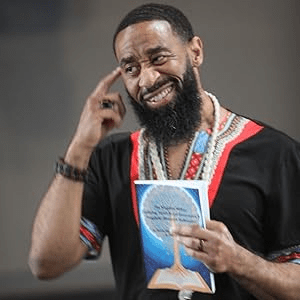
With no shame, I’m proud to say that I’m a nerd. That’s right, an unabashed, set-apart, Torah-loving, Mashiyach following nerd. I’m talking about pocket-protectors, comic books, studying, writing, teaching, talking, geeking out over convos and all that; the kind of nerd who lights up at the sight of a deep book, ancient text, or hidden principle that unlocks celestial order. I didn’t always claim it, though. Back in the day, I was all about building muscle and making motions, bound for the big leagues. Football pads, Friday night lights and Saturday afternoons had my full attention. Yup, athletics was my calling; or so I thought.
But here’s the twist: when I were to go back and look at my high school transcript, I saw something interesting. Buried beneath the sweat and stats was a hidden signal from destiny, my best classes were law classes. What’s wild about it all is I didn’t even try that hard, but I excelled. The structure, the precedent, the principles, the maxims, the articulation of order, something about it, even then, just clicked. But I wasn’t paying attention at that time; I was fixated on fame, touchdowns, and training days.
Then came the moment that changed everything: the circumcision of my heart.
It was a spiritual surgery, one I was completely unaware of, but one I desperately needed. When the Spirit of YHWH reached into the depths of my being and tore the veil off my soul and open my once blinded eyes, I began to hunger, not for trophies or titles, but for Truth. That was when all the advice my stepdad ever gave me about reading, studying, and expanding my mind suddenly ignited. And from that fire, the nerd in me was born, not in pride, but in purpose.
It was as if the Most High Himself enrolled me in a supernatural academy, one where the curriculum was Torah-based and the credential was transformation. My appetite shifted from competition to comprehension, and I realized that the greatest victories aren’t won on the field, but in the mind and soul. Also, something about understanding justice, rights, and systems of order sparked something in me, even if my young mind was still focused on returning to the gridiron and the next level of play.
But it wasn’t until I started studying Torah that the connection clicked: the law isn’t just theory or even social order, it was a calling. Torah opened my mind up to the deeper purpose behind legal structures, showing me that true law isn’t about control but about creation, covenant, and clarity. That’s when I began to see the difference between manmade rules and cosmic order. The perspective that I received reshaped everything. With this new insight, I began to see existence in terms of universals and patterns. But before we dive into universals and patterns, it’s essential at this point to ask a critical question: what is law?
In the Western mind, “law” usually means a set of rules enforced by threat of punishment. It’s civil, cold and often weaponized by those in power. But in Hebrew culture, law is not simply legislation, it’s instruction, the very meaning of the word Torah. As has already been covered in article 25, the root of the word Torah, yarah, literally means to flow like water, to cast, or shoot forth like an arrow. Torah is direction, guidance, and is considered the stream of supernal wisdom that keeps creation in alignment with its Creator.
In this way, Torah is not just about commandments, it’s about cosmic order. Torah is law like gravity is law; binding, beneficial, foundational. To live without Torah is to drift aimlessly, to exist in chaos, to fall out of sync with the rhythm of life.
So, from here, let’s expand our lens and take a wider view of reality. Whether in heaven or on earth, whether seen or unseen, every kingdom in existence is governed by the rule of law. From the microscopic to the interdimensional, every level of existence operates within laws, boundaries, patterns, and principles that sustain harmony, function, and identity. Whether we observe the flow of rivers, the cycles of planets, the behavior of animals, or the electrical impulses of our nervous system, one truth stands tall: every kingdom in existence is governed by the rule of law. This is not merely civil or criminal legislation, this is celestial order, etched into the fabric of reality itself.
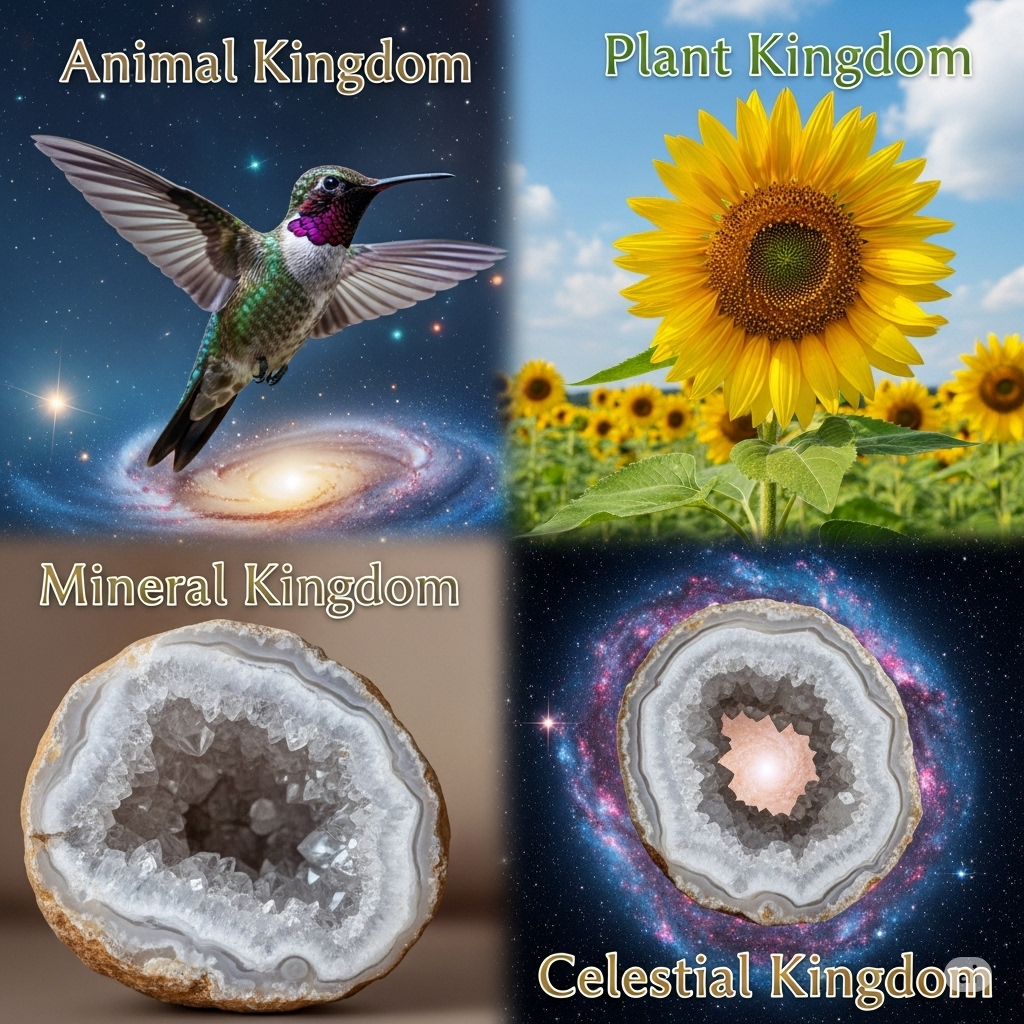
Let’s take a moment to consider some of these kingdoms:
• The Mineral Kingdom is governed by laws of chemistry, pressure, and crystalline structure. Stones don’t rebel.
• The Plant Kingdom grows according to photosynthesis, gravity, seasons, and soil composition. Trees don’t resist the soil.
• The Animal Kingdom obeys instincts, ecosystems, and hierarchies. Beasts don’t argue with their design.
• The Celestial Kingdom abides by orbital mechanics, light, heat, and time. Stars and planets keep perfect obedience.
But then, we arrive at the Kingdom of Humanity; the kingdom made in the tzelem Elohim, the image of the Creator. It is here that we see friction, we find rebellion, and experience disorder. Humanity alone resists the very laws designed to preserve life, freedom, and elevation. We exalt personal liberty while scorning universal alignment. We idolize the intellect but ignore celestial intelligence. The same soul that was given dominion is the self same soul that has become disoriented.

But even before Israel stood at Sinai and received the fullness of Torah, the Most High had already established a moral framework for all of humankind through Adam and reaffirmed it through Noah. There are seven foundational laws, known as the Sheva Mitzvot B’nei Noach, are derived from the covenant made after the flood and preserved in both Torah and Talmudic tradition.
The Torah declares, “But you shall not eat flesh with its life, that is, its blood. And for your lifeblood I will require a reckoning…” Genesis 9:4–5. This marks the beginning of a universal code given to Noah and his descendants, that is, to all nations.
According to the Mishnah Torah, Laws of Kings and Their Wars in Hilchot Melachim uMilchamoteihem 8:10, Rambam, or Maimonides, outlines the following seven Noahide laws:
- Do not worship idols – Acknowledging the One True Elohim.
- Do not curse Elohim– Upholding reverence and sacred speech.
- Do not murder – Preserving the sanctity of life.
- Do not steal – Respecting property and boundaries.
- Do not commit sexual immorality – Protecting the holiness of relationships.
- Do not eat the limb of a living animal – Practicing mercy and restraint.
- Establish courts of justice – Enforcing righteousness and order in society.
These laws aren’t just ethical suggestions; they’re universally ordained standards. They form the moral bedrock of civilization and are expected of all nations to observe. The Talmud states: “The righteous among the nations have a share in the World to Come” (Sanhedrin 105a), affirming that adherence to these principles opens the gates of spiritual elevation even outside of the covenant with Israel.
In today’s fragmented and chaotic world, these seven laws remain a timeless call to justice, self-restraint, and Universal accountability. Whether one is grafted into the covenant of Israel through Messiah, or walking with sincerity as a righteous soul among the nations, honoring these principles fosters alignment with the Creator’s universal Will.
For the Transfiguration Movement, these laws serve as a starting point for restoring moral order, awakening Torah consciousness, and bridging humanity back to the Source through righteous living.
In the full scope of creation, the Torah was not given to oppress or restrict, it was given to restore, as it is written:
And now, O Israel, what does YHWH your Elohim require of you but to fear YHWH your Elohim, to walk in all His ways and to love Him, to serve YHWH your Elohim with all your heart and with all your soul, and to keep the commandments of YHWH and His statutes which I command you today for your good?”
Deuteronomy 10:12-13
The Torah is humanity’s alignment manual, harmonizing our being with heaven and earth, with spirit and matter, with self and society. It’s not an arbitrary code, because it reflects eternal patterns, mirrored throughout creation and encoded in the spiritual architecture of existence.
Among the keys to unlocking this cosmic structure are the Seven Hermeneutical Laws, not to be confused with rabbinic rules of interpretation like Hillel’s or Ishmael’s, but more broad, expansive spiritual principles that govern understanding, being, and becoming.
These Seven Laws are ancient principles embedded in both Scripture and the soul. They are not just rules of interpretation but realms of realization, a spiritual operating system governing the inner and outer worlds of humanity. Let’s now take another moment to explore each of these powerful principles:
1. The Law of Mentalism (The Principle of Mind)
“All is mind; the universe is mental.”
This principle states that everything that exists, spiritual and physical, originates in mind or consciousness. The universe is a manifestation of supernal thought. In Hebrew understanding, this aligns with the concept of “Davar” (דָּבָר), the Word or thought of Elohim that brings things into being (see Genesis 1:3, John 1:1).
In the Torah, we are told to meditate on the commandments day and night (Joshua 1:8). Why? Because the mind is the battlefield and birthplace of all things. As Proverbs 23:7 declares, “As a man thinketh in his heart, so is he.”
Your thoughts create your world. To walk as a king or queen in the Kingdom, you must renew your mind (Romans 12:2), align your thoughts with Torah, and think as Mashiyach thinks. This informs us that transfiguration begins in the mind.
2. The Law of Vibration (The Principle of Frequency)
“Nothing rests; everything moves and vibrates.”
All matter and energy are in a constant state of vibration. Your thoughts, emotions, and actions emit frequencies that resonate with the spiritual and natural world. The Hebrew concept of Ruach (ר֫וּחַ), meaning “spirit” or “wind,” is a moving force, indicating that the Spirit of YHWH vibrates through creation.
Yeshua said, “The words I speak are spirit and life” (John 6:63). Every word spoken, every action taken, sets vibrations in motion that shape reality. Even the shofar emits vibrations that shift spiritual atmospheres.
If your life is out of harmony, you must tune your vibration. Through prayer, worship, Torah study, and obedience, we align ourselves with Heaven’s frequency. This is how we ascend the ladder of the Etz Chayim, or the Tree of Life in order to vibrate higher.
3. The Law of Correspondence (As Above, So Below)
“As above, so below; as within, so without.”
This principle reflects the interconnectedness of all things. What is true on the macro/cosmic level is mirrored on the micro/personal level. YHWH created man in His image and likeness (Genesis 1:26), a direct expression of this law.
The Mishkan, or Tabernacle, is another prime example, its structure was a mirror of the heavenly realm (Hebrews 8:5). Likewise, our inner being must mirror celestial order if we are to walk in Kingdom authority.
We are a microcosms of the universe. The way we manage our inner life reflects in our outer world. To govern others, therefore, we must govern ourselves. When we heal our inner world, we will be able to see peace in our home, community, and nation.
4. The Law of Polarity (The Principle of Duality)
“Everything has its pair of opposites.”
Everything exists in relation to its opposite: hot/cold, light/dark, male/female, peace/war. Torah itself presents blessing and curse, life and death (Deuteronomy 30:19). These are not contradictions, they are necessary contrasts for choice and awareness.
YHWH placed both the Tree of Life and the Tree of the Knowledge of Good and Evil in the garden. Why? So humanity could exercise free will and choose alignment.
Don’t be surprised by trials or oppositions, they are tools of growth. Kings and queens are shaped by contrast. Maturity comes when you learn to discern, not divide. Choose life, choose light.
5. The Law of Causality (The Principle of Cause and Effect)
“Every cause has its effect; every effect has its cause.”
Nothing happens by accident. This principle mirrors the Torah law of sowing and reaping (Galatians 6:7; Proverbs 22:8). Obedience produces blessing; disobedience brings consequence.
This is also the foundation of karma in Hebraic terms, “measure for measure” (middah k’neged middah). Torah commandments are the supernal causes that guarantee spiritual and physical effects.
You’re not a victim of random fate. Your decisions, words, and actions have consequences. Real kings take responsibility, not blame. Align your causes with Torah, and you will manifest heavenly results.
6. The Law of Rhythm (The Principle of Cycles)
“Everything flows in and out; all things rise and fall.”
Life moves in cycles, seasons, Sabbaths, festivals, life-death-resurrection. The Torah is deeply rhythmic: six days work, one day rest; seven-year shemitah cycles; Jubilee years.
Yeshua fulfilled this law by living, dying, and rising according to celestial timing. To live in the Kingdom is to understand celestial timing and not resist the ebb and flow of life.
Stop fighting your season. Learn to move with the Spirit, not against it. There is a time to sow and a time to reap, a time to fast and a time to feast. Rhythm helps you stay grounded in the will of YHWH.
7. The Law of Gender (The Principle of Masculine and Feminine)
“Gender is in everything; everything has its masculine and feminine principles.”
This principle goes beyond biology. It is the law of generation and creation. Masculine energy (seed) and feminine energy (womb) are both necessary for manifestation. In Torah, man and woman together form the image of Elohim (Genesis 1:27).
Mashiyach represents the heavenly groom, and Israel the bride (Ephesians 5, Revelation 21). The spiritual mystery of union is at the heart of the Kingdom, fruitfulness through balance.
Honor the masculine and feminine within and around you. Don’t distort one or diminish the other. The world is restored when unity is restored. Kings and queens need each other to manifest the Kingdom.
These seven universal principles are not mystical fluff, they are the spiritual operating system of the universe. Every law of Torah operates in harmony with these seven, and they are all rooted in the Etz Chaim, the Universal blueprint.
To walk as sons and daughters of the Kingdom is to live in full alignment with the laws that govern creation, natural, moral, spiritual, and eternal.
“Great peace have they who love Your Torah, and nothing shall offend them.”
Psalm 119:165
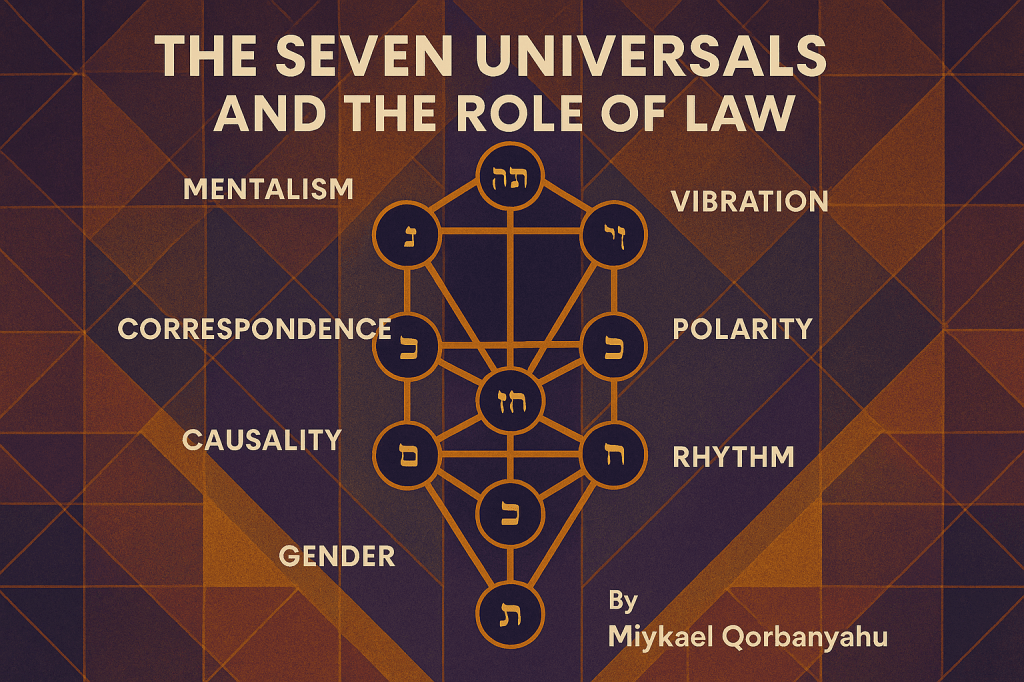
In the grand design of creation, nothing exists outside the governance of Universal Law. Whether physical or spiritual, seen or unseen, the cosmos operates with breathtaking precision under sacred principles. What many traditions attempt to grasp in fragments, the Torah has encoded in full, from the opening words of Bereshit, or Genesis, to the revealing vision of the Etz Chaim. These laws are not arbitrary rules or abstract philosophies. They are patterns: blueprints for alignment, designed to bring humanity into harmony with the Creator, with creation, and with our own cosmic potential.
The seven hermeneutical laws are often framed as universal axioms, embedded into the metaphysical fabric of existence. They govern how reality behaves at the energetic and spiritual levels, revealing how thought becomes form, motion generates matter, and opposites birth wholeness. Yet these laws are not outside of Torah, they are within it. They are the invisible structures upholding the visible scroll.
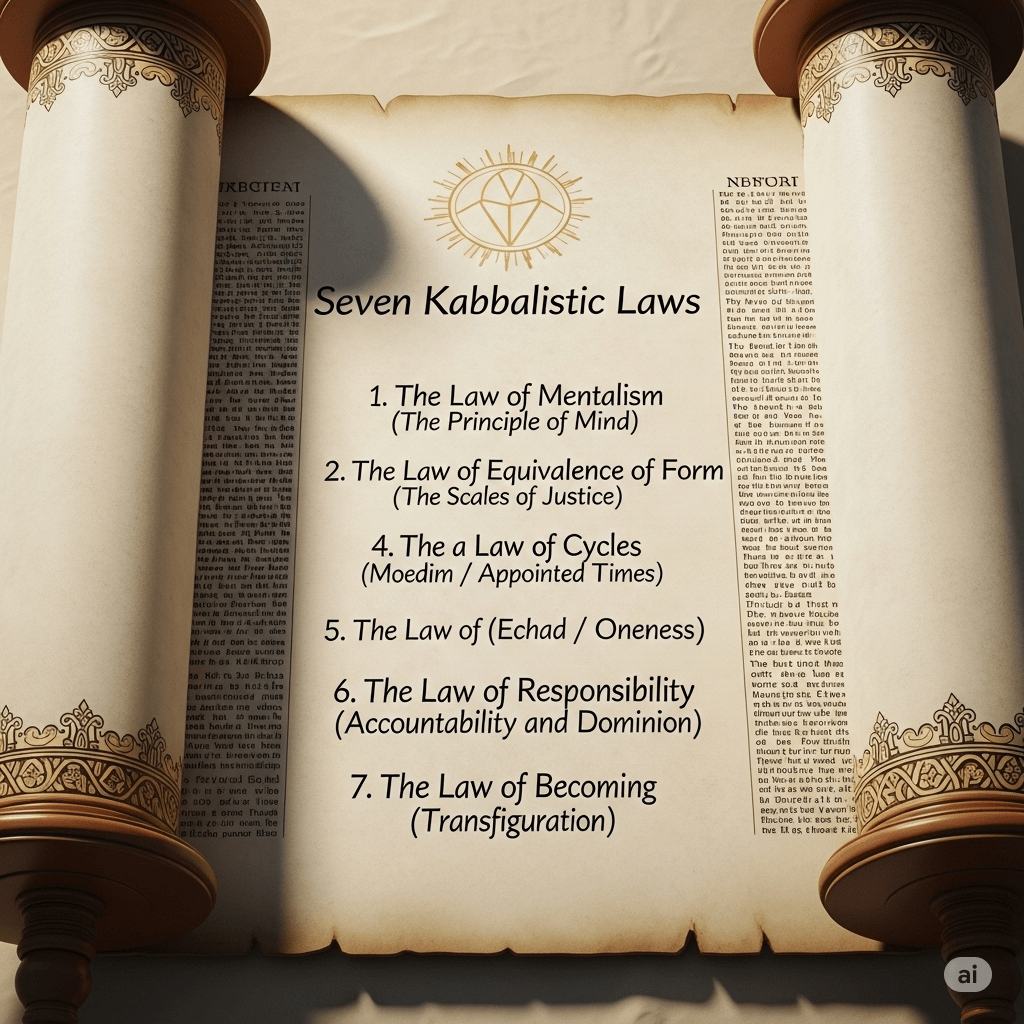
When we align these seven principles with the seven Kabbalistic laws, we discover that they are not merely parallel truths, they are interwoven truths. Each Kabbalistic law, rooted in Torah and nourished through prophetic insight, offers us a Kingdom application of a cosmic principle. For example, the Law of Origin (Bereshit) resonates deeply with the Law of Mentalism, both declare that all things begin in the unseen realm of thought and intention. The Law of Equivalence of Form mirrors the Law of Correspondence: as within, so without; as above, so below. The Torah’s cyclical times and appointed seasons (Moedim) are in perfect rhythm with the universal law of Rhythm.
This is more than intellectual alignment, it is the map for our transformation. When these laws are studied together, they reveal the Universal system by which we as human beings move from fragmentation to fullness, from exile to Eden, from flesh to transfigured splendor. These laws don’t compete, like the lesson I learned on my journey, they complete. These laws serve as the dual revelation of Heaven’s design for Earthly dominion.
So, to walk in the fullness of the Kingdom of Heaven on Earth, we must not only understand these laws, we must all the more embody them. This union of Torah-rooted Kabbalistic wisdom and the ancient hermeneutical principles offers us a path, not of information, but of transformation. As it is written, “You shall be to Me a Kingdom of priests and a qadosh, or holy, nation” (Exodus 19:6). And every Kingdom is governed by law.
Let us now explore each of these supernal principles, not as abstract ideas, but as living codes meant to activate the image of Elohim within us.
1. The Law of Origin (Bereshit / Genesis Principle)
Everything begins with a source.
Everything in creation flows from an origin, whether that origin is spiritual, physical, mental, or relational. The Torah begins with the word Bereshit, “In the beginning,” which is not just a temporal marker but a spiritual code. It reveals that there is an intentional beginning to everything, and that beginning is always rooted in the Will of Elohim. In Hebrew thought, nothing is random. The Creator is not only the originator of all things but also the sustainer, designer, and determiner of purpose.
To understand this principle is to recognize that every action, thought, and outcome begins with a seed, and every seed has a source. The Law of Origin compels us to look deeper than surface-level realities. Whether you’re experiencing conflict, blessing, confusion, or revelation, you must ask: Where did this come from? What is the root? What is the source behind the manifestation? Proverbs 4:7 says, “Wisdom is the principal thing; therefore get wisdom: and with all thy getting get understanding.” True understanding begins by tracing things back to their origin.
The Etz Chaim in Kabbalistic tradition begins at Keter, the crown, representing the Intent of Elohim. This tells us that everything that follows in creation flows from that highest level of purpose. Your life, too, is not accidental, it began in the mind of Elohim. Just as the heavens and the earth were formed from celestial speech and design, your purpose is encoded in the origin from which you came.
When facing challenges, conflicts, or opportunities, ask yourself: What is the source of this? Is it coming from fear, flesh, ego, or from purpose, Spirit, and truth? Before taking action, realign with the origin: your identity in YHWH, your covenant through Torah, and your assignment in the Kingdom. Examine your habits, relationships, and goals and trace them back to their root. When you live consciously aware of your origin in YHWH, you are empowered to walk in your destiny with clarity, authority, and alignment.
2. The Law of Equivalence of Form
This universal law teaches that in order to connect with higher realities, one must become like the higher. The closer one’s internal form, meaning one’s desires, thoughts, and actions, aligns with the supernal form, the more unity and harmony one experiences with the Creator. Dissimilarity causes distance; likeness creates closeness.
In Torah, this concept is foundational. It is echoed in Leviticus 19:2:
“You shall be qadosh, for I YHWH your Elohim am qadosh.”
Here, Israel is commanded to become like the Creator, not in essence, but in ethical and spiritual form. This is not imitation for performance; it is transformation for connection.
Kabbalistically, this law is expressed in the Etz Chayim through the alignment of the sefirot, each sefirah revealing aspects of celestial behavior we are called to embody. Chesed (loving-kindness) mirrors YHWH’s generosity. Gevurah (judgment) reflects celestial restraint. Only when we attain equivalence of form with these celestial attributes can the light of unity flow without blockage.
In Exodus 25:40, Moses is shown the heavenly design of the tabernacle:
“See that you make them after the pattern which was shown to you on the mountain.”
This wasn’t about simple architectural mimicry. The Mishkan (tabernacle) was a physical structure built to align with heavenly form, because sacred space requires sacred resonance. The people were to match the form of heaven in their actions, worship, and internal purification.
To be citizens of the Kingdom of Heaven on Earth, we must adopt the middot, or supernal attributes, becoming merciful, just, patient, and wise. This is not just ethical living. It is spiritual transformation through Torah observance, which teaches us the behaviors that match supernal form. Prayer, charity, Torah study, and mitzvot are not mere rituals, they are instruments of spiritual equivalence.
3. The Law of Balance (The Scales of Justice)
Everything must be weighed.
Balance is not simply the absence of chaos, it is the intentional harmony between forces. In Hebrew thought, righteousness (tzedek) and justice (mishpat) are deeply tied to equilibrium. They are not just moral ideals, but Universal standards encoded into the universe. Leviticus 19:36 warns, “You shall have honest balances, honest weights… I am YHWH your Elohim.” This law was not just about market ethics; it was about a cosmic principle: that all things must be properly measured and accounted for.
The Torah’s emphasis on accurate weights and measures reflects a deeper spiritual truth, that all actions, intentions, and outcomes are being weighed in the scales of cosmic justice. When we apply double standards, show favoritism, or move with unbalanced motives, we tip those scales and disrupt the harmony Elohim has built into the world.
This is why the middle pillar of the Etz Chayim, running from Keter (Crown) to Malkhut (Kingdom), serves as the axis of balance. It harmonizes Chesed (loving-kindness) on the right and Gevurah (judgment or restraint) on the left. In the center stands Tiferet, which is beauty, compassion, and truth, representing Yeshua, the embodied balance of Heaven and Earth. This middle path is not lukewarm compromise; it is refined discernment. It is the path of kingship and priesthood.
In every area of life, family, business, leadership, worship, we are called to weigh both the internal and the external. Are our motivations pure? Are our judgments impartial? Are our offerings sincere? Are our responses proportional? We must measure everything, not just in terms of outcomes, but in terms of spirit.
Daily practice might include journaling your decisions with a focus on intent vs. impact, praying for wisdom to balance mercy and truth, and asking trusted community members to hold you accountable when you stray too far into extremes. Remember: a just scale is a delight to YHWH (Proverbs 11:1). Balance is not weakness, it is strength under alignment with the Torah’s order.
4. The Law of Cycles (Moedim / Appointed Times)
All of life moves in cycles, birth and death, sowing and reaping, rising and resting. Nothing in creation is stagnant. The sun rises and sets. The moon waxes and wanes. The tides come and go. Trees lose their leaves only to bud again. This perpetual rhythm is not arbitrary; it is encoded into the fabric of creation by the Creator Himself. In Hebrew, these sacred cycles are known as moedim, appointed times, set by YHWH for qadosh encounters, reflection, and realignment.
The Torah does not merely instruct us to obey these rhythms; it invites us to become them. The creation narrative is structured around seven days, culminating in the Shabbat, a qadosh pause that reflects completeness and return. Every week we are reminded that time itself is sacred. Every feast, whether Pesach (Passover), Shavuot (Pentecost), or Sukkot (Tabernacles), is a portal in time, a spiritual window through which Heaven communes with Earth. These moedim are not rituals of the past but qadosh appointments meant to shape our future.
On a larger scale, the cycles of seven extend beyond days and into years: every seventh year the land rests (Shemittah), and after seven sevens, the fiftieth year is declared a Jubilee (Yovel), where slaves are set free, debts are forgiven, and property returns to its rightful stewards. These are not just economic reset buttons, they are spiritual declarations that time belongs to YHWH and that redemption is always embedded in the cycle.
In the Etz Chayim, the sephirot of Netzach (endurance, eternity) and Hod (splendor, resonance) represent how celestial energy flows through time. Netzach governs the long arcs of destiny, how perseverance plays out across generations, while Hod captures the beauty of each sacred moment, the reflective awareness that honors each phase of the cycle.
5. The Law of Unity (Echad / Oneness)
Everything is interconnected.
“Shema Yisrael, YHWH Eloheinu, YHWH Echad” (Deuteronomy 6:4) is not just a declaration of monotheism, it is a cosmic truth that affirms the indivisible unity of all things in creation. The Hebrew word Echad implies a compound unity, diverse elements forming a singular whole. This law tells us that beneath the surface of all multiplicity is one supernal essence. There is no true separation between the physical and the spiritual, the sacred and the secular, the human and the celestial, only degrees of awareness.
In Torah, unity is the foundation of holiness. The commandments were not given arbitrarily but as instruments to align humanity with the oneness of the Creator. Whether the mitzvah pertains to relationships, time, diet, or ritual, each one is a thread pulling us back into harmony with YHWH and one another. Yeshua prayed in John 17:21, “That they all may be one, as You, Father, are in Me, and I in You…” This is not poetic language, it’s the goal of the Kingdom.
The Etz Chaim, mirrors this principle in its structure. Every sefirah (qadosh attribute) flows from Keter (the Crown, the Source of all) and ultimately returns to Malkhut (the Kingdom, the manifestation). From beginning to end, the celestial energy moves in circles of unity. In this way, the Tree becomes a diagram of the Law of Unity: all diversity originates in oneness and seeks return to it.
Recognize the qadosh in everything and everyone. Treat others not as separate, but as reflections of the One Source. Practice the mitzvot not merely out of duty but as acts of reconnection, between you and your neighbor, between you and the Creator. Seek unity in your household, your community, and your thoughts. When disagreements arise, respond not with division but with discernment, remembering that unity doesn’t mean uniformity, but harmony within diversity. The more you align with the principle of Oneness, the more you manifest the Kingdom of Heaven on earth.
6. The Law of Responsibility (Accountability and Dominion)
You are accountable for what you know, steward, and influence.
Responsibility is not just a burden, it is a celestial honor. In the very beginning, Adam was not placed in paradise merely to enjoy its beauty, but rather “to work it and keep it” (Genesis 2:15). This commandment defines the principle of stewardship: the sacred charge to guard, maintain, and develop that which has been entrusted to us. Humanity was not created to be passive consumers of creation but active governors, endowed with purpose and power to protect, produce, and pass on legacy.
This law reminds us that dominion is not domination, it is the mature exercise of authority grounded in humility and love. To be made in the image of Elohim means to reflect the Creator’s responsibility over creation. Just as Elohim sustains the cosmos with order and wisdom, we too are expected to bring Universal order into our homes, communities, and relationships.
Throughout the Torah, Israel is held to a higher standard. To whom much is given, much is required isn’t just a nice saying, it is a spiritual law. With every revelation, with every blessing, with every gift comes a deeper accountability. We are responsible not only for our own soul, but also for how our choices ripple through the world. The sins of the leaders affected the entire nation. The righteousness of one priest could bring atonement for all. Our choices are never just our own, they are cosmic echoes.
On the Etz Chayim, this principle is rooted in Yesod, the foundation. It is the spiritual reservoir where all upper sefirot pour down into the world. Yesod is about transmission, legacy, and the disciplined handling of power and potential. It is the sefirah of covenant. Just as Joseph (Yosef) bore the weight of Egypt’s provision and moral purity, we too must stand firm as pillars of integrity and distribution.
7. The Law of Becoming (Transfiguration)
You are not fixed. You are designed to be transformed.
Creation is dynamic, not static. Nothing in the universe stays the same, not the stars, not the seasons, not the cells in your body. So it is with the soul. The Law of Becoming, also known as the Law of Transfiguration, affirms that you were not created to remain in the same state. You were made to rise. To evolve. To shed the outer man and put on the inner splendor.
Romans 12:2 commands, Do not conform to the pattern of this world, but be transformed by the renewing of your mind. The Greek word for transformed is metamorphoo, the same word used in the Gospels to describe the transfiguration of Messiah. This means that what happened to Yeshua on the mountain, when His face shone like the sun and His garments became white as light, is not only prophetic; it is instructional. It reveals the destiny of every child of Elohim who walks the narrow path of Torah and truth.
Yeshua’s transfiguration was not a supernatural anomaly, it was a manifestation of design. A revelation of what it looks like when the Will of Elohim, Torah observance, and inner purity align. When He shone, it was because there was no resistance within Him to the splendor of Heaven. That same potential rests within us. But it must be awakened through covenant obedience, spiritual discipline, and the refining fire of truth.
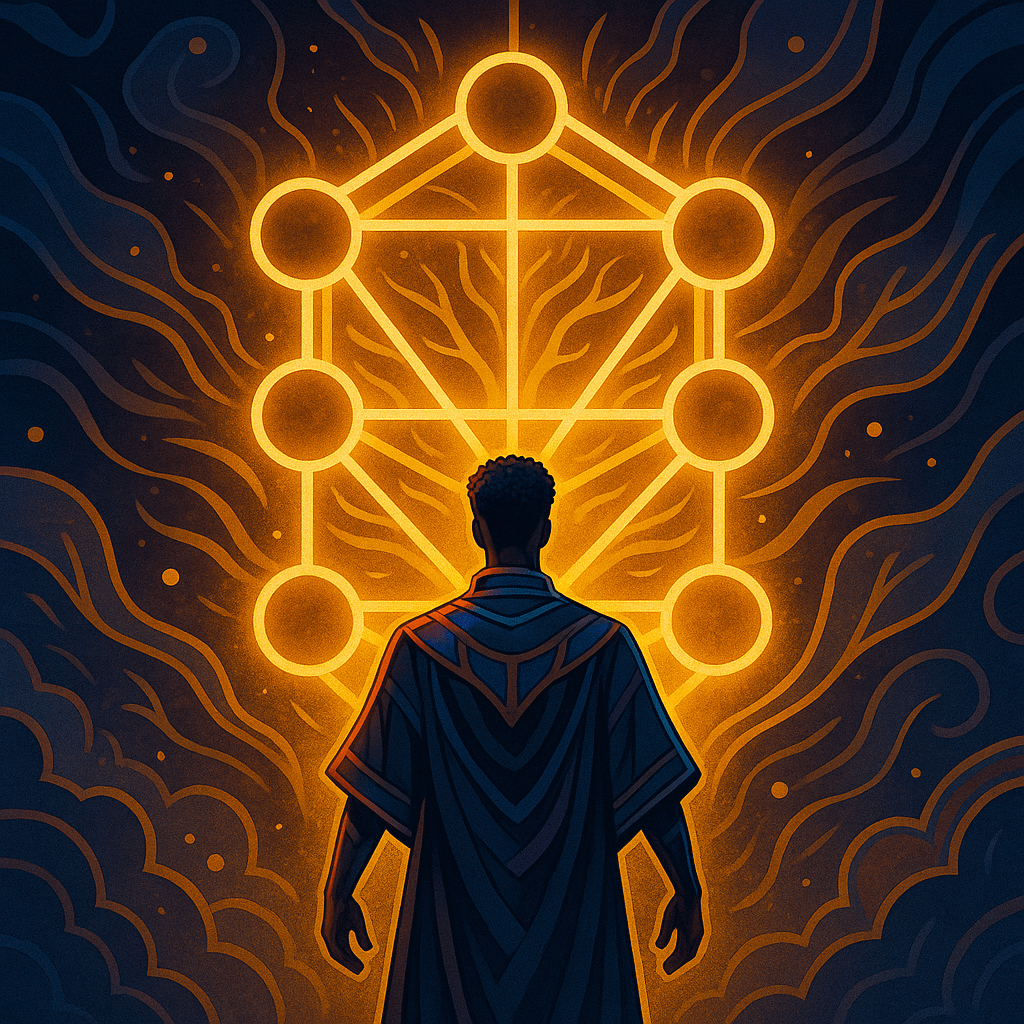
The Torah, therefore, is not just a legal code, it is a technology of ascension. It outlines a path by which the soul returns to its original radiance. Like a ladder placed upon the earth and reaching toward the heavens, this is the Etz Chaim. Every mitzvah is a rung. Every qadosh decision is a step upward. And each time you align your mind, heart, and actions with Universal order, the veil of your lower self is peeled back to reveal the image of Elohim beneath.
Practice this principle by committing to small, consistent acts of obedience to qadosh instruction. Choose one area of life, speech, finances, diet, relationships, and apply Torah truth with intentionality. Journal your thoughts and prayers, noting areas where transformation is beginning. Surround yourself with transfigured voices, those who reflect the Light, and stay away from environments that numb your spirit. Above all, renew your mind daily with the Word, and know this: your highest form is not behind you, it is waiting to be revealed within you.

When these Seven Universals are lived, not just learned, something extraordinary happens. The soul begins to transfigure. The mind is renewed. The body aligns. The family heals. The community reorders. And the people return to their covenantal calling as sons and daughters of Elohim, meant to govern creation in righteousness and wisdom.
Transfiguration isn’t an escape from the world, it’s the empowerment to restore it. It’s the light of Keter flowing into the vessel of Malkhut. It’s Mashiyach unveiled in you.
You, child of Elohim, were not born to be a subject of Babylon or a slave of Egypt. You were born a sovereign, with celestial laws written in your heart, and qodesh fire in your bones. The Torah is not merely your religion, it is your constitution, your inheritance, and your crown.
If you would rise into your kingship, if you would embody that real royalty, then walk in the Seven Universals, live according to the Torah.
Let the Etz Chaim be your inner structure.
The transfiguration of a people begins with one soul becoming luminous.
Let Mashiyach be your guiding light, and then become that light.
Transfiguration Movement #30: Complete.
Selah.
Discover more from SHFTNG PRDGMZ
Subscribe to get the latest posts sent to your email.


1 Comment