
________________________________________________________________
I’ve missed more than 9000 shots in my career. I’ve lost almost 300 games. 26 times I was trusted to take the winning shot, and missed. I’ve failed over and over and over again. That is why I succeed.
Michael Jordan
The child who falls and gets up is not learning to walk, he is learning to stand.”
Akan Proverb
__________________________________________________________________
Truth be told, I’ve failed more times than I can count; failed marriages, businesses, plans, expectations, the list goes on and on. I’ve even failed at spiritual applications and covenantal responsibilities. Some would call it losing.
Falling off.
Coming up short.
Being inconsistent.
But nowadays, I call it necessary.
What you talkin’ bout Willis, you might ask? I call it necessary because every one of those so-called failures cracked open a deeper revelation inside of me. Each failure I’ve experienced in life has been a masterclass in humility, character, and clarity. And though they felt the worse at the time, they weren’t punishments, they were process. And that process right there, is a holy rite on the journey of transfiguration. Now stay with me and let me cook some more, fam.
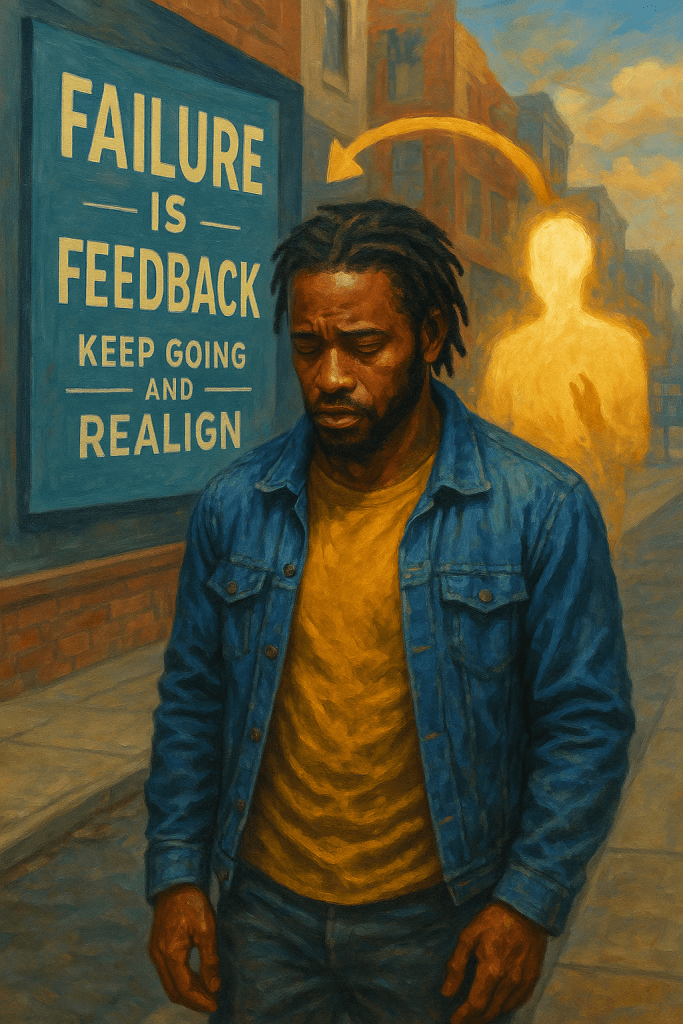
Over the course of time and various experiences, I’ve come to realize that when you’re conditioned to equate success with status, applause, and smooth outcomes, you miss the whole point of what the Most High is doing in your life. See, I used to think failure meant I was a failure, that I wasn’t good enough, that I didn’t hear Elohim right, or I was doing it “my way” like ol’ blue eyes said he did. But now I know better. I’ve learned to acknowledge and accept that failure is just feedback from the Most High, a cosmic checkpoint saying: “You’re still being formed; keep going and realign.”
Fortunately on this journey, failure isn’t final. It’s just a result that didn’t align with our expectations. But here’s the caveat, our expectations aren’t always sanctified. They’re often shaped by ego, culture, or trauma, not always something inspired and birthed by the Ruach haQodesh. So what we call failure might actually be success in the Kingdom.
Selah…let that marinate for a moment.
For a righteous man falls seven times and rises again, but the wicked stumble in time of calamity.
Proverbs 24:16
That verse has been a lifeline for me. It reminds me that falling is not the opposite of righteousness, it’s part of it. Getting up is the key.
I often think about Job, who “failed” by all worldly accounts. I mean, think about it, this man lost his wealth, his health, and his children. But he gained something far greater: revelation. When everything came together, he said,
I had heard of You by the hearing of the ear, but now my eye sees You.
Job 42:5
Now that’s success; that’s the type of transfiguration we’re talking about, when you go from theory to knowing!
Now check this out right quick. When Job uttered the words, but now my eye sees You, he wasn’t just talking about a physical revelation. He was describing the most profound spiritual transfiguration a human can undergo; the shift from intellectual knowledge to direct experience. He went from hearing about Elohim to seeing Elohim, not with his two eyes, but with his single eye; the ayin echad, what the ancients and mystics would call the eye of the spirit, the third eye, the seat of universal insight. And let’s be clear, this isn’t some esoteric mysticism, this is straight up and down Torah truth, buried in plain sight.
Yaw still with me? Good, because it’s about to get real flavorful right about now.
So, we’re well aware at this point in our journey that the Hebrew word for “eye” is עַיִן (ayin), and again, take note that it’s written in the singular. Here, Job wasn’t talking about vision with the flesh, but perception from within, the kind that comes after you’ve been broken, pressed, and proven.
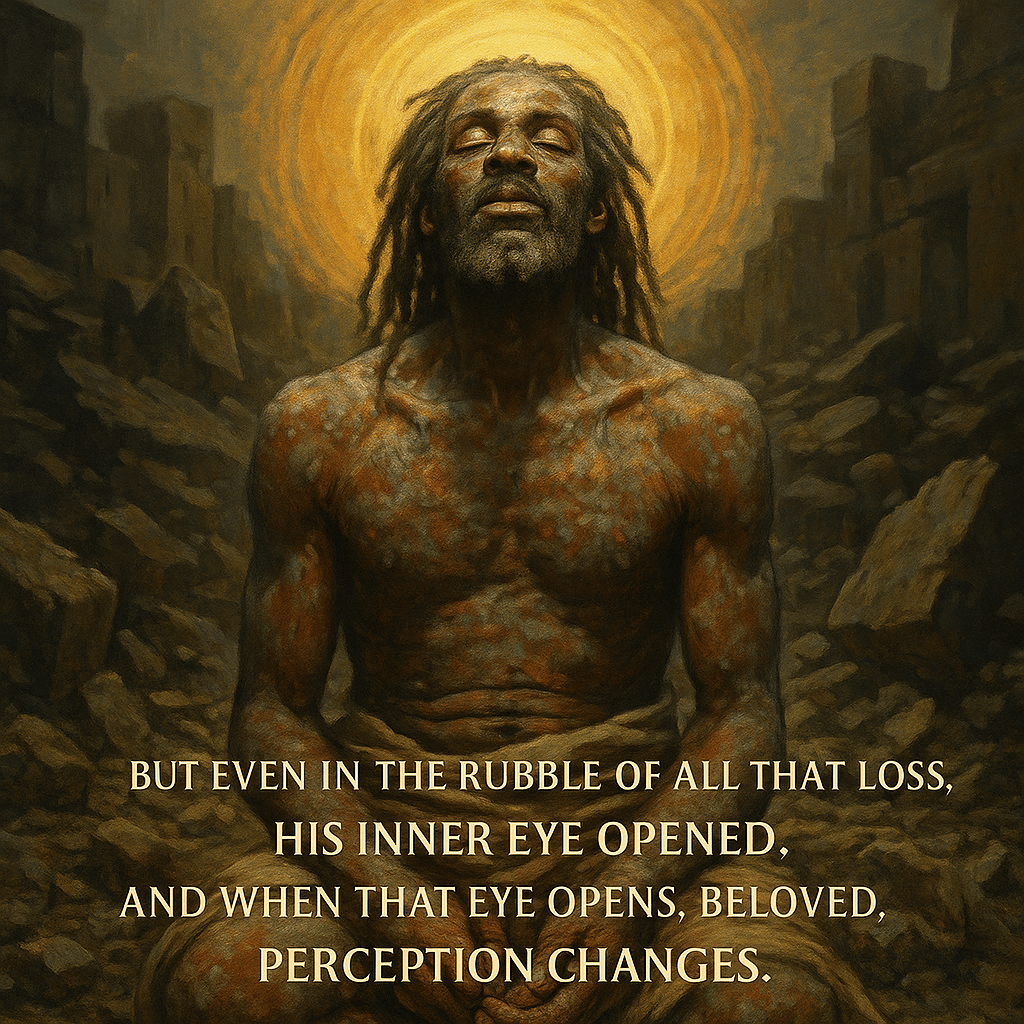
This is exactly what The Success of Failure is all about. This is because what happens in the process of success is that failure, if we learn the lesson it avails, allows for us to peel back the layers of illusion. It strips us of our ego and false security. In the book of Job we read about how he lost everything; I’m talking about family, fortune, friends, name it. He was reduced to ash and afflicted in body. But even in the rubble of all that loss, his inner eye opened. And when that eye opens, beloved, perception changes. And when perception changes, it’s no longer about how things look outwardly, it’s about what’s being revealed inwardly. Now I just referred to this verse I’m about to quote in the last article The Mastery of Servitude, but it applies here as well. Messiah Yeshua said,
The lamp of the body is the eye. If therefore your eye is single, your whole body will be full of light
Mattityahu 6:22
When Yeshua said this, he was emphasizing how the idea becomes clear when perception allows our mind to clarify everything. When we really examine the inner meaning of this statement, it become evident that the principle of the image of Elohim comes into focus relative to both vision and mindset. What this teaches us is that when we are functioning in the Mind of Messiah, which is the embodied Torah, we are able to see all things as they truly are, and not as we want them to be. This is truly what being created in the image of Elohim is all about and why the prophet Isaiah revealed the reality that
‘my thoughts are not your thoughts, neither are your ways my ways,’ declares YaH. ‘As the heavens are higher than the earth, so are my ways higher than your ways and my thoughts than your thoughts.
Isaiah 55.8-9
Naturally, this prophetic statement presents the reality of human mindsets relative to the omniscient One, but when alignment takes place and humans enter the state of yechidah, that’s when we experience Torah, Kingdom, self-mastery and, yes, success. When your inner eye is focused, when your life is purified through the fire of so-called failure, when your mind is able to perceive reality as it’s been called into existence by our Creator and Maker, then you begin to see the Most High from within; no more do you just hear about, or believe, because now, you experience It, just like Job.

So, In my own journey, through broken relationships, failed ventures, injuries and betrayals, I can honestly say that it wasn’t the success that gave me my inner sight, it was the suffering. It was when I felt I had nothing left that I was finally able to really see. The eye that Job speaks of is the eye of mastery, the eye of clarity; it’s the eye that sees purpose in pain and holy presence even in the darkest darkness. And once that eye is open, even failure becomes a friend, because what you see transforms what you do. And that again, family, is what transfiguration is all about.
In the Book of Sirach (Ecclesiasticus), a gem from the Apocrypha, it says:
My child, if you come to serve YaH, prepare yourself for testing. Set your heart right and be steadfast, and do not be impetuous in time of calamity.
Sirach 2:1–2
That’s a whole word right there. What I present with that verse in mind is that what we have to understand and embrace is that the presence of failure doesn’t mean the absence of favor; it’s often a sign that you’re in training, and that your breakthrough is on the way. It just requires you to trust in YaH as you go through the process.
And that’s really it right there, because the Hebrew word for faith, aman (אָמַן), doesn’t just mean belief in some abstract idea or intellectually acknowledging some principle. According to the Dictionary of Torah Names and Words, one of the core connotations of faith/emunah is training. Taking this into account changes everything. This reveals that faith isn’t just a feeling or a belief; it’s a formation, and the consistent discipline of becoming steady, firm, and aligned with purpose. The aman word carries the essence of confidence, loyalty, fidelity, but with the principle of training, we learn that it’s about our being developed while in the dark. The failures, the letdowns, the delays, they’re not evidence of YaH’s disapproval, instead, they’re proof that you’re in Heaven’s training camp. Aman is more akin to the flow of life in unity with purpose. So when you fail, but stay faithful, you’re not falling off, you’re being formed for righteous goals. That’s the success of failure: it activates your aman and initiates your mastery.
It’s also important to bear in mind that success, in the Kingdom, isn’t a trophy. What is, though, is our obedience, alignment and faithfulness to the process. It’s learning how to stand even when the winds of life knock the breath out of you. We see this exemplified in the life of Israel during their wilderness experience. With setback afeter setback, Israel reached a point in their journeys that an entire generation had to get purged out in order for them to fulfill their purpose and experience the goal of their Exodus from Egypt; to enter the Holy Land and become the Kingdom of Priests and Holy Nation that they were called to be. To experience this even included losing the servant-leader Moshe who brought them out of bondage; a major transition that was required for them to accept as their new servant leader was charged with the responsibility of serving the people and midwifing their birth into the Promise. Of this matter, Yahoshua son of Nun was told the following, as it is written,
…this book of the Torah shall not depart from your mouth, but you shall meditate on it day and night…then you will make your way prosperous, and then you will have good success… Joshua 1:8

Forged in the fires of trial and tribulation, drawn from the disappointments and discouragements of an entire generation, Yahoshua ben Nun was well acquainted with what failure looked like as a servant-leader. Despite his exposure to at his predecessor experienced, Yahoshua girded up his loins, tucked his chin and focused his vision on what was before him; entry into the inheritance of the descendants of Abraham and Sarah, Isaac and Rebekah, Jacob and Torah defines success as being rooted, not just rising. It’s about the inner man being aligned with the will of YHWH, not the outer man being applauded by men.
The Mishnah Pirkei Avot teaches:
“Ben Zoma said: Who is wise? He who learns from every person…Who is rich? He who rejoices in his lot… Who is honored? He who honors others.”
Avot 4:1
Success, then, is measured by wisdom, contentment, and honor. All of which can be forged through failure.
For me, when I stopped calling them L’s because they’re not losses, but lessons, I got the full value of the lesson which is often greater than the value of a win. Not to undercut the dub, because a win gives you confidence. A loss, though, that’s what gives you clarity, and clarity will carry you when confidence fades.
In full consideration of the matter, failure:
- Shows you what doesn’t work
- Reveals the state of your heart
- Trains your emotional resilience
- Strengthens your patience
- Forces you to rely on YaH and not your own strength
This is the alchemy of self-mastery: taking raw experience and refining it into wisdom. As I usually do, I like to offer you several steps that I believe are effective in helping us all overcome the feeling of failure. Those steps being,
- Reflect without shame.
Ask: What happened? What did I expect? What did I learn? Don’t rush past the pain because there’s treasure in the rubble. - Extract the wisdom.
Every experience has a teaching embedded in it. What did YHWH expose in you, pride, haste, fear, assumption? - Reframe the story.
Stop calling yourself a failure and start identifying as a learner, a vessel, a servant in training. - Repent and Realign.
If the failure exposed disobedience, repent sincerely and return. This step unlocks favor. - Recommit with new strategy.
Try again, but do so wiser, slower, more aware, and with Spirit-led intention. - Share the testimony.
Your failure is someone else’s blueprint, so don’t hide the scar, rather show how it healed. - Stay the course.
Transfiguration is not instant, it’s a movement. Stay faithful to the climb until you reach your summit.
Transfiguration is all about becoming. It’s the shift from outer image to inner illumination, from identity to integrity, from survival to sovereignty.
And yes, failure is part of that transformation. The Master Himself was “a man of sorrows, acquainted with grief,” (Isaiah 53:3) and yet His death, what looked like the ultimate failure, became the door to the resurrection. Are you able to see it now? The stake was not defeat, it was design.
So don’t despise your stakes, because they are your conversionary catalysts.
To those reading this article who have fallen: k(NO)w you are not finished, but you are being forged. Know that there’s honor in your grit, and mastery in your mistakes.
So Keep learning.
Keep listening.
Keep laboring.
Let failure teach you how to be resilient and how to be faithful.
The transfigured ones are not those who never fall, but those who rise again and again, refined.
“Consider it all joy, my brethren, when you encounter various trials, for the testing of your faith produces perseverance. And let perseverance finish its work so that you may be mature and complete, not lacking anything.”
James 1:2–4
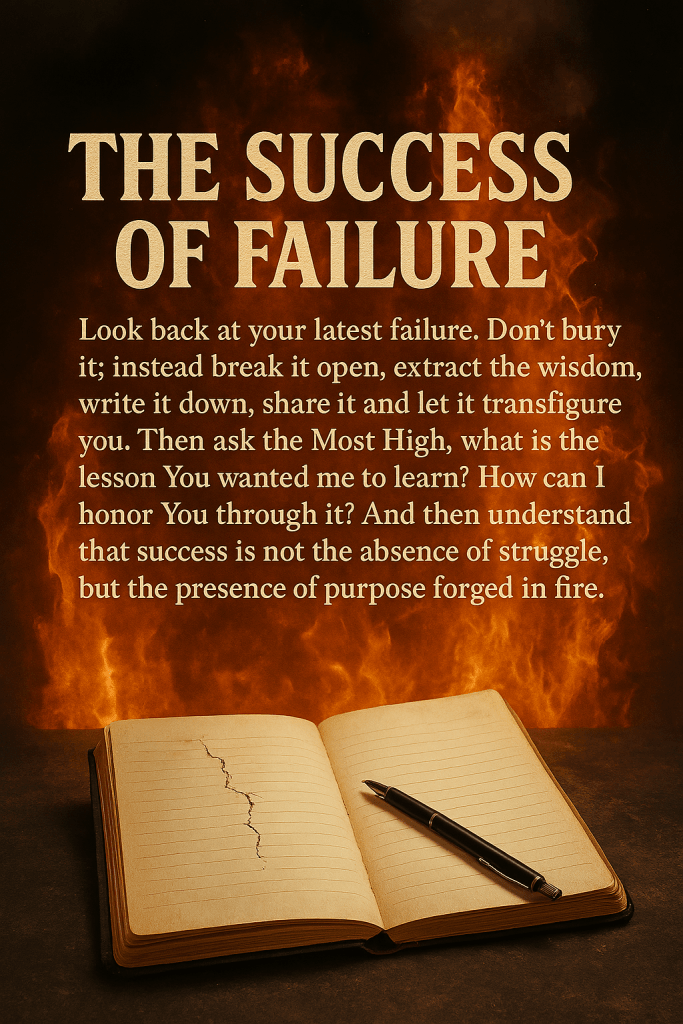
Look back at your latest failure. Don’t bury it, instead break it open, extract the wisdom, write it down, share it and let it transfigure you. Then ask the Most High, what is the lesson You wanted me to learn? How can I honor You through it? And then understand that success is not the absence of struggle, but the presence of purpose forged in fire.
So again, keep rising and keep learning.
Most importantly, transfigure through it all.
Selah…
Discover more from SHFTNG PRDGMZ
Subscribe to get the latest posts sent to your email.


1 Comment