
___________________________________________________________________________________
And you shall be a kingdom of priests – that you shall minister to Me, in that you shall crown Me upon you. And that is why the first letters of these words [spell], kingdom (malkhut). And that is the essence of the receiving of the Torah, that we accept His Kingship upon us, may His name be blessed. And with this, that we accepted it, we became a kingdom of priests. And that is the idea of the two crowns that we had when we said, “We will do and we will listen.” For we had two ornaments when we accepted His Kingship, may His name be blessed. And that is why afterwards, it is stated (Exodus 33:6), “So the Children of Israel stripped themselves of their ornaments from Mount Sinai on.” For they [no longer] had their two ornaments mentioned above. And that is why the essence of everything is the acceptance of His Kingship, may His name be blessed, with a full heart and soul.
Zera Kodesh, On Torah, Yitro
AND now, my children, I command you, love Levi, that ye may abide, and exalt not yourselves against him, lest ye be utterly destroyed. For to me HaShem gave the kingdom, and to him the priesthood, and He set the kingdom beneath the priesthood. To me He gave the things upon the earth; to him the things in the heavens. As the heaven is higher than the earth, so is the priesthood of Earthly higher than the earthly kingdom, unless it falls away through sin from HaShem and is dominated by the earthly kingdom. For the angel of HaShem said unto me: HaShem chose him rather than thee, to draw near to Him, and to eat of His table and to offer Him the first-fruits of the choice things of the sons of Israel; but you shall be king of Jacob.
Testament of Judah 4.1-5
___________________________________________________________________________________
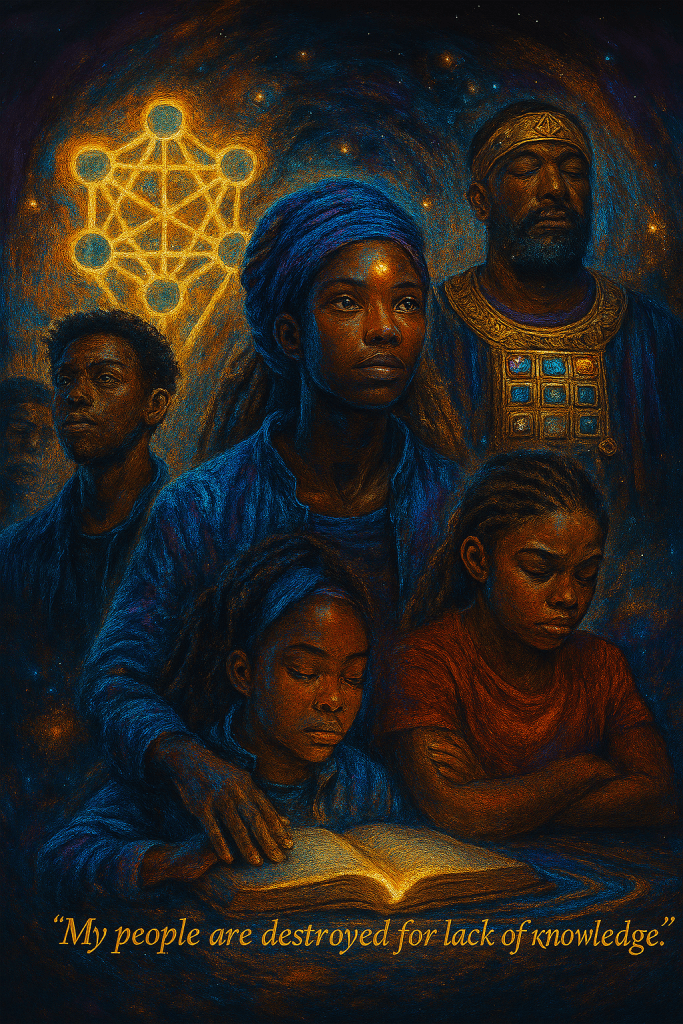
I remember during my high school and college years sitting in classrooms where textbooks taught about slavery like it was just a footnote in history; like it was something that happened to a nameless people for reasons unknown. And at first, I accepted that perspective of history, but as time passed and I began to read more, and the more I read, the more I knew better that to accept that whitewashed version of his story. Even as a child, though not fully connected to the ideas, I felt the weight of something ancient pressing through the silence; something covenantal, something prophetic. In consideration of our condition, Hoshea 4:6 comes to mind,
My people are destroyed for lack of knowledge: because you have rejected knowledge, I will also reject you from being priest to Me…
When we really take this passage into account, it becomes clear that it isn’t just a Bible verse, it’s a diagnosis. It’s Elohim telling us in light of our rebelliousness, we didn’t just lose our land, we lost our alignment; we didn’t just lose our name, we lost our priesthood. And when the priesthood is lost, true elevation is impossible. Because elevation is always tied to obedience, intimacy, to knowing the Most High, not just intellectually, but covenantally; it’s what allows for us to reconnect with our story and no longer left clueless in attempting to solve the mystery (or my story).
We, as so-called African-American, didn’t just fall into oppression. Instead we walked out of alignment; an extremely unpopular opinion. And Deuteronomy 28.15-68 reads like a mirror in reflection of our plight: ships, yokes, broken families, lost identities, enslavement and punishment. While some commentaries are unable to place the prophetic words in Deuteronomy 28, the prophecy finds its fulfillment in our historical, diasporic experience, and no other people on earth, throughout time, wear those curses like we do; not historically, spiritually or prophetically. And what’s so unfortunate about all of it this is that today we’ve normalized our disobedience, we’ve glamorized our rebellion, we’ve rejected the knowledge that once made us priests, and so now we walk heavy, crowned in trauma, stripped of our dignity and honor wondering why our condition is so bleak.
But yet and till, our antidote is in our poison. The same covenant we broke is the same covenant we must return to. And like I’ve stated repeatedly throughout these chronicles, repentance is our remedy, alignment is our elevation, and unity—I’m talking about real unity, not just cultural but spiritual unity, is how we ultimately overcome.
What I’ve come to find out and know about us as a people is simple but profound, we are Israel; not just by blood, not just by spirit, but by burden. And each of us carries the responsibility to return, to realign, to re-crown the Most High upon us. Because when we walk in the Most High’s will, we rise. When we minister to El Elyon, we manifest the Most High, and when we know El Elyon, we become the throne the Most High sits on. And when we are the throne that the Most High sits on, there is nothing in the world that is able to prevent the Kingdom of Heaven from manifesting on Earth through our agency.
And as mere humans, we find ourselves at a very unique intersection of heaven and earth. As was discussed in the last article From B’nai Adam to B’nai Elohim, being created with both elements of eternity and the temporal world within us, our challenge is to discover the hidden aspects of our nature and to enter into the higher calling of being children of Elohim as John 1 tells us that as many as receive Yahoshua as Messiah are empowered to become children of Elohim. Yet the question remains,
What is man, that You are mindful of him, and the son of man, that You care for him?
This profound question and response from Psalm 8, which King David posed, blessed be his memory, is one that still remains a lingering point of clarity to explain for us today. Even more, given that there is a Creator, why does Elohim even care about humanity? And considering the course of history on which we’ve embarked, it actually makes sense for some of us to struggle with the thought of why in the world would the Creator of galaxies and eternal realms, again given Its existence, take notice of our fragile flesh and fleeting breath? Thoughts for the thoughtful, right?
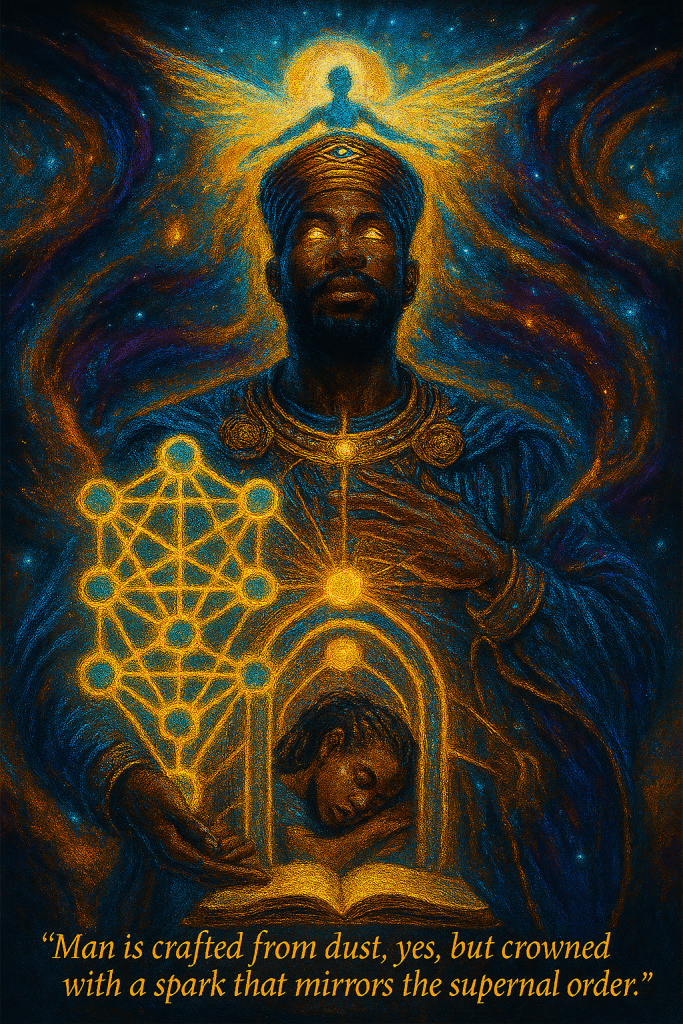
Even more profound than this, though, is the beauty of the matter that this Psalm doesn’t just leave us hanging in suspense, unsure of the answer to the question. In fact, King David goes on to say that humanity was made “a little lower than Elohim.” The oral tradition plays with that phrase. Some rabbis say “a little lower” doesn’t mean less than, but rather positioned close, almost touching. Man is crafted from dust, yes, but crowned with a spark that mirrors the supernal order. And as a reflection of the image and likeness of Elohim, we stand as a bridge between earth and heaven; a hybrid-like being, able to move in both dimensions of earth and heaven.
And this capacity is the clue to Israel’s call. If humanity in general was made close to the angels, Israel specifically was chosen to function as the angels, as messengers, or malakim in Hebrew, embodying the will of heaven in the dirt and dust of this world. That’s not me stretching the point because Malachi 2:7 says plainly: “The lips of the priest guard knowledge, and men seek Torah from his mouth; for he is the malak (angel) of HaShem (the Name) Tzevaot.”
So if this is the case, then here’s the question: if priests are angels, and Israel was called to be a kingdom of priests (Exodus 19:6), then what does that say about us as Israel? What does that say about who we’re supposed to be, and what we’re supposed to be doing right now?
As mentioned in the introduction from Zera Kodesh, the sages remind us that when Israel stood at Sinai and proclaimed with one heart, “we will do and we will listen,” they were adorned with two crowns. These ornaments were not of metal or stone but of spirit, signifying the union of action and understanding, obedience and insight. In that moment, Israel became the vessel of Kingship, the very manifestation of malkhut, for to accept the Torah was to accept His rule upon ourselves. This is the essence of priesthood, to crown Him upon us in every generation, to minister not only with offerings of lips but with the posture of life itself. And though the ornaments were later set aside after the sin, the teaching reveals that the essence remains: that the heart of covenant is the willing acceptance of His sovereignty with fullness of heart and soul. To walk as a kingdom of priests is to reclaim those crowns, not outwardly but inwardly, until our lives bear the radiance of Sinai once more, reflecting the eternal Kingship of the Holy One through the covenant we embody.
Here is where prophetic fulfillment is brought clearly into the picture. And what is prophetic fulfillment? Simply the keeping of the Word of El Elyon; in a word, faithfulness. This is because our faithfulness causes the sovereign will of the Most High to become a reality in space-time. This is done when we serve the Most High El in Spirit and Truth, which transcends space-time as this is a topic that I’ll deal with in more depth in a future chronicle.
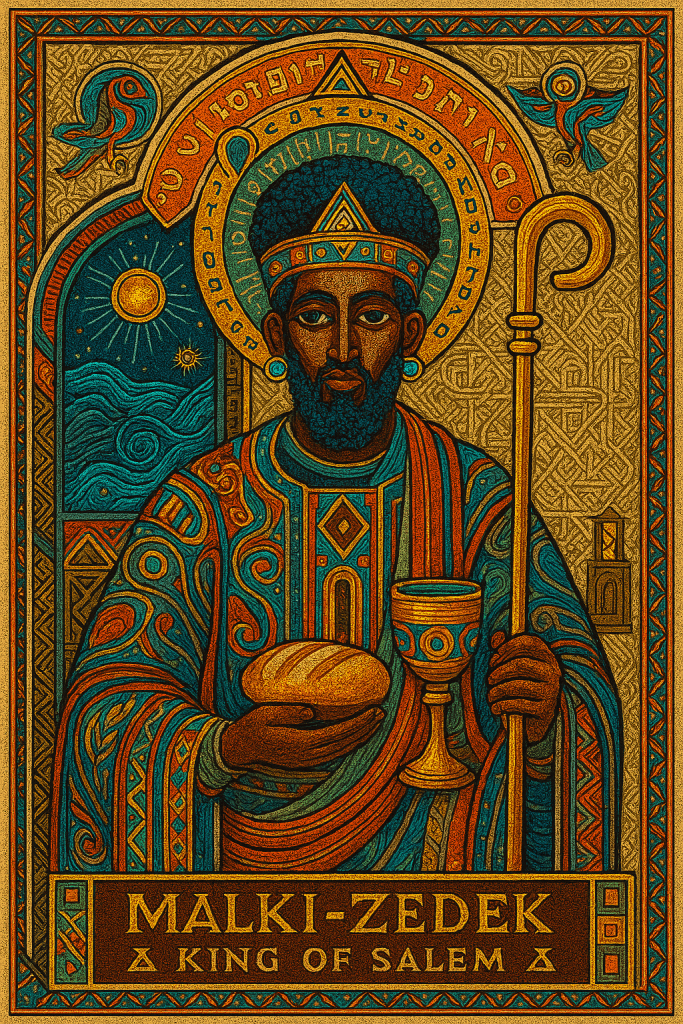
To even approach the answer, we gotta step back into the priestly storyline. Before Levi ever shouldered the task, there was Melchizedek — king of Shalem, priest of El Elyon. Genesis 14 paints him stepping into the scene with bread and wine, blessing Abram before Abram became Abraham. Melchizedek is priesthood in its purest archetypal form: not bound by bloodlines, not locked in ritual, but flowing from eternal order. His very name, Malki-Tzedek, literally means king of righteousness; he was also the king of Shalem, which means the king of peace.
Break it down letter by letter, spelled mem, lamed, kaf, yod, tzadi, dalet, yod, the name reads like a manual for cosmic leadership:
- Mem – hidden waters of wisdom.
- Lamed – instruction, the shepherd’s staff.
- Kaf – vessel, capacity to hold and give.
- Yod – divine spark.
- Tzadi – righteousness, alignment.
- Dalet – doorway, opening.
- Qof – holiness, transcendence.
Put together, Melchizedek is the righteous king who holds the spark, guides with wisdom, opens the doorway, and stands as a vessel of holiness.
Now contrast that with Levi. Levi represents priesthood as covenantal duty, structured into the life of the nation. The Levites were assigned to teach Israel, to guard the sanctuary, and to keep the people in tune with Elohim’s rhythm. His name says it all, spelled in Hebrew, lamed, vav and yod, we find the following:
- Lamed – instruction.
- Vav – connector, joining realms.
- Yod – spark of divine life.
Levi is the one who connects, the one who joins Israel to heaven through Torah.
So here’s the beauty: Melchizedek shows us priesthood as eternal archetype. Levi shows us priesthood as national covenant. And Yeshua? He steps into history as the living synthesis of both.
If priests are angels and Israel is called to be a kingdom of priests, then the nation itself is meant to function as one living malak. Not just individual priests in a temple — but the whole people as a single messenger. That’s why Ezra 3:1 and Nehemiah 8:1 talk about Israel gathering as ish echad, one man. In unity, the nation becomes a priest — a mediator for the whole world.
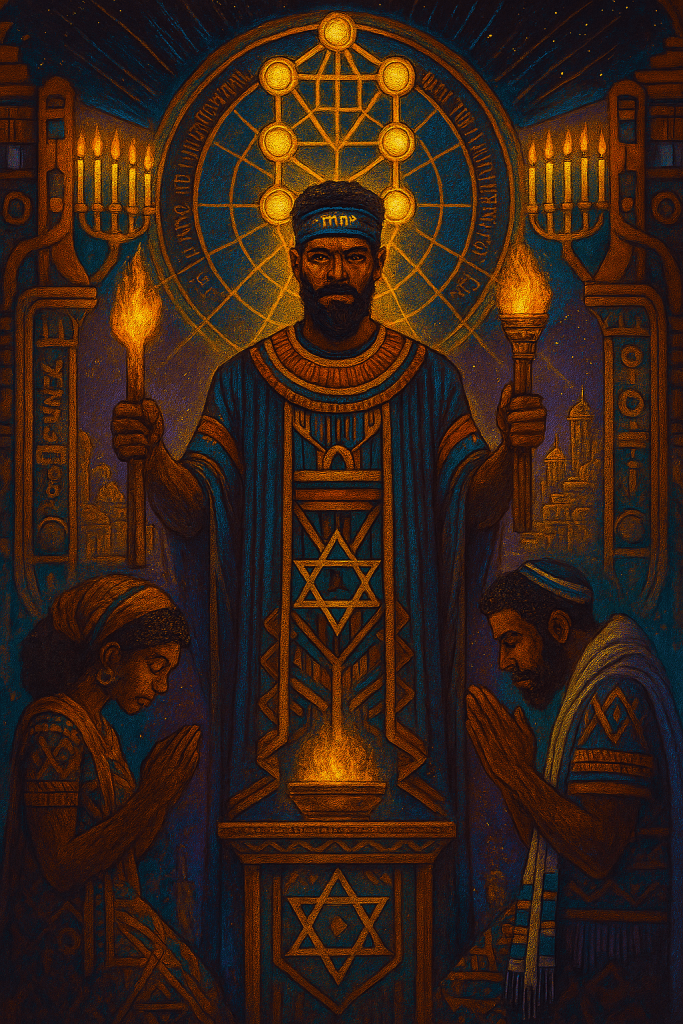
Yeshua understood this when He said, “You are the light of the world. A city set on a hill cannot be hidden.” (Matthew 5:14) He wasn’t flattering — He was calling Israel back to priesthood. Light isn’t optional for Israel. It’s our identity. We’re the menorah of the nations, designed to burn with Torah fire and spread divine consciousness.
So what do priests actually do? Leviticus 10:10–11 spells it out: distinguish between holy and unholy, clean and unclean, and teach Torah. That means priests are the ones drawing lines where the world tries to blur them. They don’t just chant in temples; they train society in discernment. They cultivate attunement.
The priest is basically a cultural alchemist. They take raw human potential and refine it — spiritually, mentally, physically. They transform base instincts into sublime consciousness. That’s what it means to turn brass into gold: to take the ordinary and elevate it into a vessel of light.
The Zohar even pushes it further. It says that when a soul rises in Torah and mitzvot, it becomes reborn as a yeled Elohim, a child of God. That’s the destiny hidden in priesthood — not just managing sacrifice but transforming souls into divine children, humanity elevated into godliness.
And this only works if Israel moves as one. The priesthood isn’t an individual hustle — it’s collective. When Israel stands together, we become ish echad, one body, one priest. Every home, every family, every soul plays their part. Fathers, mothers, children — all are sanctuaries in miniature.
If Levi is the angel of YHWH, then all Israel is angelic. If Yeshua is high priest, then His body must bear His office. If we’re light, then we’ve got to shine in a world addicted to shadow.
Here’s the punch: before Levi’s consecration, every firstborn in Israel was meant to serve as priest. That calling hasn’t disappeared; it’s just been deferred. It’s waiting to be reawakened in this generation.
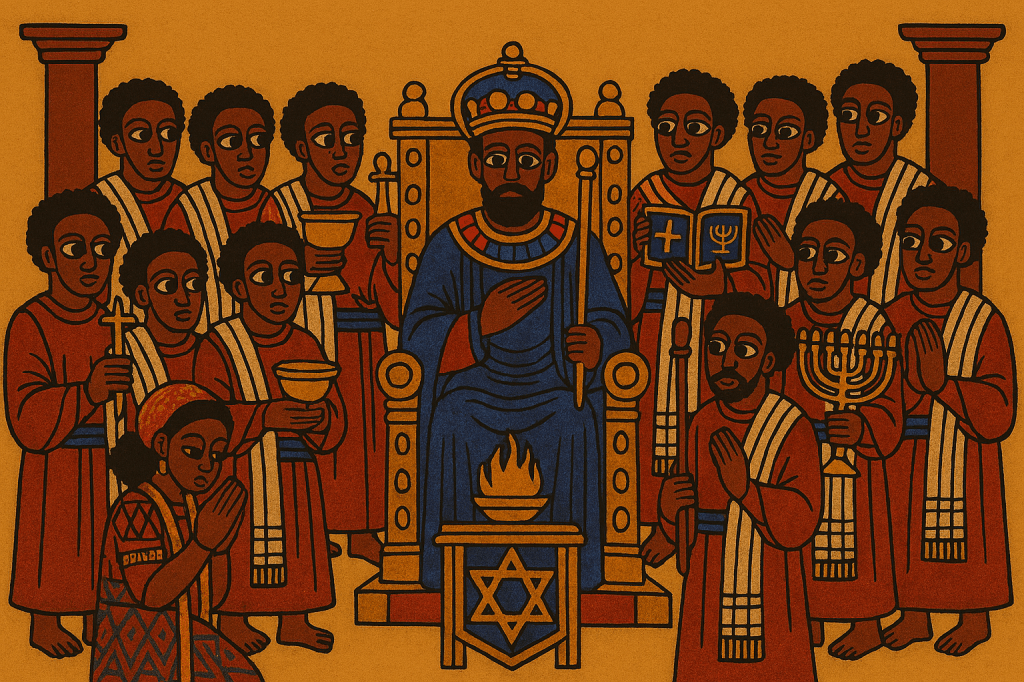
Referring again back to the introduction, the words of Judah in his last will and testament to his sons strikes us with a sobering clarity; the kingdom was given to Judah, but the priesthood was entrusted to Levi. And here Judah himself admits that the throne of earth stands beneath the altar of heaven. This is a principle we cannot ignore: earthly authority, power, politics, even kingship itself, are secondary to the spiritual charge of the priesthood. For it is our priesthood that carries with it the responsibility of drawing near, of standing at the Divine table, of handling the first fruits that belong to Elohim alone. The priestly office is not ornamental but foundational; it is the channel by which heaven flows into earth, by which nations are aligned to righteousness, by which the sacred is discerned from the profane.
So what does that mean for us right now? It means that as Israel, called a kingdom of priests, we cannot put our hope in worldly power structures, crowns, or thrones. Those may be given, and they may be taken away. But the priesthood, the higher office, belongs to us eternally if we remain faithful. Our task now is to live as priests in every dimension of our lives. To love Levi, as Judah commanded, is to honor the sacred work of Torah, instruction, holiness, and discernment above the lure of domination or material supremacy. It means we place prayer above politics, wisdom above wealth, service above self-exaltation. It means training our households to function as sanctuaries, with fathers and mothers serving as priests to their children, distinguishing between clean and unclean in their diet, their speech, their choices. It means reclaiming the discipline of offering first fruits, not just grain, wine and oil, but the first fruits of our time, our energy, our attention, our creativity, all laid upon the altar of Elohim.
This is how the priesthood becomes real in us: by aligning every aspect of life under the sovereignty of heaven, recognizing that as the heavens are higher than the earth, so too is the priestly call higher than any earthly ambition. And if Judah himself bowed to this reality, then surely we, his descendants and grafted companions, must take heed. For to walk in the preeminence of the priesthood is to ensure that the Kingdom of Elohim is manifest in us, through us, and unto the nations.
So how do we step back into it? By purification. By separating ourselves from what’s unclean and profane. By rooting ourselves in Torah rhythms, prayer, study, fasting, meditation, and justice. By making our homes sacred again, by teaching our children, by blessing our communities. This is not optional; it’s covenantal.
The kingdom cannot outrank the priesthood, because the kingdom draws its very legitimacy from the priesthood. Without the priesthood, kingship becomes tyranny; without priests, thrones lose their alignment to heaven. That’s why every Israelite must rise to their priestly office. It’s not just the Levite who must distinguish between the holy and the profane — it’s every one of us, because the covenant at Sinai clothed the entire nation with priesthood. We were crowned there, and though we stripped those ornaments off in sin, the call never left us.
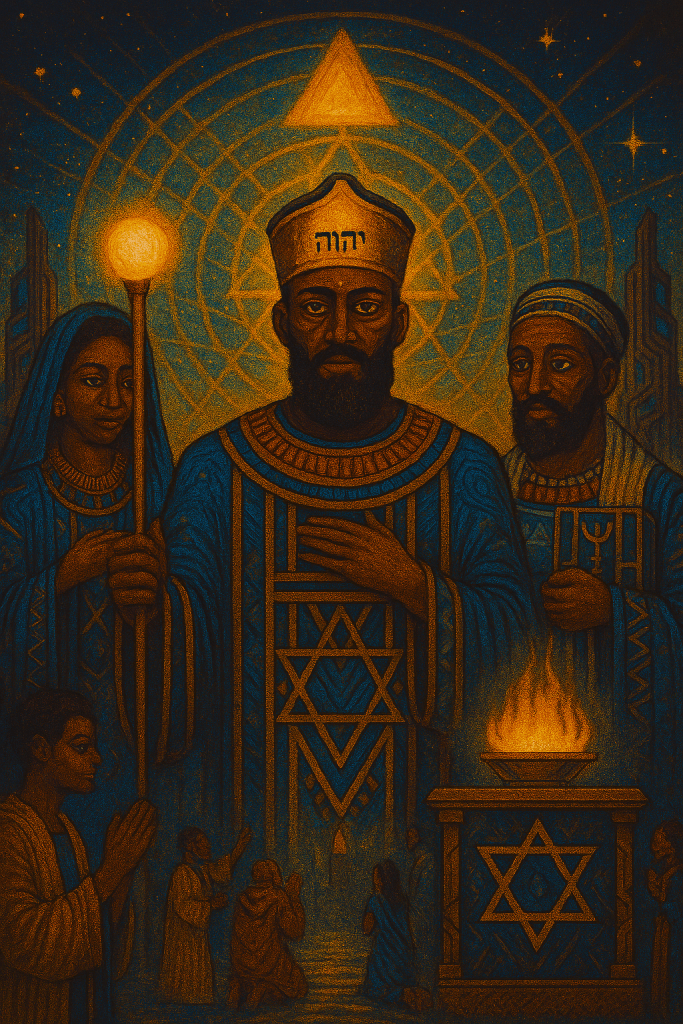
And what is that call? To be messianic priests, anointed to stand between heaven and earth. To bear the image and likeness of Elohim not as a theological idea but as a living reality. To function as Elohim on earth — not in arrogance, but in service, justice, and holiness. For when the world sees an Israelite in their true priestly role, they see a mirror of the Divine Presence itself.
Because we are the priestly kingdom. We are the malakim of Elohim. And when we finally embrace that truth, the world will see in us not just a people, but the very reflection of Elohim’s light. And when Israel fully stands in that priesthood, kingdoms will bow — not to us, but to the Presence shining through us. This is the preeminence of the priesthood: the alignment of heaven and earth, until all creation knows that Elohim dwells in His people.
This is the path of transfiguration. Not once-and-done, but day by day. Even when the weight is heavy, we keep pressing. Even when we fall, we rise.
So as I bring this article to a close, I want to go back to how this chronicle opened with the first sentence in the first quote:
“And you shall be a kingdom of priests—that you shall minister to Me, in that you shall crown Me upon you.”
Now as we close let us consider that this statement is not just a reflection, but a revelation. In being a revelation, this statement isn’t just about titles or position; it’s about function and order; it’s about knowing who we are before we do anything else. And with that dynamic taken in to account, let us know and comprehend that before we are able to manifest the Kingdom, we must first reestablish the Priesthood, because, as we’ve read, the Kingdom is the fruit of the Tree, but the Priesthood is the root.
Exdous 19:6 laid the blueprint:
“You shall be to Me a kingdom of priests and a holy nation.”
That wasn’t a suggestion. That was the original covenantal design. And we’ve been out here trying to build the Kingdom, through influence, visibility, dominion, without restoring the priestly foundation that makes the Kingdom sustainable, sacred, and real.
Urban intellect meets eternal Torah: To “minister to Me” means we become the altar. The throne. The place where the Divine Presence rests. That’s what it means to “crown Me upon you.” It’s not about putting Him above us, it’s about enthroning Him within us. That, my beloved readers, is what priesthood is all about; true power and prophetic alignment.
Isaiah 61:6 confirms the call:
“You shall be named the priests of YHWH; men shall call you the ministers of our Elohim.”
And the sages echo it in the Zohar:
“When Israel fulfills the priestly role, the Shekhinah dwells among them, and the world is sustained.”
So here’s the shift: We’re not just reborn to rule, we’re reborn to minister. To carry the fire. To walk in the order of Melchizedek. To become the living sanctuary.
The Kingdom will manifest when the Priesthood is restored. Because when we crown Him upon us, we don’t just represent Him, we reveal Him.
This is the movement. This is the mantle. This is the moment.
Let’s return to the altar. Let’s restore the order. Let’s crown Him…upon us.
To do this, keep studying.
Keep praying.
Keep fasting.
Keep serving.
Keep stretching.
Keep building resistance.
Keep meditating.
Keep loving.
Keep living.
Keep transfiguring!
Selah.
Discover more from SHFTNG PRDGMZ
Subscribe to get the latest posts sent to your email.

