
_________________________________________________________________________________________
We have a tradition that a spiritual rebellion will take place in the land of Israel and among [the people of] Israel in the period of the beginning of the renaissance of the nation. The physical tranquility that will come to a part of the nation, who will imagine that they have already attained their entire goal, will diminish [their] soul. And days will come “of which you will say, ‘There is nothing desirable in them’” (Ecclesiastes 12:1). The yearning for elevated and holy ideals will entirely cease, and therefore the spirit [of the people] will descend and sink, but then a storm will come and bring about a revolution. Then it will be clearly apparent that the strength of Israel lies in eternal holiness, in the light of God, in the Torah, in the desire for spiritual illumination, which is the absolute might that conquers all of the worlds and all of their powers. The necessity for this rebellion is the tendency toward the aspect of materialism that must of necessity come into being in the nation as a whole in a powerful form, after periods of many years have passed in which the nation as a whole was completely devoid of the need and ability [to engage in] the material endeavor. And when this tendency is brought into existence, it will trample with wrath and create whirlwinds. These are the birth pangs of the Messiah, whose pains will refine the entire world.
Shemoneh Kevatzim 2.247
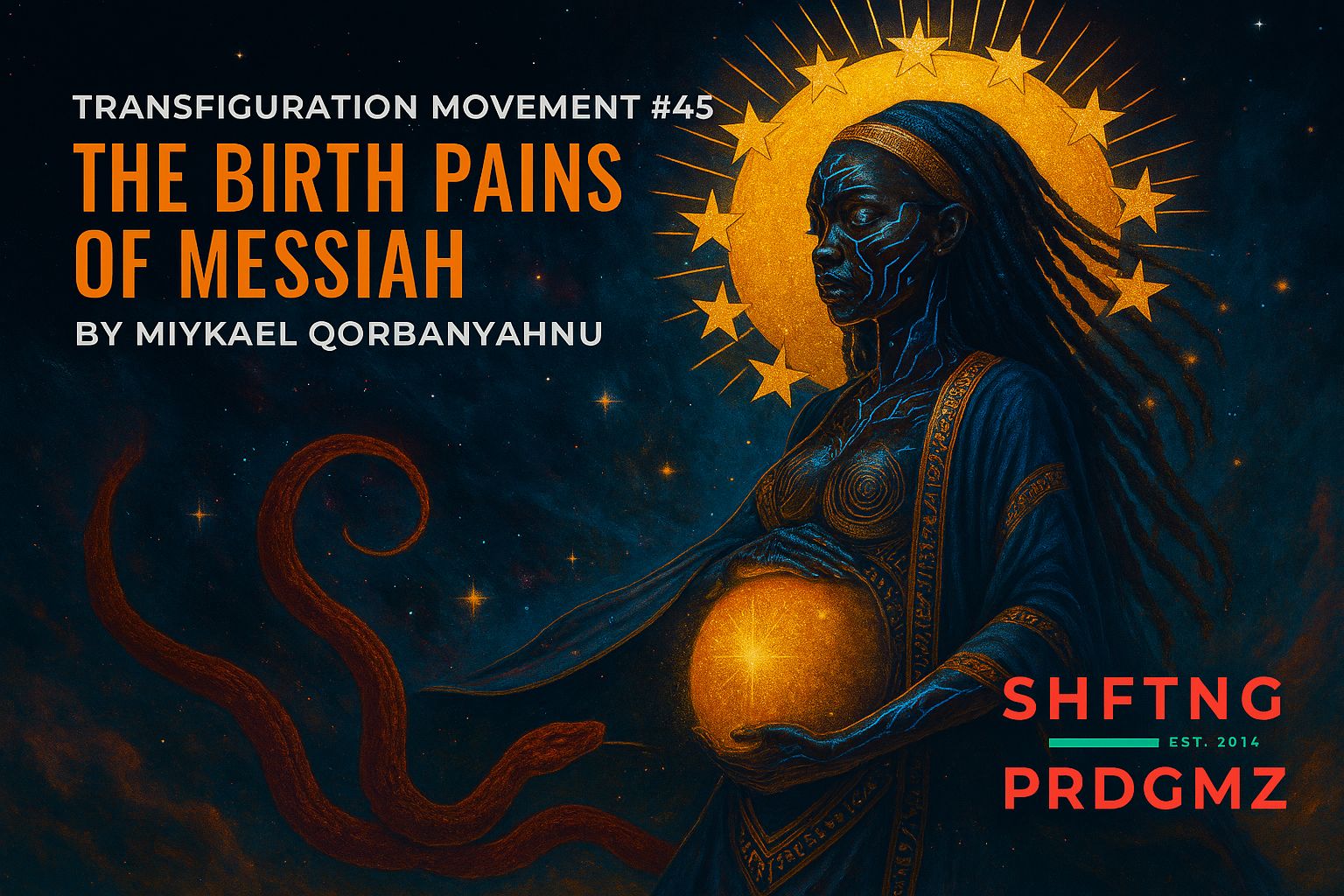
And a great sign was seen in the heaven: a woman clad with the sun, with the moon under her feet, and on her head a crown of twelve stars. And being pregnant, she cried out in labour and in pain to give birth. And another sign was seen in the heaven: and see, a great, fiery red dragon having seven heads and ten horns, and seven crowns on his heads. And his tail draws a third of the stars of the heaven and throws them to the earth. And the dragon stood before the woman who was about to give birth, to devour her child as soon as it was born. And she bore a male child who was to shepherd all nations with a rod of iron. And her child was caught away to Elohim and to His throne.
Revelation 12.1-5
_________________________________________________________________________________________
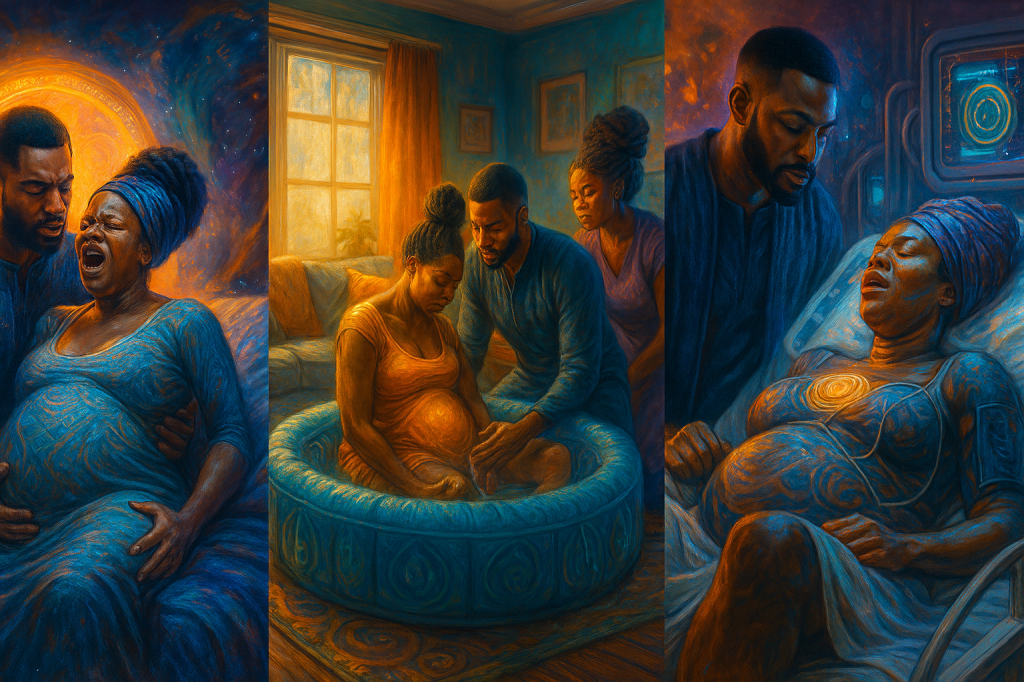
I’ve been in three delivery rooms, well two actually, with one of my children born in the living of our house at the time. But nonetheless, those were three sacred sanctuaries where time and eternity met in the cry of each new life. Truly a blessing, each of my sons came through a different gateway, each birth carrying a unique rhythm, an individual struggle, and a personal purpose, all for a collective revelation. Even now, I can still feel the electric stillness that filled the air before a child’s first breath. The heartbeat monitors, the whispered prayers, the deep groans of creation vibrating through a woman’s body—these are not just medical moments; they’re prophetic parables.
The first and third births were natural, vaginal deliveries. Those two, and especially the home birth which the mother had no epidural and went all natural, was raw, primal and powerful. I will say, though, that the mothers of my sons bore down with a strength that seemed ancient, like the echo of Chawwah herself pushing through the curse to find redemption. The contractions came like waves, each one both in agony and anticipation. I remember holding hands slick with each of them, palms sweaty, whispering affirmations between gasps, breathing in sync with them, watching the rhythm of pain and purpose merge into one sacred motion. Then came that moment, the crowning, the final push, and suddenly, the world shifted. Breath entered flesh, heaven exhaled into earth and another image and likeness of Elohim was incarnated, purely innocent and righteous.
My secondborn’s birth came differently. It was a C-section; sterile, surgical, yet still heavenly. The blade cut open his mother’s flesh so that destiny could emerge. When I saw it, I was honestly overwhelmed but I also remember thinking about how sometimes deliverance doesn’t always come the way that we expect. Sometimes the Kingdom breaks in not through the canal of what’s natural, but through the incision of what’s necessary. Either way, blood is spilled, a womb is opened, and new life appears; HALLELUYAH!
In their experiences, each of these births taught me something about prophecy, process and how the Most High works in patterns. Birth is never painless; it’s messy, rhythmic, full of trembling , doubt, fear and tears, but on the other side of the travail stands joy. As Yeshua said,
A woman, when she is in travail, has sorrow…but as soon as she is delivered of the child, she remembers no more the anguish, for joy that a manchild is born into the world
John 16:21
And now that I think about it, isn’t that what the prophets were always declaring? That joy comes through labor and the Kingdom doesn’t always arrive clean and quiet, but that it forms through repentance, breaks through contractions, groans through nations and screams through revolutions.
When I think about my cubs births, my mind drifts to Isaiah 11:
For unto us a Child is born, unto us a Son is given; and the government shall be upon His shoulders.
Some time ago, I used to think of that passage as one miraculous moment in history, a single nativity scene in Bethlehem. But the more I have lived and studied Torah, the more I have seen that this Child keeps being born over and over and over again; in fact, I’ve come to find that each and every generation bears the Child again. Every movement of righteousness midwives the Child anew. The government upon His shoulders isn’t just merely politics, it’s more about Torah order, YaH’s sovereignty righteously carried out through the bodies of those servants willing to labor for it.
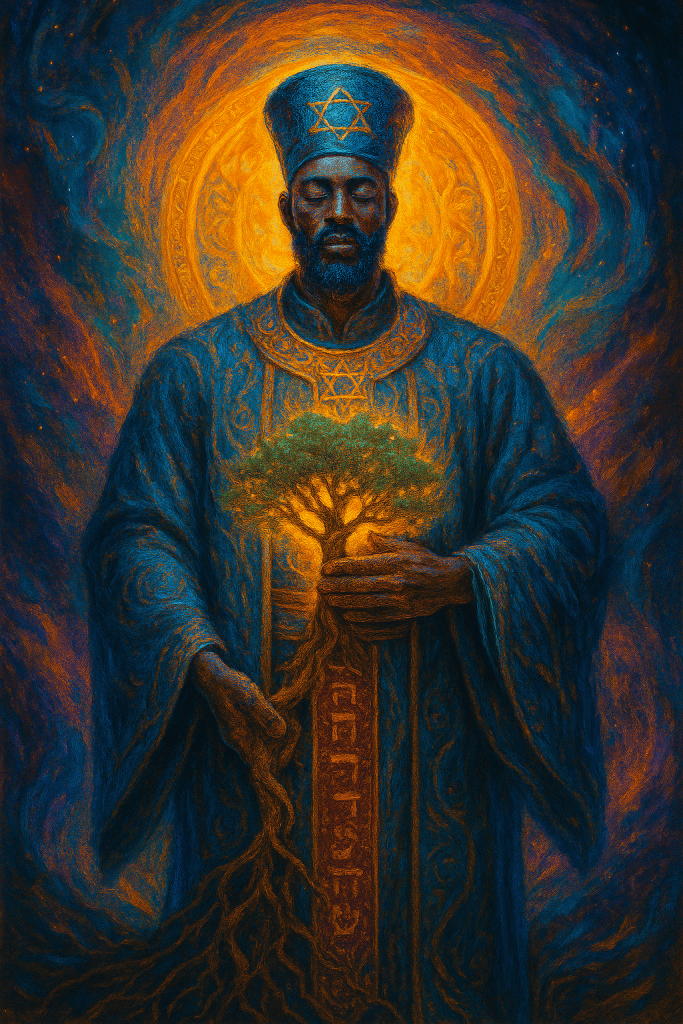
It’s in this light that the oral tradition tells us Isaiah’s vision wasn’t just about a baby, it was about a principle. The Tzemach, the Branch, sprouting from the root of Yishai, or Jesse, which symbolizes the continual emergence of YaH’s rulership through human vessels. And being that Israel was called to be an entire Kingdom of Priests, according to Exodus 19.5-6, we find that the priest, prior to entering into office, was anointed and ordained to execute their duties. Therefore, each righteous soul that arises to confront chaos participates in that same birthing, if operating under the unction of the Spirit of Torah, is a Messiah. This is because, in that sense, the Messiah is both an office and a process; an anointing that keeps being revealed through those who yield to the labor of heaven.
Returning to Isaiah’s prophecy, it shows us that it reaches deeper than the image of a single infant. The oral tradition reads “And a shoot (tzemach) shall come forth from the stump of Jesse” (Isaiah 11:1) as an archetype, a living principle of renewal that re-emerges in every generation. The Midrash Rabbah (Bereshit 85:9) says,
From every righteous man a branch grows that will yet redeem the world
The Targum Jonathan paraphrases Isaiah 11:1 as,
A king shall arise from the sons of Jesse, and the Messiah shall be revealed from his children
This is not only a genealogical claim but a pattern: each time righteousness rises to confront chaos, a new tzemach breaks the surface.
The Torah intially framed Israel as the vessel through which this principle must flow. As I earlier stated, at Sinai the Holy One declares,
You shall be to Me a kingdom of priests and a holy nation
Exodus 19:5-6
Priesthood (kehuna) is not an honorific calling, but one whose purpose is to mediate between heaven and earth. Leviticus 8 describes how Aaron was anointed, mashach, before he could serve. That same verb gives us Mashiach, the Anointed One. In rabbinic understanding, every priest and prophet who acts under prophetic anointing shares, in miniature, the quality of mashiach. The Babylonian Talmud (Sanhedrin 98b) even says,
If Israel are worthy, the Messiah will come with the clouds of heaven; if they are not, he will come lowly and riding upon a donkey
Worthiness here means readiness to manifest the anointing already latent within the people.
The inner teachings expand this idea through the image of the Body of the King. In Zohar III 153b we read:
All the righteous are the limbs of the King; the Shekhinah receives their light and they are crowned together in one body
In this prophetic revelation of mystical anatomy, every enlightened soul becomes a nerve in the Messianic body, transmitting supernal vitality into the world. When such a person acts from the ruach d’oraita, the spirit of Torah, they participate in what the sages called it’aruta d’letata, the arousal from below that awakens heaven’s own movement above. That cooperative labor is what births redemption.
Rabbi Moshe Cordovero in Pardes Rimonim (Gate 23) writes,
The anointing flows through the channels of compassion; when Israel acts with lovingkindness, the oil of the upper world descends.

The metaphor of oil connects the priestly consecration to the continual outpouring of Spirit. Each righteous act refills the lamp of the world. Thus, for Israel, individually and collectively, Messiah is not only a historical individual but an ongoing infusion of divine oil into human clay; a process always seeking embodiment.
In other words, given the labor of faith that we as a united Kingdom of Priest endeavor to unify, we are able to generate the righteous merit of favor in order to warrant the Messianic Kingdom based on our ability to manifest Messianic Consciousness individually and collectively. Of this concept, the Rabbinic, or Pharasaic Judaism, has this to say,
[In the Babylonian Talmud’s last chapter of Tractate SanHedrin called Pesek Helek,] the perek’s messianic discussion is mostly composed of tannaitic and early amoraic material loosely bound together by overarching editing. Somewhere midway through this compilation, Rav makes the case that not only can we improve the world through our good actions, but also that our moral improvement is the key to the messiah’s arrival. He states, “All of the appointed times have passed, and the matter [the eschaton] only depends on repentance and good deeds.” While according to some rabbinic opinions the messiah will come at an appointed time, Rav argues that those appointed times are irrelevant―not only do teshuvah and good deeds impact the messiah’s arrival; they are the only factors that will impact his arrival. The Gemara goes on to connect Rav’s opinion to the tannaitic statement of Rabbi Eliezer, who simply states: “If the [Israelite] people repent they are redeemed, and if not they are not redeemed.” According to Rav and Rabbi Eliezer, our cumulative good actions and repentance are the catalyst that will bring the messiah. Not only are my good actions valuable in the immediate good they provide, but they also have the power to create the radical change of world redemption.
Can We Transform The World? An Analysis of the Talmudic Messiah by Atarah Cohen
Paul the emissary echoed this same current when in his epistle to the Assembly at Ephesus, chapter 4, verses 11-13, he wrote the following,
And He Himself gave some as emissaries, and some as prophets, and some as evangelists, and some as shepherds and teachers for the perfecting of the set-apart ones, to the work of service to a building up of the body of the Messiah, until we all come to the unity of the belief and of the knowledge of the Son of Elohim, to a perfect man, to the measure of the stature of the completeness of Messiah,
This, too, is the language of priesthood and anointing. Rav Shaul describes a living system of consecrated offices through which the oil of Messiah flows. To be “in Mashiach” is to take one’s place in that sacred order, each emissary, prophet, shepherd, and teacher functioning like vessels in the Temple that together sustain the fire upon the altar. The anointing, again, from this perspective, is therefore not solitary but communal; it circulates through the members of the body so that the whole may grow into maturity. As John the Beloved affirmed,
You have an anointing from the Holy One, and you all know
1 John 2:20
The prophetic, messianic, rabbinic, and mystical voices all agree: the Spirit of Torah distributes itself through the collective, reproducing holiness until the Body attains the full stature of Messiah.
Therefore, when a soul rises to confront injustice, to heal division, or to speak the living word of Torah into a darkened age, that soul steps into the priestly current and takes part in the chevlai ha-Mashiach, the birth pangs of the Anointed One. It is here we clearly find that it is the mission of every generation to deliver its portion of the Messiah into history. Like that of Melchizadek, the office is eternal; the participants rotate. As the Zohar I 173a says,
The Holy One clothes Himself in the righteous of each age.
To yield to that clothing, however, is to let the Spirit of Torah wear your flesh so that we all come to share in the labor of heaven. And this labor, is our burden, the pains that we were told that we would experience as the bride of Elohim, something Chawwah was told in the Garden prior to her and her husband’s exile from it:
I greatly increase your sorrow and your conception – bring forth children in pain. And your desire is for your husband, and he does rule over you.
Genesis 3.16
Here we find that in Hebrew, the word for birth pains is חבלי – Chevlai (chet, beit, lamed, yod). It’s the same root used for cords, bonds, or ropes, something that both restrains and connects. Each letter of Chevlai tells a story.
Chet (ח) opens and closes, like the gate of life and death.
Beit (ב) is the house, the womb, the dwelling place of spirit in matter.
Lamed (ל) reaches upward, the staff of the shepherd guiding the process.
Yod (י) is the divine spark, the point of light that crowns creation.
Together, Chevlai paints a picture of supernal tension: heaven tethered to earth, light straining through flesh, a kingdom pressing to be born through its own contractions.
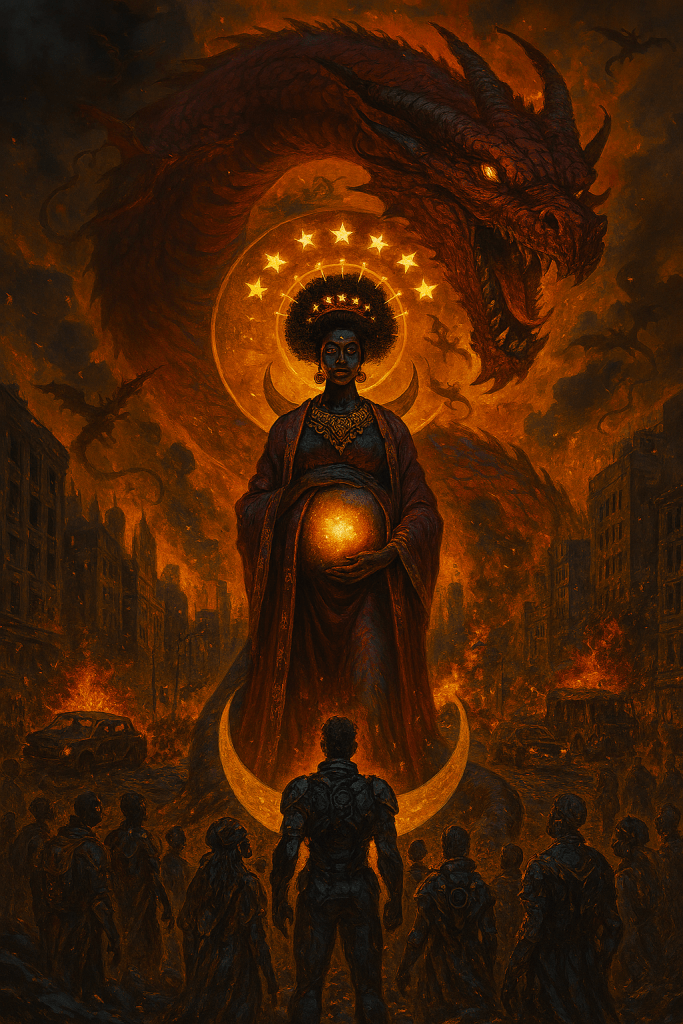
Interestingly, in confirmation of this point, the sages said the Chevlai ha-Mashiach would come before the dawn of redemption. They spoke of upheavals, wars, moral confusion, nations roaring like waters, truth falling in the streets, not as punishment, but as process. These are the contractions of the world trying to push the Messianic Child into manifestation.
So, from the serpent in Eden to Cain slaying Abel, from Pharaoh drowning the infants to Herod hunting the newborn King, every generation witnesses the same drama: the dragon of resistance crouched before the womb of promise. Revelation 12, one of the introductory quotes to this article, speaks of that same pattern; a woman clothed with the sun, standing on the moon with a crown of twelve stars travailing in birth, pained to be delivered, while the red dragon waits to devour her child. It’s the story of every righteous vision ever born and sought to be aborticided.
Nimrod tried to extinguish Abraham.
Saul tried to silence David.
Babylon tried to exile Judah.
Rome tried to crush Yeshua.
The adversary has always been midwifing death where the Most High was midwifing life.
Yet each time, life prevails.
Each cut of the enemy’s blade becomes another C-section through which YaH brings forth His promise.
HalleluYaH!
Today the Red Dragon has new faces, systems that commodify souls, media that desensitizes spirit, industries that feed on distraction and peddle poison and slow death. Violence becomes entertainment, lies become marketing, mistaken identities become algorithm. These are not random cultural shifts; they’re contractions. The world is in active labor, and as Rav Shaul wrote, in his epistle to the Romans,
For the intense longing of the creation eagerly waits for the revealing of the sons of Elohim. For the creation was subjected to futility, not from choice, but because of Him who subjected it, in anticipation, that the creation itself also shall be delivered from the bondage to corruption into the esteemed freedom of the children of Elohim. For we know that all the creation groans together, and suffers the pains of childbirth together until now.
Romans 8.19-22
Isaiah, in the 66th chapter of his prophecy, writes of how he heard the same groaning:
A roaring sound from the city, a voice from the Hĕḵal, the voice of יהוה, repaying His enemies! Before she laboured, she gave birth; before a pain came to her, she was delivered of a male child. Who has heard the like of this? Who has seen the like of these? Is a land brought forth in one day? Is a nation born at once? For as soon as Tsiyon laboured, she gave birth to her children. Shall I bring to birth, and not give delivery?” says יהוה. “Shall I who give delivery restrain birth?” said your Elohim.
Isaiah 66.6-9
Transformation, the very meaning of labor, is, before our very eyes, happening right now. Every social tremor, every moral crisis, every awakening is a push, and humanity is dilating. And in this dilation, we see the dragon once again, perched at the feet of the woman travailing, ready to consume the child at its delivery. But like the deeds of our ancestors, which serve as signs for their decendents, our story will not end with the demise of the child; in fact, the child will rise to overcome the dragon, as the serpent was told in the Garden,
And I put enmity between you and the woman, and between your seed and her Seed. He shall crush your head, and you shall crush His heel.
Genesis 3.15
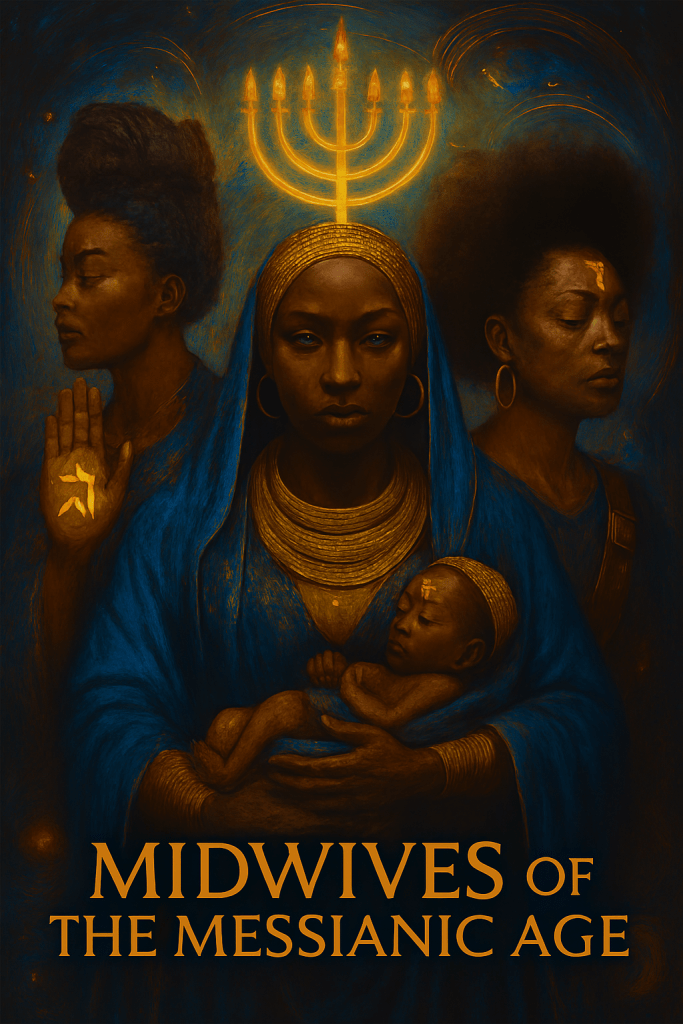
Considering this prophetic outcome, it’s interesting to note that when I study the Exodus story, my spirit keeps returning to Shiphrah and Puah, the Hebrew midwives. Pharaoh commanded them to kill the sons, to abort the future before it could cry. But these women feared Elohim more than empire, they resisted the edict, and they preserved life. Because of them, Moses, the deliverer, the anointed one, could be born. And so, my beloved readers, that’s what time it is right now, again. We’re in an ominous hour that needs midwives, souls who know how to catch the promise, wipe the blood from its brow, and whisper, LIVE!
So to all my artists, teachers, healers, prophets, poets, counselors, you are the new midwives of the Transfiguration! The creatives who channel truth through color and sound, the healers who mend the psychic tears of a people, the priests who stand in the gap, the prophets who interpret the contractions, the poets who spit the truth, each is part of the birthing team for the Messianic age.
And yes, the cost of spiritual labor is high. Anyone who’s ever birthed vision knows the fatigue, the sleepless nights, the ridicule, the near-miscarriage of faith is a daunting and challenging opposition. But to overcome the challenges and raise this child, we have to breathe through pain, push through resistance, and trust that what we’re carrying is real even when it feels invisible. But endurance is the proof of our conception. As James said,
Blessed is the one who endures trial; for when they have stood the test, they shall receive the crown of life.
James 1:12
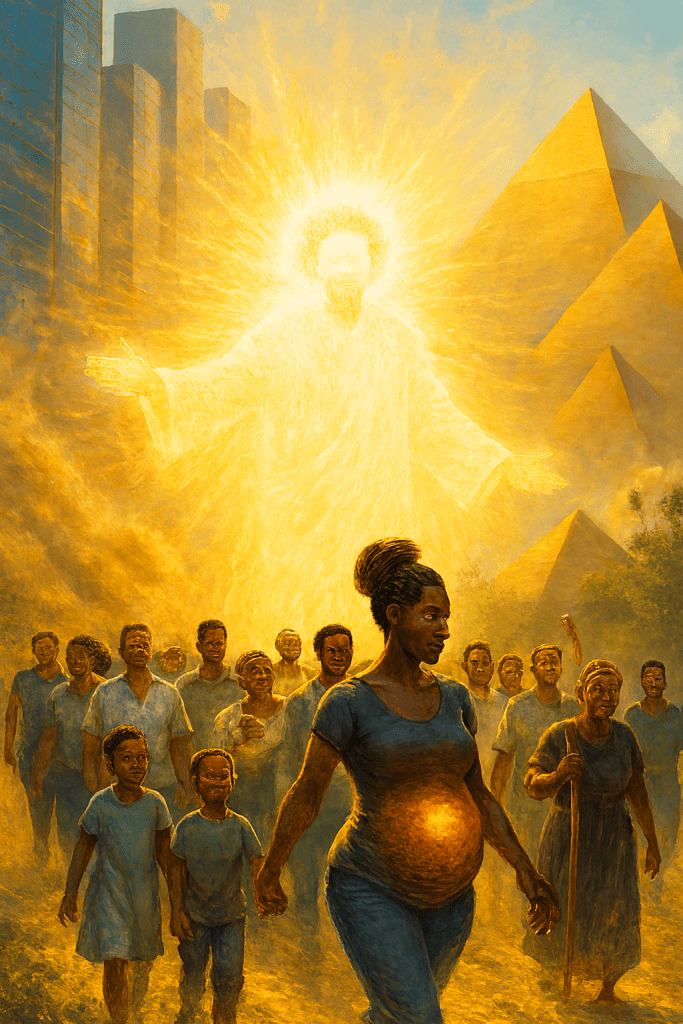
And that, b’nai Elohim, is what it’s all about; that Crown of Life, or Keter Chayyim, which is none other than the Messiah Itself. And it’s not as one man this time, but as a collective individual, the many-membered body becoming one anointed consciousness. The Zohar hints at this when it describes the Adam Kadmon, the primordial man, restored through unity. Paul touched the same mystery in 1 Corinthians 15, saying, “The first man was of the earth, earthy; the second man is the Master from heaven.” The transfiguration of humanity, from terrestrial to celestial, is the final delivery.
To further affirm this dynamic with another witness, Raphael Patai recorded traditions that the Messiah is born in every generation, waiting for the people to be ready to raise Him. This isn’t mythology; it’s more like the biology of the spirit, because it is Mashiach-consciousness that keeps gestating within us until we decide collectively to push.
With that in mind, we must know that we are that womb, that we are Zion in travail. And the contractions we feel, climate, conflict, cultural chaos, oppression, repression, are not endings; they’re beginnings. They are signs that the world isn’t dying; it’s dilating, and giving birth to transformation.
And Elohim shall wipe away every tear from their eyes, and there shall be no more death, nor mourning, nor crying. And there shall be no more pain, for the former matters have passed away. And He who was sitting on the throne said, “See, I make all matters new.” And He said to me, “Write, for these words are true and trustworthy.”
Revelation 21.4-5
So what do we do while these pains increase? What do we do when our children our murdered in cold blood, when our women are disappeared, when our men abandon their families and end up in the grave or in prison? We do what any mother in labor does; we breathe.
We hold each other’s hands.
We sing through the contractions.
See, that’s where art comes in: music, murals, poetry, ritual; these are the soundtracks of birth. Every prophetic song, every righteous act of creation, every painting that catches light is an epidural of hope. This is because art is that which anesthetizes despair and awakens remembrance.
Symbolism becomes medicine.
Rhythm becomes midwife.
We have to resist like Shiphrah and Puah; refusing to let Pharaoh’s decrees of despair terminate the next generation of spiritual sons. The movement needs protectors of life: the counselors who speak shalom into trauma, the priests who cleanse shame, the prophets who call out the counterfeit, the healers who remind us that the body is still sacred.
And because the Transfiguration Movement isn’t about escape, but about emergence, we keep pushing. We keep pushing because it’s about humanity stepping out of its old skin, shedding the serpent’s residue, and realizing the luminous being beneath. We keep pushing because that’s what the Mount of Transfiguration was always showing us, that flesh can glow when aligned with purpose, that mortality can hold honor, and that Heaven can dwell in the dust of Earth.
We all know that the contractions are increasing, that the Dragon is raging, but the midwives, too, are rising.
And the Child, the collective Messiah, the embodied Kingdom, if we look closely, is crowning!
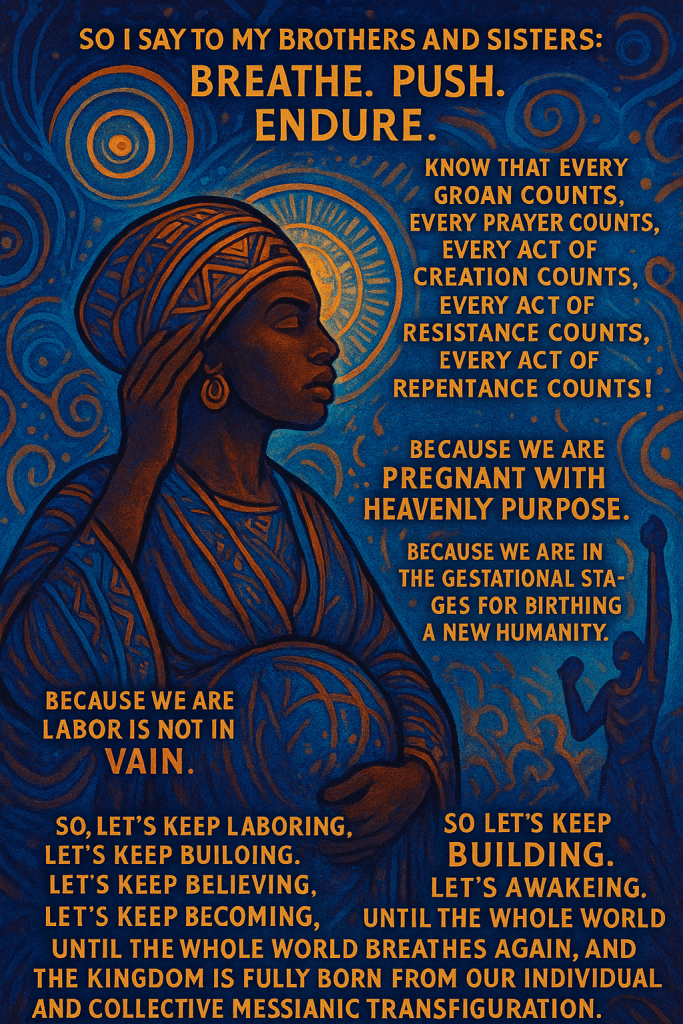
So I say to my brothers and sisters:
Breathe.
Push.
Endure.
Know that every groan counts, every prayer counts, every act of creation counts, every act of resistance counts, every act of repentance count!
Because we are pregnant with Heavenly purpose
Because we are in the gestational stages for birthing a new humanity.
Because our labor is not in vain.
Because the movement of Transfiguration will not miscarry; it’s prophesied!
So, keep your eyes on the prize.
Keep your hands steady on the promise.
Keep your heart open to the pain and the joy intertwined.
And remember, the moment you feel like giving up is usually the moment of crowning.
So keep pushing and know that the Transfiguration is not coming; it’s happening.
The Messiah is not waiting; It’s awakening, through us.
So let’s keep laboring.
Let’s keep building.
Let’s keep believing.
Let’s keep becoming, until the whole world breathes again, and the Kingdom is fully born from our individual and collective Messianic Transfiguration.
Selah…
Discover more from SHFTNG PRDGMZ
Subscribe to get the latest posts sent to your email.

