
Program’s Mission: Stimulate critical thought in order to realistically redefine our narrative and positively reshape our reality through dialogue with self-determination.
Dedication: The Moorish Spaniard rabbi Moses ben Maimon [known to English speaking audiences as Maimonides and Hebrew speaking audiences as Rambam or Rav MBM] (1138–1204) is the greatest Jewish philosopher of the medieval period and is still widely read today. The Mishneh Torah, his 14-volume compendium of Jewish law, established him as the leading rabbinic authority of his time and quite possibly of all time. His philosophic masterpiece, the Guide of the Perplexed, is a sustained treatment of Jewish thought and practice that seeks to resolve the conflict between religious knowledge and secular. Although heavily influenced by the Neo-Platonized Aristotelianism that had taken root in Islamic circles, it departs from prevailing modes of Aristotelian thought by emphasizing the limits of human knowledge and the questionable foundations of significant parts of astronomy and metaphysics. Maimonides also achieved fame as a physician and wrote medical treatises on a number of diseases and their cures. Succeeding generations of philosophers wrote extensive commentaries on his works, which influenced thinkers as diverse as Aquinas, Spinoza, Leibniz, and Newton.
Perspective: Verily, we vehemently deny and we cleanse ourselves before El Shaddai of the accusation attributed to us that we espouse the treatise that the soul will never return to the body and that it is impossible for that to occur. For such a denial (in the resurrection of the dead) leads to the denial of all miracles (chronicled in the Bible) and the denial of miracles is equivalent to denying the existence of Elohim and abandonment of our faith. For we do consider the resurrection of the dead to be a cardinal principle of the Torah. There is nothing in our writings which would indicate a contradiction to the return of the soul to the body; on the contrary (our writings) show the opposite.
Rambam’s The Treatise of the Resurrection #27
Thirteen principles of Hebrew faith:
1. Belief in the existence of the Creator, who is perfect in every manner of existence and is the Primary Cause of all that exists.
2. The belief in YaH’s absolute and unparalleled unity.
3. The belief in YaH’s non-corporeality, nor that He will be affected by any physical occurrences, such as movement, or rest, or dwelling.
4. The belief in YaH’s eternity.
5. The imperative to worship YaH exclusively and no foreign false gods.
6. The belief that YaH communicates with man through prophecy.
7. The belief in the primacy of the prophecy of Moses our teacher.
8. The belief in the divine origin of the Torah.
9. The belief in the immutability of the Torah.
10. The belief in YaH’s omniscience and providence.
11. The belief in divine reward and retribution.
12. The belief in the arrival of the Messiah and the messianic era.
13. The belief in the resurrection of the dead.
From the Siddur (Amidah/Shemoneh Esreh): In summer say: He causes the dew to descend. In winter say: He causes the wind to blow and the rain to fall. You are mighty forever, my Elohim; You resurrect the dead; You are powerful to save. He causes the dew to descend. He sustains the living with loving kindness, resurrects the dead with great mercy, supports the falling, heals the sick, releases the bound, and fulfills His trust to those who sleep in the dust. Who is like You, Elohim! And who can be compared to You, King, who brings death and restores life, and causes deliverance to spring forth! You are trustworthy to revive the dead. Blessed are You YaH, who revives the dead.
Secret of the Dew
Rav Isaac Luria explains how the spiritual dimension called Atika Kadisha (the Ancient Holy One, which is the highest level of existence/consciousness) is the source of a “dew” that brings about resurrection of the dead. He further explains that the dew is really the three letters in the Tetragrammaton, Yod, Hei and Vav (Yahu). The Tetragrammaton is the Four Letter Name of Elohim. Now, why are three of these letters referred to as the dew? Follow closely: According to Kabbalistic numerology, the word “dew” and the three letters of Elohim’s Name both share the same numerical value. So “dew” is really a code for these three letters of Elohim’s Name, which really refer to the realm that we call the 99% reality. The 99% Reality is the hidden realm and source of all Light and wisdom that flows into our world. Why should any of us care about the Four Letters of Elohim’s Name? Simple. The letters represent these hidden spiritual dimensions that are the source of all wisdom, life-force, creativity, knowledge, passion, love and Light that emanate and radiate from the force that we call Creator and the 99% reality. Here’s how it works: The final letter in Elohim’s Name (the Hebrew letter Hei) refers to our physical world. You know this place very well. It’s where we find both order and chaos, darkness and Light, and pain and pleasure. This one letter is disconnected from the first three letters. What does this mean? It means our world is disconnected from these hidden Upper Dimensions. It means the lamp is not plugged into the wall socket to draw electrical energy and therefore the room, our world, remains in darkness. It means we are disconnected from the 99%. Not good. Because of this disconnection between our world and the source of all Goodness, the Zohar says Elohim’s Name is not complete. Elohim’s Name is not unified…Rav Isaac Luria teaches only through repentance (inner change, and not by saying I’m sorry) can we reconnect to resurrect our happiness and resurrect whatever has died in our life. When enough individual people reconnect, then the gates of the 99% will open wide enough so that even the dead will resurrect and immortal existence (Messiah) will arrive. This is the long-held, tightly guarded Kabbalistic secret behind the teachings of Yeshua concerning Golgotha, Resurrection and repentance. Let’s now explore and understand the true meaning of repentance. Repentance really means in Hebrew, to return. You might ask, Return to where? We are returning to ourselves, and this world, to the 99%. We are returning the final letter Hei, in Elohim’s Name, back to the first three letters to unify Elohim’s Name and thus, unify our world with the 99% reality. This is the secret of the dew. The dew is the three letters of Elohim’s Name that are returning ourselves to. This is why they share the same numerical value. It was a secret code to let us know what’s really taking place. This is why the dew is associated with resurrection in the Zohar. When we return or reconnect to the 99% (symbolized by the three letters of Elohim’s Name) the Light goes back on. The code name for that is resurrection. When you unplug a light from the wall socket and disconnect from the electrical energy, the light in the room dies. You have darkness. If you want to resurrect to the light again, plug the lamp back into the wall socket.
A Great Secret about Golgotha, the Zohar and Yeshua
Early Reference of Resurrection
“The discussion of the revelation in Shabbat 88a-89b includes two traditions, both ascribed to R. Joshua ben Levi [who lived in the first half of the third century], that emphasize the overpowering nature of the revelation experience. The first tradition develops further the notion found in Song of Songs Rabbah that the souls of the Israelites departed after hearing the first of the Ten Commandments. In this tradition the ‘resurrection’ of the dead Israelites is brought about by the dew with which [Elohim] will resurrect the dead in the time to come – Rabbi Joshua b. Levi said: at each and every utterance (dibbur) that issued from the mouth of the Holy One, blessed be He, the soul of Israel went forth, as it is said, ‘my soul went forth (yasa) when he spoke.’ But since their soul went forth after the first commandment, how could they receive the second commandment? He brought down the dew with which He will resurrect the dead in the future and He resurrected them, as it is said, ‘a bounteous rain, O Elohim, You did pour down; when Your heritage languished You did restore it” (Psalm 68.10)…
Veda and Torah: Torah and Revelation p. 293
Genesis 27.22-29
Zohar, Shemot, Section 2, Page 83a Then he said to R. Simeon: ‘Would it please the Master to deign to interpret the whole verse, including the last words, “and feed thee with the heritage of Jacob thy father”?’ R. Simeon then repeated what he had said before, and added that the last words are a reference to Isaac’s blessing, “And G-d give thee of the dew of heaven” (Gen. XXVII, 28), this being “the heritage of Jacob”. Now this blessing wherewith Isaac blessed Jacob was made in regard to that “heaven” of which we have spoken, and in these words he indicated that Jacob’s children will rise again from the dead at the time of the Resurrection, by means of that heavenly dew, at the time when it shall issue forth from the Ancient of Days to the “Small of Countenance”. R. Abba thought for a while, and said: ‘Now everything is clear, and I see that there is even more significance in Isaac’s blessing than I had thought.’
Isaiah 26.12-19
Zohar, Bereshit, 130b By means of that dew all will rise from the dust, as it says, “for thy dew is as the dew of lights” (Is. XXVI, 19), these being the supernal lights through which the Almighty will in future pour forth life upon the world.
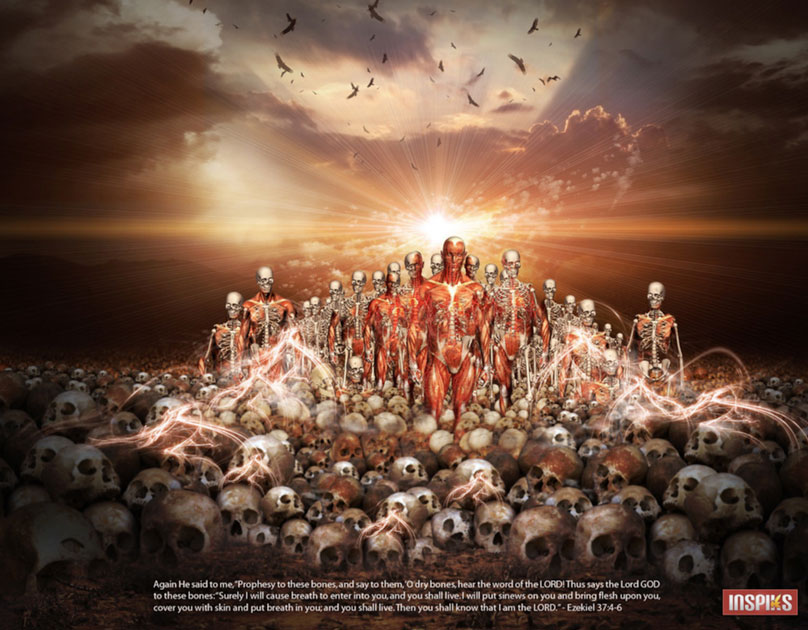
Ezekiel 37.1-14
Pirke d’Rebbi Eliezer chapter 33 The dead (bones) which Yehezekel brought back to life– dew from heaven descended upon them.
I Corinthians 15.12-54
Discover more from SHFTNG PRDGMZ
Subscribe to get the latest posts sent to your email.

