
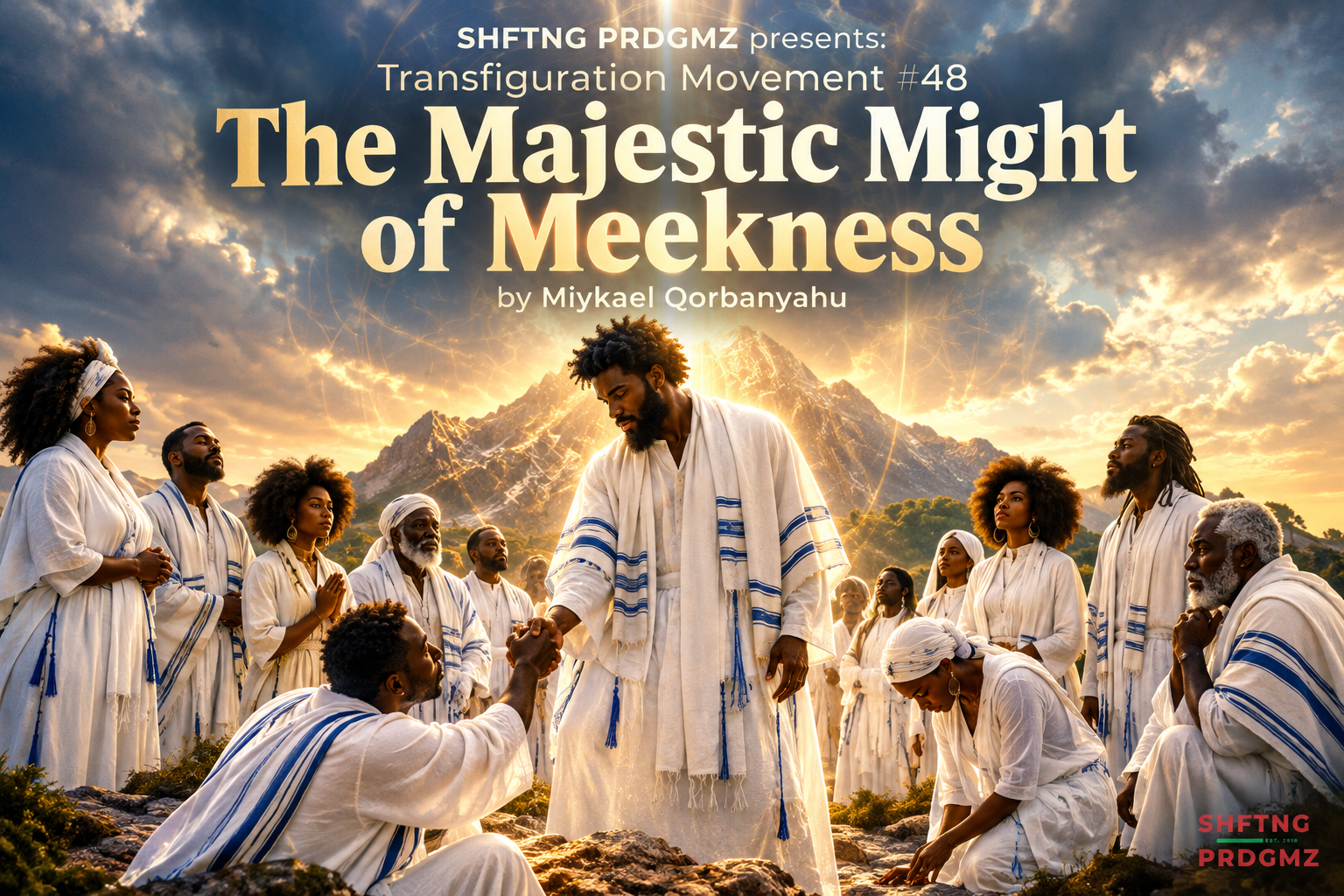
by Miykael Qorbanyahu
__________________________________________
The Gemara relates: Rava says, and some say Rabbi Yoḥanan says: Greater is that which is stated with regard to Moses and Aaron than that which is stated with regard to Abraham. As with regard to Abraham it is written: “And I am but dust and ashes,” while with regard to Moses and Aaron it is written: “And what are we,” i.e., we are not even dust and ashes. And Rava says, and some say Rabbi Yoḥanan says: The world endures only in the merit of Moses and Aaron. It is written here: “And what are we,” and it written elsewhere: “He hangs the earth upon nothing” (Job 26:7). That is, the earth endures in the merit of those who said of themselves that they are nothing, i.e., Moses and Aaron. With regard to that verse, Rabbi Ile’a says: The world endures only in the merit of one who restrains [shebolem] himself during a quarrel, as it is stated: “He hangs the earth upon nothing [belima]. Rabbi Abbahu says: The world endures only in the merit of one who renders himself as if he were non-existent, as it is stated: “And underneath are the everlasting arms” (Deuteronomy 33:27), i.e., one who considers himself to be underneath everything else is the everlasting arm that upholds the world.
Chullin 89a.8-9
Do not fret because of evil-doers, do not be envious of the workers of unrighteousness. For they soon wither like grass, and fade like green plants. Trust in HaShem, and do good; dwell in the earth, and feed on steadfastness. And delight yourself in HaShem, and let HaShem give you the desires of your heart. Commit your way to HaShem, and trust in HaShem, and HaShem does it. And HaShem shall bring forth your righteousness as the light, and your right-ruling as midday. Rest in HaShem, and wait patiently for HaShem; do not fret because of him who prospers in his way, because of the man doing wicked devices. Abstain from displeasure, and forsake wrath; do not fret, also to do evil. For evil-doers are cut off; but those who wait on HaShem, they shall inherit the earth. Yet a little while and the wrong is no more; and you shall look on his place, but it is not. But the meek ones shall inherit the earth, and delight themselves in plenty of peace.
Psalm 37.1-11
__________________________________________
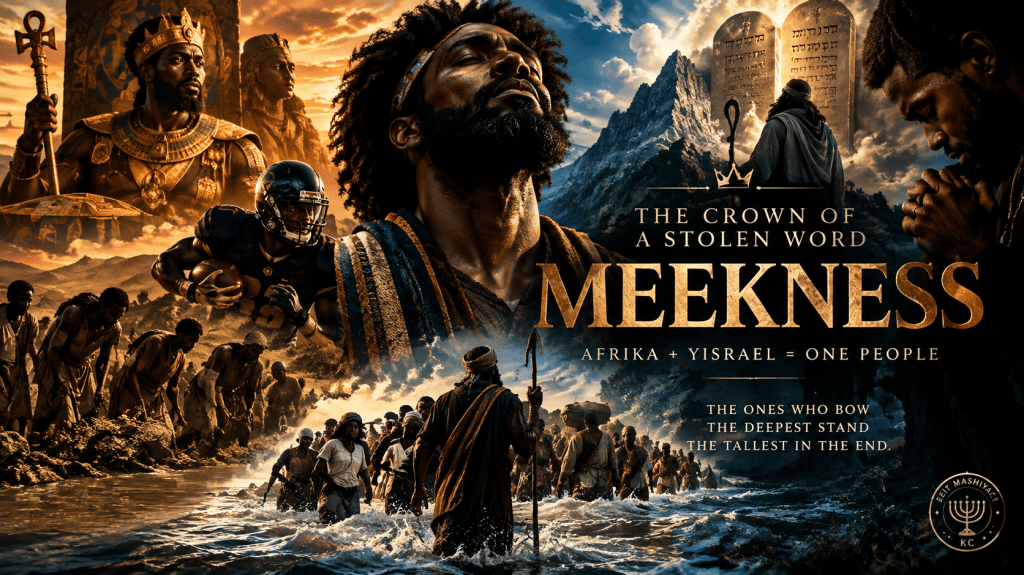
Before I ever followed my blockers out the backfield or crossed over a defender, my ancestors ran through wilderness and waded through rivers. Before any award was ever placed in my hand or I was offered a scholarship to play football, our forefathers carried burdens too heavy for most men and still found a way to rejoice and sing. Afrika gave the world kings who ruled with scepters of wisdom; Yisrael gave the world a Torah given from a mountain too low for empire-builders to notice. Put those two rivers together and you get a people who know something the world has forgotten: the ones who bow the deepest stand the tallest in the end. This word is for the descendant of the field hand and the descendant of the shepherd, the sons and daughters of those enslaved and the children of those who stood on Sinai, because meekness beats in both bloodlines. With this writing, I beseech each of you to come close and listen, family of Yah, because today I want to talk about restoring the crown of a word that has been stolen, dressed in rags, and sold back to us as weakness. This word is meekness.
If you’ve tuned in to this series of writings, then you know that before I ever picked up a microphone, I used to do my best to shine on a football field and a basketball court. For the most part, when I was on the field and court, I was the quiet one. I did my work, I said little, and let the loud ones collect the attention. People who watched me play in those early days in middle school, however, could see the ability in me take shape on both grounds. I was present, capable, and more about the performance on the field than the personality behind my mask and underneath my jersey.
Then something in me shifted. As I aged, I began to elevate my game. I studied more, trained harder, and stopped apologizing for the gifts and abilities with which I was blessed. During my high school years, especially in my junior and senior years, when the game tightened and the clock ran down, I wanted all the amoke. I started to take over. My assertiveness arrived, and it arrived with weight.
And with that, here is what I want you to take away with you, though. Even when I was dominating, I carried myself as a sportsman; I didn’t showboat, I didn’t taunt the team that we had just beaten, and I didn’t stand over anyone to prove a point. When someone went down, my nature and instinct was to extend a hand. And even though I played hard and played to win, I played always with my pride under governance. Even when provoked and called out my name on the field, I usually responded with more effort and assaulted the team with my performance than with verbal assaults.
Interestingly, I didn’t have the vocabulary for it back then, but I understand now that what I was practicing on the field and court was a shadow of a Torah virtue. Power that has been brought under the authority of character is a weapon that HaShem can trust; and that’s the beginning of meekness.
So before I go on any further, let me first define this word properly, because the English language has done damage to it. In common speech, meek has come to mean timid, spineless, easily pushed around; that definition’s a counterfeit. But before I actually, I always like to use the analogy of a champion race horse who has been trained to reserve all of its power until the race. This is a powerful creature, one that could exert its might without effort, because that might is present within even when it isn’t being accessed. But because it has been properly trained, this horse exercises a meekness that demonstrates its majestic might. This is what meekness is all about, and when it’s properly understood, meekness is undeniably a matter of strength under submission, power yielded to a higher authority and therefore refuses to be driven by ego, offense, or the need to be seen. The meek person has force yet chooses restraint; conversely, the weak person has no force and calls the absence of it a virtue. These are not the same, and the Kingdom has never confused them.
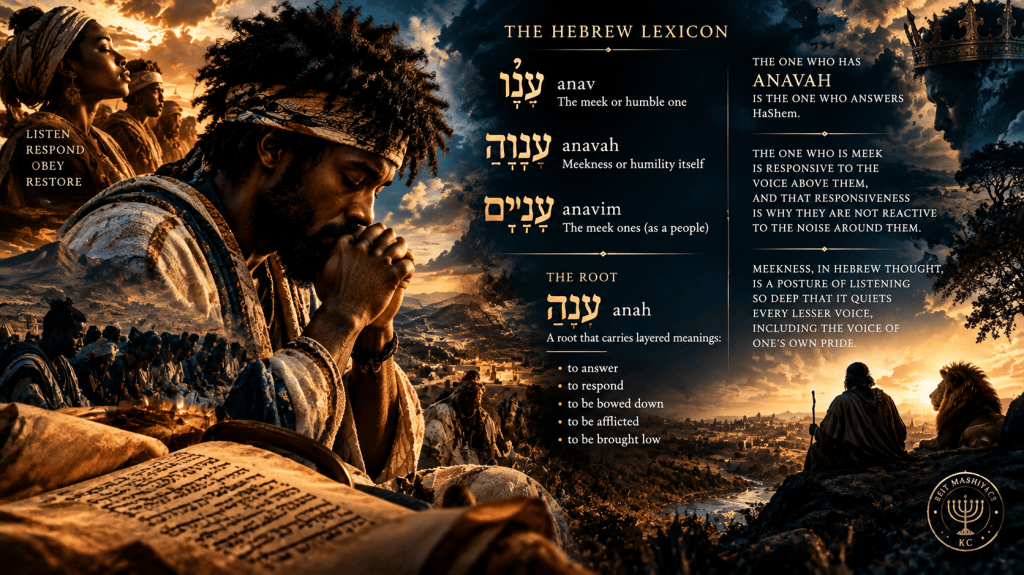
In the Hebrew lexicon, the picture grows richer. The key words are anav, the meek or humble one, and anavah, meekness or humility itself, with the plural anavim naming the meek ones as a people. These words grow out of the root anah, a root that carries layered meanings: to answer, to respond, to be bowed down, to be afflicted, to be brought low.
Sit with that for a moment.
The one who has anavah is the one who answers; more specifically, the one who answers HaShem. The one who is meek is responsive to the Voice above them, and that responsiveness is why they are not reactive to the noise around them. Meekness, in Hebrew thought, is a posture of listening so deep that it quiets every lesser voice, including the voice of one’s own pride.
The root also touches affliction, and this matters significantly. Many of the anavim in the Tanak are those who have been pressed down by hard circumstances and have been shaped into vessels rather than broken into bitterness. Affliction in the hand of HaShem becomes a sculptor, ad it is in this light that the anav is the one who allowed the pressure to carve a space for the Shekinah Presence. And with this Transfiguration chronicle, I speak to a people who know affliction intimately, a people from a people whose backs carried the whip and whose spirits still learned to sing Zion’s songs in a strange land.
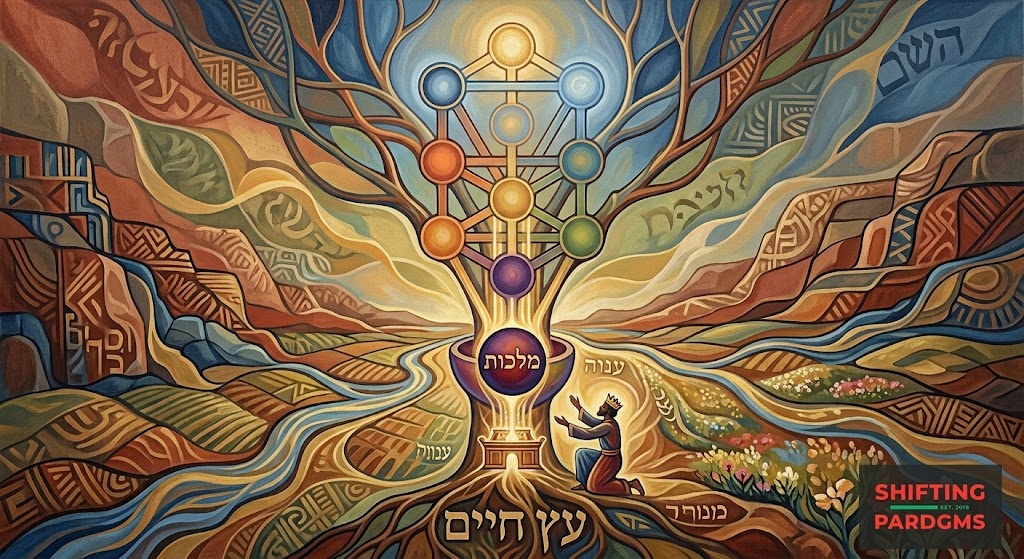
Looking at this from the perspective of Etz Chayim, or the Tree of Life, the sefirah of gevurah carries the Hebrew sense of might and strength. The Kabbalistic tradition teaches that this sefirah functions as judgment and restraint, the discipline that contains and channels raw power rather than releasing it without limit. In this light, Gevurah mirrors meekness perfectly, demonstrating how strength governs itself, how force answers to a higher order, and how might proves its greatness through the boundary it accepts rather than the force it unleashes.
The Kabbalistic tradition goes even deeper. The sages of the hidden wisdom speak of bittul, the nullification of the self before the Infinite. They teach that the highest crown, keter, is called ayin, or nothingness, not because nothing is there but because nothing of the ego is there. Some of the masters even read the question in the book of Iyob, where wisdom is found, as an answer: wisdom is found from ayin.
Do you see it yet?
Can you see how the more empty of self a vessel becomes, the more Light it can hold?
Anavah is the making of the vessel; a cup full of itself cannot be filled by the Source.
Chazal, an acronym for chachameinu zichronam livrachah, or our Sages of blessed memory, said it plainly in the Mishnah. Rabbi Levitas of Yavneh taught in Pirkei Avot 4:4 to be exceedingly, exceedingly lowly of spirit, doubling the word for emphasis. And in the Talmud, Sotah 5a, the Sages observe that Elohim passed over all the lofty mountains and caused the Shekinah presence to rest upon Mount Sinai, a lowly mountain, so that we are taught where the Shekinah dwells. The Torah itself was given on a low place, and our tradition teaches that Torah, like water, flows to the lowest ground and stays there.
This points to a crucial lesson about meekness, because the thing about meekness is this; it’s not inherited by temperament, getting attention or arrogance. And while some people are born quiet, they’re not meek at all, because they’re quietly proud. Others are born with fire and learn in the school of HaShem to become the meekest people on earth. And for this reason, meekness is acquired not inherited, and right now, right quick, I want to name some ways Scripture reveals how meekness becomes manifest.
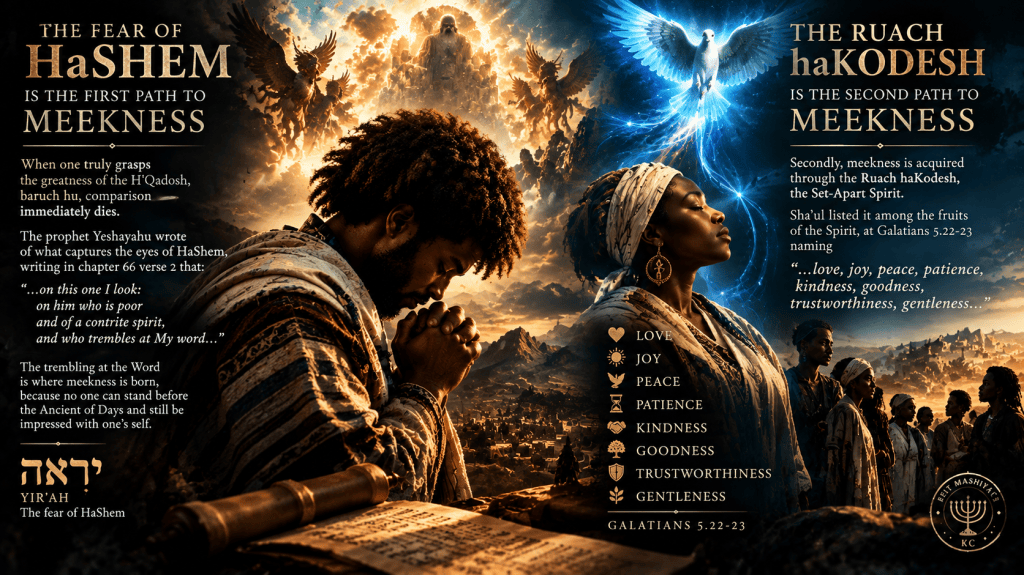
First and foremest, meekness is acquired through the fear of HaShem. When one truly grasps the greatness of the H’Qadosh, baruch hu, comparison immediately dies. The prophet Yeshayahu wrote of what captures the eyes of HaShem, writing in chapter 66 verse 2 that:
…on this one I look: on him who is poor and of a contrite spirit,
and who trembles at My word…
The trembling at the Word is where meekness is born, because no one can stand before the Ancient of Days and still be impressed with one’s self.
Secondly, meekness is acquired through the Ruach haKodesh, the Set-Apart Spirit. Sha’ul listed it among the fruits of the Spirit, at Galatians 5.22-23 naming
…love, joy, peace, patience, kindness, goodness, trustworthiness, gentleness…
…as indications of the characteristic. Gentleness there is the same family of word as meekness in the Greek of the Besorah, or Good News. Simply put, one doesn’t manufacture fruit by effort, rather it’s becomes when one abides in the Vine, and the fruit appears. Meekness, therefore, is the Spirit’s signature on a yielded life.
It’s also acquired through discipleship to the Meek One Himself. Matthew 11.29 witnesses that Mashiyach Yahoshua ha Notzri once said,
…Take My yoke upon you and learn from Me, for I am meek and humble in heart, and you shall find rest for your beings…
Notice that He says learn. This is because meekness has a Teacher, a yoke, and even a curriculum. We take His yoke, which means we walk in His pace, in His Torah, and in His authority, and as we walk, His character is formed in us.
Selah…
Meekness is most especially acquired through correction and through the wilderness of trial. Mosheh rabbeinu spent forty years in Midyan tending sheep after being raised as a prince of Mitsrayim. The man who once killed an Egyptian in a surge of self-appointed zeal became the man of whom it was written that he was the meekest on the face of the earth. The wilderness was his school. So, if you are in a season where your platform has shrunk, where your voice has been quieted, where the applause has stopped, do not despise it. You may be in the classroom where HaShem teaches anavah.
And, lastly, but not in the least, meekness is acquired through the Torah. The Sages said that the words of Torah endure only in the one who makes himself like a wilderness; open, ownerless, and willing to receive. A mind crowded with its own opinions has no room for revelation, but the one who sits at the feet of the Word with an empty cup leaves with a full one.
And yeah, I can you hear loud and clear, but why does HaShem require meekness of His people (yup, in that voice, too)?
The answer to your questions; it’s because the purpose of meekness isn’t to make us small, instead it’s to make us safe in order to be entrusted with greatness.
That’s right, try that on and see how it good it looks on you, especially when you get called into your esteem.
On the flip, though, let’s take a moment to consider what unmastered power does.
It corrupts, it devours, it exploits, it builds empires on the backs of the vulnerable; you know that I could go on and on…
And you know that the history of this world is largely the history of strong people who were never meek. And that’s why HaShem, in Its wisdom, will never release the authority of the Kingdom to those who would use it for self-exaltation. So HaShem forms meekness in us first, as it serves the purpose as the governor on the engine, the covenant guardrail that lets the vehicle go fast without leaving the road.
And it’s in this light that we can see that another purpose of meekness is receptivity. In the Kabbalistic ordering of the sefirot, the lowest sefirah, Malkhut, has nothing of its own; it receives from all that is above it, and that is precisely why it can bring the Light down into the physical world. Dawid, the shepherd king, is associated with Malkhut, and what a portrait of meekness he gives us; a man who held the power of a throne and still danced undignified before the Ark. The meek become the channel through which heaven touches earth; the proud, however, are like blocked pipes.
Another purpose of meekness is for healing and reconciliation. We read at Proverbs 15.1 that
…a soft answer turns away wrath…
This is because the meek can walk into rooms of conflict and lower the temperature, not because they’re afraid, but because they’re not fighting for their own ego. That makes them effective ambassadors of HaShem.
And, rounding this out, the purpose of meekness is also inheritance, which brings us to the promise.
As from the Torah to the Prophets to the Writings to the Besorah, we find that the Word speaks with one voice about the meek.
In Psalm 37.11, the Psalmist sang,
…but the meek shall possess the earth, and shall delight themselves in the abundance of peace…
Now let’s be absolutely about this matter, in that the setting of that psalm very much so matters. Dawid wrote it while surrounded by the prosperity of the wicked. He tells us not to fret, not to envy, not to burn with anger, and the reason is that the apparent winners of the age are temporary. The meek, against all instinct and societal pressures, wait on HaShem, and they’re the ones who will hold the land after the arrogant have been cut off.
Chew on that right there, my beloved readers.
At Psalm 147.6, the Psalms continue the testimony:
…HaShem lifts up the meek; He brings the wrongdoers down to the ground…
Notice the divine reversal. HaShem uplifts the meek, which means the meek don’t have to lift themselves. Translate that for me, Kael. Gladly, fam. In other words, the self-promoter exhausting their self for height that HaShem gives freely to the humble, is all for naught, because, ultimately, it’s just a shadow and breath, as eventually, that soul becomes nothing more that a dissipating thought. This is the legacy of vanity; nothingness. But when the Psalmist declares in chapter 22.6 that
…the meek shall eat and be satisfied…
…this shows us that the meek are not starved by their restraint; instead, ultimately, they are fed.
The prophet Tsephanyah in chapter 2 verse 3 gave a command to the whole earth in the day of HaShem’s wrath:
Seek righteousness, seek meekness
Meekness is something we are told to seek, as it is a pursuit. In the day of judgment, as HaShem would have it, it serves as part of what hides us.
Yeshayahu announced that the meek shall increase their joy in HaShem. Joy is the fruit of meekness, because the meek are not carrying the weight of defending a self-created image; they’re free. And this same prophet saw the Messiah as the one who judges with righteousness on behalf of the meek of the earth. The King of Kings has a special advocacy for the anavim.
Then the Master Teacher Himself opened His great teaching on the mountain and pronounced, as recorded in the Witness of Matthew 5.5,
Blessed are the meek, for they shall inherit the earth
Here, I want you to comprehend fully what He was doing. Yahoshua was here quoting Psalm 37 and placing His seal upon it. He was not inventing a new doctrine, He was confirming the ancient promise and declaring that it’s operational in our Father’s Kingdom. The word translated inherit is the language of covenant inheritance, of a family receiving its portion by promise. Therefore, what He’s clearly explaining is that the earth isn’t conquered by the meek, it’s, instead, inherited by them, because they are heirs.
Keeping this flow of consciousness flowing, Rav Sha’ul, in Ephesians 4.2, instructed that
…we walk worthy of our calling with all lowliness and meekness, with patience, bearing with one another in love…
In 1 Kepha, 3.4, the talmid, or disciple, Kepha wrote of
…the hidden man of the heart, in the incorruptible adornment of a meek and quiet spirit, which is very precious
in the sight of Elohim…
Precious in the sight of Elohim.
This is simply because meekness isn’t cheap in heaven; it’s costly garments.
And Ya’aqob wrote in his letter, chapter 4 verse 6, that Elohim
…resists the proud, but gives favor to the humble…
In this, we our vision should start perceiving clearly, that there is a Heavenly resistance against pride.
Think about that.
The proud are not merely disliked by HaShem, they’re opposed by Him.
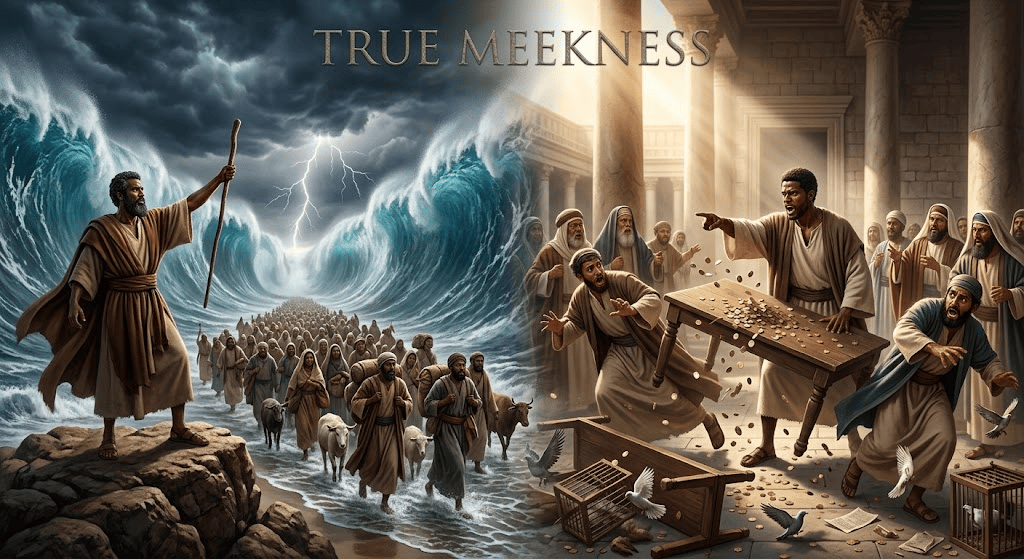
Bringing this article to a close, I want to now speak a most vital word here to my melanated brothers and sisters, because this teaching has been weaponized against us. For generations, meekness was preached to a wounded people as a call to passivity, to accept injustice, to bow to oppressors in the name of a pseudo-righteousness. But that depiction of meekness, is flat out perversion. Mosheh, the meekest man on earth, confronted Pharaoh, split a sea, and led a nation out of bondage. Yahoshua, the meek Sovereign, overturned the tables in the Temple and spoke boldly against the corrupted leaders of His day, even calling them children of the devil.
What we must know about biblical meekness is that it has never meant servility to unrighteous power. Meekness, in all its power, is strength submitted to HaShem…alone, which is exactly why it fears no Pharaoh, no Caesar, no President, no Tyrant. The one who bows only to the Ha Qadosh, barukh hu, cannot be made to bow to anyone else.
And as we all know, sometimes the best way to understand a virtue is to watch it walk. This is where the Scriptures come in to give us a gallery.
We are told that Mosheh the man Mosheh was very meek, more than all the men who were on the face of the earth. Look at where this verse sits; just prior, Miryam and Aharon, his siblings, had spoken against him. Yeah, that’s right, his own family attacked his leadership. And despite that, the text doesn’t record him defending himself but it does tell us that HaShem Itself rose to defend him, and even when Miryam was struck with leprosy, Mosheh cried out on her behalf, interceding for the very one who had slandered him. That, b’nai Elohim, is meekness; the refusal to retaliate and the readiness to intercede. The Kabbalists note that the gematria of Mosheh, 345, equals that of HaShem, the Name, equating the principle that when one empties their self of self, HaShem Itself fills the space.
Selah…
Yoseph was sold by his brothers, falsely accused, forgotten in prison, Yoseph also rose to rule Mitsrayim and held the power of life and death over the very men who betrayed him. When they trembled before him, he wept and said that what they meant for evil, Elohim meant for good. Here is power with every opportunity for revenge, restrained by a vision of HaShem’s larger purpose. In the deeper scheme of Kingdom, Yoseph is the channel of Yesod, the foundation that carries Light to the lower worlds. The meek become conduits.
Dawid twice had Sha’ul in his hands, once in a cave and once asleep in a camp, and twice he refused to touch HaShem’s anointed. His men urged him to strike, but he cut only the corner of a robe, and even that bothered his conscience. Dawid understood that promotion belongs to HaShem, and a throne seized by force is a throne without blessing. The man who waits on HaShem for his throne will keep it with integrity.
Gide’on, when HaShem called him, answered from the posture of a man who saw himself as the least in his father’s house. After the victory, the proud men of Ephrayim came and quarreled with him for not calling them sooner. A lesser man would have made a speech about his own accomplishments. Gide’on answered with a soft word that honored their gleanings above his own harvest, and their anger subsided. Here is Proverbs 15:1 walking in sandals.
Yahoshua provides with the greatest portrait that stands above every other. He washed the feet of men who would scatter at His arrest. He rode into Yerushalayim on a donkey, not a warhorse. He silenced legions of messengers at His disposal and chose the cross instead. Of Him, it was prophesied that He was oppressed and He was afflicted, yet He opened not His mouth. Yet this same meek Master cracked a whip of cords and overturned the tables of the money changers, because meekness submitted to HaShem still stands against corruption in the house of Elohim. He is both Lamb and Lion, and in Him meekness reaches its fullest majesty.
Let us fully accept the principle that meekness is not theory as it walks out in daily decisions.
As we seek to grow in our lives, it would behoove us to receive correction without defensiveness. And as challenging as it is to be corrected, and admit that we were in the wrong, it is the spirit of meekness that allows for growth to take place despite how we feel about our error. So when a brother or sister brings a word of rebuke, let our first response be reflection rather than rebuttal.
Listen.
Receive.
Reflect.
Release your right to retaliate.
When wronged, hand the matter to HaShem as Dawid handed over Sha’ul, trusting the Most High as Vindicator rather than seizing vengeance for ourselves.
Honor the opposition rather than attacking their character, answering heat with a soft word as Gide’on did.
Serve in hidden places where no crowd watches, trusting the Father who sees in secret to reward our efforts openly.
Guard our tongue in triumph, celebrating victory without trampling the one you defeated, the way true sportsmanship once taught me on a field long before I understood its spiritual weight.
Study Torah with an empty cup, approaching the Word ready to be corrected rather than ready to confirm what you already believe.
Most unfortunately, this generation worships arrogance and calls it confidence.
It mistakes volume for authority and clout for character.
Social platforms reward the loudest boast and the sharpest insult, training a whole generation to believe that domination proves worth.
That’s why I want to issue this charge to every son and daughter of the Kingdom: rise and confront this haughtiness, not with louder noise, but with the quiet dominance of a transfigured life.
Let your meekness expose every empty boast around you.
Let your restraint shame every display of unchecked ego.
Walk into rooms of conflict as Gide’on did and lower the temperature with a soft answer.
Build like Yoseph built, holding power without wielding it for personal vengeance.
Confront Pharaoh like Mosheh when injustice demands a voice, and bow only before the Throne of the Most High.
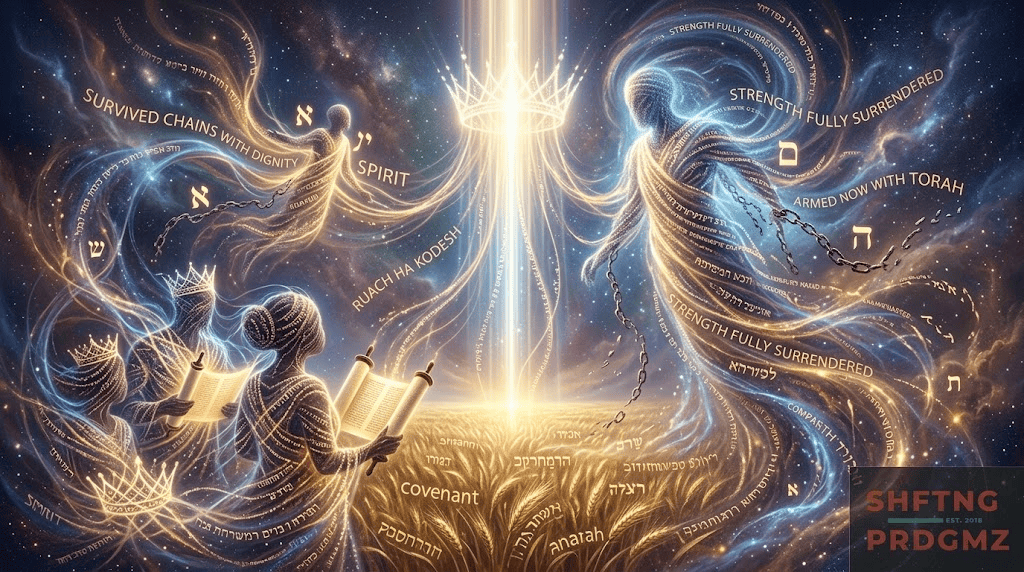
Our ancestors survived chains with a dignity that oppression never managed to strip from their spirit, and that same anavah runs in us today, armed now with Torah and filled with the Ruach haKodesh.
Stand as a living rebuke to the conceit of this age.
Truth be told, meekness stands as a hallmark of the Transfiguration Movement.
Every son and daughter who transforms into the image of Yahushua carries this crown; strength fully surrendered, power fully submitted, ego fully nullified before the Infinite.
This is the inheritance promised to the anavim: the earth itself, held not by conquest but by covenant.
Let the fire in your chest bow only to the One who kindled it, and watch Him lift you higher than pride ever could.
Walk this road with me, family of HaShem and let’s continue to transfigure.
Selah..
Discover more from SHFTNG PRDGMZ
Subscribe to get the latest posts sent to your email.

