
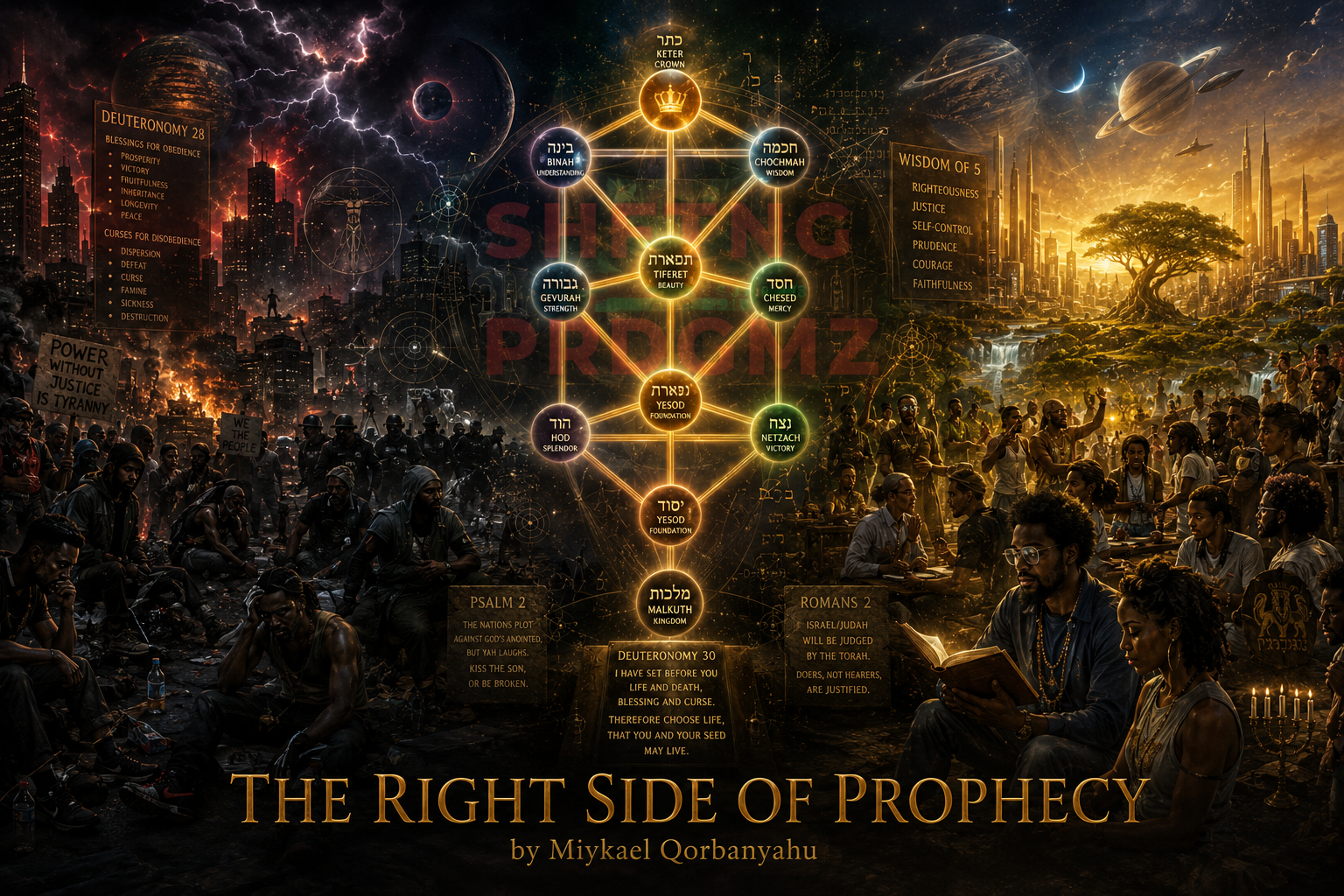
by Miykael Qorbanyahu the End Time Scribe
_________________________________________________________________
The arc of the moral universe is long, but it bends toward justice.
MLK
Surely HaShem Elohim will do nothing, but he revealeth his secret unto his servants the prophets.
Amos 3.7
_________________________________________________________________
I’m pretty sure that you’re familiar with the saying, “make sure you’re on the right side of history.”
Politicians invoke it.
Activists carry it as a rallying cry.
Commentators deploy it to pressure movements and nations toward particular decisions.
The phrase carries real moral urgency because it calls people to account by appealing to a future judgment rendered by human memory, cultural consensus, and the long arc of social progress. Every generation hears it spoken over the defining conflicts of its moment; over civil rights battles, over wars, over the treatment of the vulnerable and the marginalized. It’s a powerful phrase precisely because it acknowledges that actions have consequences that outlast the moment in which they are taken.
But are you familiar with the phrase “the right side of prophecy?”
This is a phrase that came to me about a year ago during one of our Shabbat fellowships with Beit Mashiyach. I went on to look for the phrase on the internet, sure that I would find it in use, or even trademarked. But low and behold, after doing the search, and even asking AI before writing this article if it’s a term that has been used, I found nothing.
Suffice it to say, these two sayings, revolving around history and prophecy, sound similar on the surface as both sides invoke and carry the weight of consequence for those who choose poorly. The difference between them, though, runs deeper than language; it runs all the way down to the source of the verdict itself, and to the nature of the standard by which that verdict gets rendered.
The right side of history answers to human judgment. Future generations, scholars, cultural movements, and the court of public opinion determine who was right and who was wrong. History’s verdict shifts; what one generation celebrates, another condemns. The needle seemingly moves back and forth because the standard belongs to human beings, and human beings vacillate with their minds. Empires once celebrated as civilizing forces now stand condemned by the very descendants of those they colonized. Movements once marginalized now occupy the center of the moral conversation. While the right side of history is a real concept and carries genuine weight, its foundation rests on human consensus, which means it remains perpetually subject to revision. But know that no human court renders a final verdict, every ruling stays open to appeal.
The right side of prophecy, however, answers to a different court entirely.
Moshe ben Maimon, also known as Maimonides and by the acronym RaMBaM (Rabbi Moshe ben Maimon), offers the most rigorous philosophical treatment of prophecy in the people of Israel’s entire tradition. In his perennial work, The Guide for the Perplexed, Part II, chapters 32 through 48, Rambam builds a framework that grounds prophecy in the perfection of human faculties working in concert with a divine emanation flowing from the Active Intellect.
Rambam describes prophecy as an overflow, a shefa (שֶׁפַע), that descends first upon the rational faculty and then upon the imaginative faculty of a person who has cultivated both to their highest capacity (Guide II:36). This overflow doesn’t select its recipients arbitrarily. It requires a specific convergence, specifically intellectual perfection acquired through the study of wisdom, moral perfection achieved through the mastery of the passions and the appetites, and a natural holistic readiness of the imaginative faculty to receive and give form to what the intellect apprehends. A person lacking any one of these three elements, RaMBaM argues, cannot receive prophecy regardless of their desire for it (Guide II:32).
This prophetic framework carries direct weight for my thesis relative to the right side of prophecy. RaMBaM insists that prophecy is not a random gift bestowed without regard for the condition of the recipient. It’s, rather, the natural consequence of a life ordered toward wisdom and the mastery of the body by the intellect; the prophet stands prepared before the overflow ever arrives. In this we find that preparation precedes reception and alignment allows for revelation.
Furthermore, RaMBaM distinguishes eleven degrees of prophecy, each corresponding to the proportion of intellect to imagination active in the prophetic experience (Guide II:45). At the summit of this ladder stands Moshe, whom RaMBaM places in a category entirely apart from every other prophet. Moshe received the divine word through the intellect alone, without the mediation of the imaginative faculty and without the accompaniment of vision, parable, or dream (Guide II:35). This is why Deuteronomy 34:10 declares that no prophet since has arisen in Israel like Moshe, one whom the Most High knew face to face.
For the right side of prophecy, RaMBaM contribution stands as a bridge between the covenant demands of Deuteronomy 28 and 30 and the internal transformation Romans 2 requires of the heart. The overflow of prophecy, in Rambam’s account, arrives only where the intellect governs the passions and where wisdom has done its full work in a person’s life. Standing on the right side of prophecy, by this measure, begins long before the prophetic word ever descends; it begins in the deliberate cultivation of the mind and the discipline of the will toward the Most High.
Taking RaMBaM’s account into consideration, it becomes clear that prophecy doesn’t shift with cultural consensus, nor does it revise its verdict when political winds change. It doesn’t wait for scholarly agreement or popular movement to validate what it has already declared, because prophecy speaks from outside the timeline of human opinion and moves toward fulfillment with or without acknowledgment. To stand on the right side of prophecy means to align yourself with a declaration that preceded your birth, that will outlast your generation, and that carries consequences written into the fabric of creation itself. The right side of history asks: what will people think? The right side of prophecy asks: what has already been declared by the Most High El, and where do I stand in relation to it?
This distinction matters enormously for where we stand in this present moment. While the world debates the right side of history, repositioning statues, rewriting curricula, relitigating the past through present politics, the scrolls have already rendered a verdict that operates on an entirely different frequency. Two peoples, two divine assignments, two recorded histories of departure from those assignments, and one open door of return. The prophetic record names all of it with a specificity that human recollection and judgment can’t match and human consensus can’t overturn.
That record lives in Deuteronomy 28, Wisdom of Solomon 5, Psalm 2, Romans 2, and Deuteronomy 30. Together these texts form a prophetic court document addressing two peoples; Israel, the covenant people, and the Gentile nations, the surrounding world order. Both carry a divine assignment and a recorded history of walking away from it. Both face the same ancient call, echoing across every century since it was first spoken:
Return.
Repent.
Realign.
Live.
Moshe stood before the assembled nation of Israel at the edge of the promised land and delivered what may be the most precise prophetic document in all of scripture. Deuteronomy 28 opens with the fullness of covenant blessing, a comprehensive flourishing touching every dimension of life laid out in the first fourteen verses:
The city blessed.
The field blessed.
The womb blessed.
The basket blessed.
Enemies defeated before them.
Nations of the earth recognizing Israel as set apart.
Then the chapter turns.
Beginning at verse 15, Moshe lays out with extraordinary detail the consequences of covenant departure. What follows reads less like a warning and more like a historical document written centuries in advance. Confusion, defeat, dispersion among all nations, becoming a byword and a proverb, serving enemies in lands not their own. The text arrives at its most devastating passage in verse 68, describing a people brought back to Egypt in ships, a reversal of the Exodus itself, and finding no buyers even among those who would enslave them.
History answers this passage with specificity. The Babylonian captivity of 586 BCE carried the southern kingdom of Judah into a seventy-year exile documented across Jeremiah, Lamentations, and Daniel. The Assyrian destruction of the northern kingdom in 722 BCE scattered the ten tribes across the ancient Near East, a dispersion that scholars and prophetic traditions continue to trace. The Roman siege of Jerusalem in 70 CE under General Titus resulted in the destruction of the Second Temple, the massacre of over a million Yahudi according to Josephus, and the beginning of a global dispersion spanning two millennia. The transatlantic slave trade, in which millions of African people were transported across the ocean in ships under conditions of extreme brutality, carries for many scholars and prophetic traditions a direct resonance with Deuteronomy 28:68. The Lemba of Zimbabwe, the Igbo of Nigeria, the Hebrew Israelite communities of the Americas, and scholars such as Dr. Yosef ben-Jochannan and Dr. Rudolph Windsor have traced this connection with historical and anthropological seriousness.
Israel’s position on the wrong side of prophecy wasn’t imposed from the outside; the covenant itself carried both the promise and the consequence which Moshe plainly named when he told Israel,
I have set before you life and death, blessing and cursing
Deuteronomy 30:19
For Israel, the wrong side was chosen, not assigned.
Romans 2 delivers the same verdict from within the covenant community’s own prophetic tradition. Rabbi Shaul, also known as the apostle Paul, writes directly to those who carry the law:
You who preach against stealing, do you steal? You who say do not commit adultery, do you commit adultery? You who abhor idols, do you rob temples?
Romans 2:21-22
The indictment targets the gap between declared identity and lived covenant faithfulness. Rav Shaul’s sharpest line arrives in verse 24:
The name of God is blasphemed among the Gentiles because of you.
Israel’s covenant departure did not happen in a vacuum. The nations watched, and what they saw with Israel didn’t reflect the honor of the covenant. The wrong side of prophecy carries public consequences that extend far beyond the people who chose it.
The Wisdom of Solomon, a deuterocanonical text composed between approximately 100 BCE and 50 CE, carries a prophetic force that the early assembly recognized as authoritative. Chapter 5 opens at the moment of judgment; the wicked, those who mocked the righteous, despised their way of life, and considered their path foolish, now stand in the presence of the vindicated. What follows is one of scripture’s most striking confessions: the oppressor speaks his own verdict into the record.
We fools accounted his life madness, and his end to be without honor. How is he numbered among the sons of God, and his lot is among the saints?
Wisdom of Solomon 5:4-5
The text identifies the error with precision, and history since 70 CE names the specific nations who committed it. The Gentile nations didn’t simply misunderstand the righteous, they actively chose to stand against them, and this pattern followed the scattered seed of Israel through every leg of the dispersion that Rome initiated at the fall of Jerusalem. The so-called Negro carries this history in a direct line, taken in ships across the Atlantic, held in chattel bondage for centuries, measured not as covenant people but as property to be dominated and extracted from. The Gentile nations that built the transatlantic slave trade measured success by dominance, wealth, and the power to oppress without consequence, constructing plantation economies and colonial empires on the forced labor of a people whose true identity as Israel remained hidden beneath the name imposed on them. Wisdom 5:8-9 captures the moment of recognition that awaits every empire built this way:
What has pride profited us? Or what good has riches with our vaunting brought us? All those things are passed away like a shadow.”
Empire, in this text, dissolves at the moment of prophetic reckoning. The plantation economies of the Americas, the colonial administrations of the Caribbean, and the segregationist structures that followed emancipation all stood on the same foundation chapter 5 from the Wisdom of Solomon names, and that foundation has already begun to give way, just as it did for every Gentile power the scriptures name before it.
Psalm 2 places this Gentile positioning in its cosmic frame. The psalm opens with a question carrying both bewilderment and warning:
Why do the nations rage, and the people imagine a vain thing?
As I’ve written extensively in my most recent work, The Prophetic Priority of Covenant for Liberation, the raging of the nations is a coordinated posture against the Most High and Its Anointed, as well as against the divine order represented by them. Kings and rulers take counsel together, the text says, to break the bands and cast away the cords of divine governance. The wrong side of prophecy, for the Gentile nations, looks like sovereignty claimed in direct defiance of the Most High. The historical record answers Psalm 2 with sobering clarity.
Egypt held Israel in bondage for four centuries before the Exodus dismantled Pharaonic power.
Assyria destroyed the northern kingdom and carried the ten tribes into dispersion.
Babylon razed Jerusalem and the First Temple in 586 BCE.
Rome destroyed the Second Temple in 70 CE and later became the administrative architecture through which colonial Christianity spread across Africa, the Americas, and the indigenous world, frequently as a tool of conquest rather than liberation.
The transatlantic slave trade, the colonization of Africa formalized at the Berlin Conference of 1884-85, and the ongoing systems of economic extraction that followed all extend this prophetic line forward into modern history.
The nations have consistently positioned themselves against the covenant people and against the divine order, often while claiming religious sanction for doing so.
Wisdom of Solomon 5:15 draws the line that frames the Gentile verdict:
But the righteous live forever, and their reward is with the Most High; the care of them is with the Most High.”
The nations built empires.
The righteous inherited eternity.
Prophecy never presented these as equivalent outcomes.
Deuteronomy 28 and Wisdom of Solomon 5 occupy different positions in the prophetic library, yet they speak to the same structural reality. Both texts operate as courtroom documents. Both name specific behaviors that produced specific consequences. Both point toward a verdict already rendered in the heavenly record, now working its way into visible history.
The Yahudi stands before the covenant.
The Gentile stands before the righteous.
Both face the same recognition in their respective texts: the wrong side of prophecy produces outcomes that no amount of power, wealth, or religious performance can reverse.
Only realignment produces restoration.
Psalm 2 closes with an invitation speaking directly to the Gentile nations still operating in defiance:
Be wise now therefore, O kings; be instructed, you judges of the earth. Serve the Most High with fear, and rejoice with trembling. Kiss the Son, lest he be angry, and you perish from the way
Psalm 2:10-12
The raging of the nations carries a remedy. The psalmist names it plainly; wisdom, instruction, service, and reverence, the movements of repentance, the reorientation of a people who have been running in the wrong direction and now face the choice to turn.
Romans 2:4 carries the same invitation toward the Yahudi who has drifted from covenant faithfulness:
The goodness of God leads you to repentance.
The path back to the right side of prophecy runs through an honest reckoning with where you actually stand, followed by the decision to move toward what the covenant requires.
Repentance in the prophetic tradition is a directional event. The Hebrew teshuvah (תְּשׁוּבָה) means to turn, to return, to face the direction you came from and walk back toward it with intention. Repentance repositions you within the prophetic arc. It moves you from the wrong side to the right side, not by erasing history, but by changing the trajectory in a way that the Most High honors with restoration.
For the Yahudi, Romans 2 makes the terms of return clear, circumcision of the heart (Romans 2:29); the inward alignment of identity with covenant reality, carries more prophetic weight than outward religious markers disconnected from lived faithfulness. The covenant people return to the right side of prophecy by living the covenant they carry, not merely citing it as a badge of identity.
For the Gentile nations, Psalm 2 and Wisdom of Solomon 5 together name the terms of repositioning. The nations must release the posture of defiant sovereignty and move into the posture of wisdom and service. Wisdom of Solomon 3:9 names what awaits those who make this turn:
Those who trust in him will understand truth, and the faithful will abide with him in love.
Faithfulness produces abiding and abiding results in the life that the nations were always meant to live alongside the covenant people.
Time and again, history carries examples of Gentile nations and individuals who made this turn.
Ruth of Moab stands as the prophetic archetype, a Gentile woman who chose covenant alignment and became an ancestor of David and of the Messiah himself.
Rahab of Jericho sheltered the spies and aligned with the covenant people at the moment of prophetic fulfillment.
The Ninevites of Jonah’s generation heard the prophetic word, repented as an entire city, and received a stay of the judgment already in motion.
These are prophetic case studies in what it looks like to move from the wrong side to the right side and what the Most High does when a people decides to turn.
For Israel, Moshe doesn’t end the covenant address at the curses of Deuteronomy 28. He instead continues into chapter 30, and what he delivers there stands as the most important passage in the entire framework of this article. After naming every consequence of covenant departure, after laying out the full weight of what the wrong side of prophecy produces across generations and civilizations, Moshe turns and speaks the word that changes everything:
I call heaven and earth to record this day against you, that I have set before you life and death, blessing and cursing: therefore choose life, that both you and your seed may live
Deuteronomy 30:19
Choose life.
The command is simple.
The implications are total.
Deuteronomy 30 opens with the promise that even from the furthest point of dispersion, even from the most complete state of covenant departure, the path back remains open.
The Most High your Elohim will circumcise your heart, and the heart of your seed, to love the Most High your Elohim with all your heart, and with all your soul, that you may live
Deuteronomy 30:6
The restoration is divinely initiated in response to the decision to return. The Yahudi who chooses life does not climb back to the right side of prophecy through religious effort alone. The Most High meets the turning people and does the inward work that makes sustained covenant faithfulness possible across generations.
For the Gentile, choosing life means releasing the raging of Psalm 2 and taking up the wisdom it offers. It means recognizing, as the wicked of Wisdom of Solomon 5 recognized too late, that the path of the righteous was never foolish, it was the only path that leads somewhere worth going.
The right side of prophecy carries blessings as specific as the curses were. Deuteronomy 28:1-14 names them in full: abundance, fruitfulness, victory, recognition among nations, and the settled experience of being a people held by the covenant of the Most High. These blessings don’t expire, they wait on the other side of the decision Moshe named at the plains of Moab and that every generation faces again in its own moment.
As this article draws to close, I want to now turn my focus to Mashiyach Yahoshua ben Yoseph who also carried prophetic consciousness at a level the four witnesses, Matthew, Mark, Luke, and John, each testify to from their own vantage point. Across all four accounts, he speaks with the awareness of one who doesn’t merely predict future events but who identifies himself as the fulfillment of the prophetic record itself. In Luke 4:21, after reading from Isaiah in the synagogue at Nazareth, he declares plainly,
This day is this scripture fulfilled in your ears.
This is prophetic consciousness in its fullest expression; not observation of prophecy from a distance, but embodiment of it in real time.
The clearest allusion to the right side of prophecy comes directly from his teaching in Matthew 25:31-46, with the account of the sheep and the goats. Yahoshua describes the Son of Man seated on the throne of his esteem, with all nations gathered before him, and the separation that follows:
And he shall set the sheep on his right hand, but the goats on the left.
Matthew 25:33
The right hand receives the inheritance prepared from the foundation of the world, feeding the hungry, clothing the naked, visiting the sick and imprisoned. The left hand receives everlasting punishment for the neglect of these same acts. This is not a parable about position for its own sake, it’s a direct prophetic statement that the right side carries eternal consequence tied to lived righteousness, not merely professed identity.
Yahoshua reinforces this positioning when questioned before the high priest in Mark 14:62. Asked directly whether he is the Messiah, he answers,
I am: and you shall see the Son of man sitting on the right hand of power, and coming in the clouds of heaven.
This is a direct invocation of Psalm 110:1 – “Sit at my right hand, until I make your enemies your footstool;” the same right-hand prophecy discussed earlier in this article. Yahoshua places himself at the right hand of power, fulfilling the very Psalm that names the ultimate seat of prophetic authority.
John’s witness carries this theme into its fullest cosmic expression in the book of Revelation. John writes of one like the Son of man whose right hand holds seven stars (Revelation 1:16, 20), and later of the Lamb who alone is found worthy to take the scroll and loose its seals (Revelation 5:1-7). The scroll in the right hand of the one seated on the throne represents the fullness of prophetic history and judgment, sealed until the appointed time. Only the Lamb, the one who walked in perfect covenant alignment, proves worthy to open it. Revelation 20:12 completes this picture at the great white throne, where the dead are judged “according to their works,” out of the books, including the book of life. The right side of prophecy, in John’s final witness, culminates in a judgment that separates according to alignment with the Lamb and with the record of a life lived toward righteousness according to Torah.
Taken all together, the four witnesses and Revelation confirm what Deuteronomy 28, Wisdom of Solomon 5, Psalm 2, and Romans 2 have already established. Yahoshua’s prophetic consciousness didn’t introduce a new standard, it embodied and fulfilled the prophetic standard already declared, positioning himself at the right hand of power and naming the right side as the place reserved for those whose lives align with covenant faithfulness expressed through righteous action.
Every argument this article has made, the prophetic positioning of Israel, the reckoning of the Gentile nations, the courtroom of Deuteronomy 28, the confession of Wisdom of Solomon 5, the rage and the remedy of Psalm 2, the goodness that leads to repentance in Romans 2, the open door of Deuteronomy 30, all of it converges on a single conclusion that Solomon himself delivered as the summation of all human wisdom and all prophetic inquiry.
After exploring the vanity of wealth, the futility of power, the emptiness of pleasure pursued apart from divine alignment, and the inevitable reckoning that comes for every person and every nation, the Convener arrives at the only conclusion that holds:
Fear Elohim and keep His commandments, for this is the whole duty of man. For Elohim shall bring every work into judgment, with every secret thing, whether it be good, or whether it be evil
Ecclesiastes 12:13-14
This is the summation. This is the axis around which all prophetic declaration turns. The right side of history asks what people will say. The right side of prophecy asks what Elohim has declared. And Solomon, having sat at the intersection of wisdom, wealth, covenant, and consequence more than any figure in the prophetic record, names the answer with the clarity of a man who has seen both sides and knows which one stands.
Fear Elohim.
Keep Its commandments.
This is what produces the alignment that Deuteronomy 28 promised in its opening verses. This is what yields the vindication that the Wisdom of Solomon 5 describes for the righteous who held their position while empires raged around them. This is what bears the fruit of the life that Deuteronomy 30 placed before every generation as the available and chosen inheritance of those who turn and return.
The nations that feared Elohim and kept covenant, even partially, even imperfectly, even through the long process of teshuvah, found themselves on the right side of the verdict. The nations and peoples that substituted power, pride, and the accumulation of earthly dominion for covenant faithfulness found themselves in the position of the wicked in Wisdom of Solomon 5, watching the righteous stand vindicated and confessing too late that they had measured by the wrong standard all along.
The prophetic court adjourns.
The record stands.
Solomon closes the book.
Fear Elohim.
Keep His commandments.
That is the right side of prophecy.
Discover more from SHFTNG PRDGMZ
Subscribe to get the latest posts sent to your email.

