
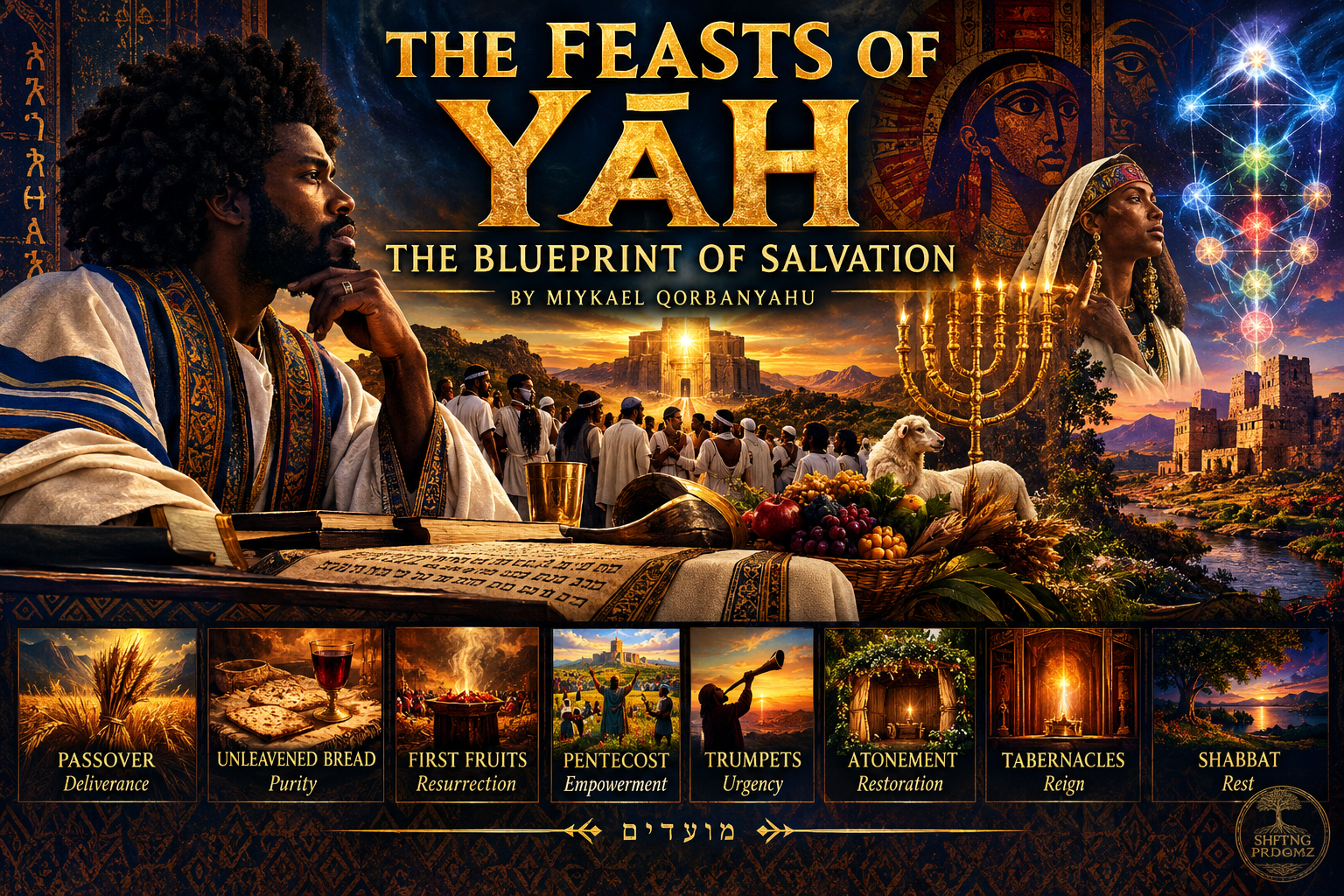
by Miykael Qorbanyahu
I remember the interview I had for an instructor position at the Afrikan Centered Education Collegium Campus (ACE) back in 2006 in Kansas City, Missouri. The appointment stood fixed for a Friday at one o’clock in the afternoon, and the man across the table was brotha Heru Khepera, Dean of Instruction and one of my own mentors. I was dressed in all white that day cultural attire that day, every thread chosen with intention, and I walked in carrying a brief presentation built to demonstrate the method of pedagogy I would bring to the students I would one day instruct. I arrived early and ready. The hour was set by someone else upon whom I would come to depend on for resources, information and direction, and my task was to meet it fully prepared for what it required.
I carry that memory with me into every reading of Leviticus 23. The chapter discusses how HaShem sets a table and names a time for Israel. With that, HaShem doesn’t send a reminder twice; the covenant people who arrive prepared, in body, mind, and spirit, receive what the appointment holds. Consider the words of Yahoshua ben Yoseph from Mattityahu 25.1-10 when he teaches that
…the reign of the heavens shall be compared to ten maidens who took their lamps and went out to meet the bridegroom. And five of them were wise, and five foolish. Those who were foolish, having taken their lamps, took no oil with them, but the wise took oil in their containers with their lamps. Now while the bridegroom took time, they all slumbered and slept. And at midnight a cry was heard, ‘See, the bridegroom is coming, go out to meet him! Then all those maidens rose up and trimmed their lamps. And the foolish said to the wise, ‘Give us of your oil, because our lamps are going out. But the wise answered, saying, ‘No, indeed, there would not be enough for us and you. Instead, go to those who sell, and buy for yourselves. ‘And while they went to buy, the bridegroom came, and those who were ready went in with him to the wedding feast, and the door was shut. And later the other maidens also came, saying, ‘Master, Master, open up for us! But he answering, said, ‘Truly, I say to you, I do not know you.’ Watch therefore, because you do not know the day nor the hour in which the Son of Aḏam is coming,
The Torah calls these appointments moedim (appointed times), and understanding them changes a person from a spectator of Scripture into a participant in the plan of redemption.
Scripture records seventy-two moedim (appointed times) across the Torah, the Prophets, and the Writings, a number that rabbinic tradition ties to the seventy-two-letter Name of HaShem drawn from Exodus 14, the passage of the parting of the sea. Seventy-two is not decoration. It is architecture. Each appointment functions as a load-bearing beam in the structure of covenant history, holding up the promise that HaShem governs time itself and invites Its people into that governance. HaShem gave these memorials because a people without appointed times becomes a people without collective memory, and a people without memory forgets its covenant, its enemies, and its El. The moedim function as anchors that interrupt the drift of ordinary days and pull the nation back to the fixed points of deliverance, judgment, and hope. Every appointment rehearses a past redemption while it points toward a future one.
The word moed (appointed time) first appears in Genesis 1:14, where the lights in the heavens exist for signs, and for seasons, the Hebrew moedim, establishing from the foundation of creation that time itself carries appointment. By Leviticus 23:2, moed becomes explicit covenant language: “the appointed times of HaShem, which you shall proclaim to be set-apart convocations.” A moed is a fixed meeting point between HaShem and Its people, set by Him, kept by us. It carries the sense of a rendezvous, a mutually recognized place and hour where two parties agree to meet.
Chag (feast or festival) carries a different weight. Rooted in the verb chagag, meaning to circle or to dance, chag describes the pilgrimage feasts, Passover, the Feast of Weeks, and the Feast of Tabernacles, when the whole nation converges on Jerusalem in celebratory motion.
The moed sets the appointment, and the chag becomes the joyful procession toward it; together they form salvation’s rhythm: HaShem fixes the meeting, and Its people move toward Him in obedient joy.
This rhythm addresses salvation on two fronts at once, and Torah names both protections directly. Exodus 23:14-17 and Exodus 34:23-24 command every man of Israel to appear before HaShem three times a year at the pilgrimage feasts, and the text attaches a promise to that obedience:
For I will cast out the nations before thee, and enlarge thy borders: neither shall any man desire thy land, when thou shalt go up to appear before HaShem your Elohim thrice in the year.
HaShem stakes Its own reputation on the security of a land whose people keep their appointments with Him. When the covenant people ascend to Jerusalem for the pilgrimage feasts, the borders they leave behind do not sit exposed. HaShem Himself becomes the firewall around the land, holding back the covetous eye of every surrounding nation, guarding the fields and homes of a people occupied with worship rather than watch duty.
The same appointed times that deliver the covenant people from sin and death also deliver the covenant people from political enemies, since Passover commemorates deliverance from Pharaoh, the Feast of Tabernacles commemorates wilderness protection from hostile nations, and the prophetic trajectory of these feasts points toward the final overthrow of every earthly power that opposes HaShem’s kingdom. Redemption from sin and redemption from tyranny share one calendar, and one verse in Exodus proves the two were never separate promises.
Passover (Pesach) opens the sacred calendar with the historical exodus from Egyptian bondage, the blood on the doorposts, and the judgment that passed over the houses of Israel. That same night hints toward the Lamb who bears the sin of the world, whose blood marks out a covenant people from a judgment that falls on the nations. Passover calls every generation to examine the leaven in its own house, since chametz represents pride and corruption that must be searched out before deliverance can be received. Hidden within this feast rests the mystery of substitution itself, the truth that life passes to another so that a nation might live, embedding vicarious atonement into the fabric of Creation’s calendar.
The Feast of Unleavened Bread (Chag HaMatzot) follows immediately, seven days of eating bread without leaven that commemorate the haste of the exodus. Those seven days picture the sinless life, unleavened by corruption, that becomes the standard for covenant walking. This feast calls the covenant people to sustained purity, since one day of removing leaven marks a start, but seven days builds a discipline that reaches into the whole household. The deeper mystery of Unleavened Bread points to a body kept from decay, matzah itself standing as a picture of incorruption.
The Feast of Firstfruits (Bikkurim) arrives as the wave offering of the first barley harvest, presented before HaShem as the guarantee of a fuller harvest still to come. This offering hints at the firstfruits of resurrection, the pattern that guarantees a greater ingathering beyond itself. Firstfruits calls the covenant people to bring their first and best to HaShem, trusting Him with the beginning rather than surrendering only the leftover. Its secret meaning carries resurrection life itself as the down payment on the age still ahead.
The Feast of Weeks (Shavuot), also called Pentecost, comes fifty days from Firstfruits, marking the giving of Torah at Sinai and the ripening of the wheat harvest. This feast hints at a pouring out that expands the covenant beyond the original camp, the wheat symbolizing the full body of the nation ready for ingathering. The Feast of Weeks calls the covenant people to receive Torah afresh, not as inherited ritual but as living instruction written directly on the heart. Its hidden mystery reveals the covenant marriage between HaShem and Its people, sealed at Sinai and renewed at every Feast of Weeks that follows.
The Feast of Trumpets (Yom Teruah), also known as Rosh HaShanah, sounds the shofar on a day of solemn rest and remembrance. That same trumpet blast hints at the King’s approach and calls the sleeping to awaken before Its arrival. This day calls every soul to self-examination in preparation for judgment, since the shofar summons a soul to account before it summons a nation to war. Its deepest secret carries the sound of the final trumpet, the great awakening of the dead and the gathering of the elect from the four corners of the earth.
The Day of Atonement (Yom Kippur) stands as the one day of the year the High Priest enters the Holy of Holies, the nation afflicting its soul and fasting before HaShem. This day hints at the great High Priest who enters once for all, bearing away the sin the scapegoat carried into the wilderness. The Day of Atonement calls the covenant people to genuine affliction of soul, true repentance that reaches deeper than performed ritual. Its secret meaning holds the mystery of atonement itself, kaphar, covering, the reconciliation of Heaven and earth accomplished in the innermost chamber of Creation.
The Feast of Tabernacles (Sukkot), also called Booths, closes the cycle with seven days dwelling in temporary shelters, commemorating HaShem’s protection of the nation in the wilderness. This feast hints at the Word who tabernacled among us, dwelling in a frail structure to bring near what once stood far away. The Feast of Tabernacles calls the covenant people to remember that every earthly dwelling stands temporary and every true security rests in HaShem’s covering alone. Its deepest mystery points toward the coming Kingdom, the eighth day, Shemini Atzeret, sealing the whole cycle with the promise of eternal habitation with HaShem among Its people.
Before any of these seven appointed times appears in Leviticus 23, the Sabbath (Shabbat) stands first, the weekly appointed time that never moves with the seasons because it stays fixed to Creation itself. The first thing in all of Scripture decreed to be set-apart (qadosh), Shabbat carries the same double deliverance the yearly feasts carry, and it carries it every single week rather than once a year. Deliverance from sin and death shows up in Shabbat rest itself, since a soul that ceases from labor for HaShem’s sake practices the very trust that overcomes sin’s demand for constant striving, and the Sages teach that Shabbat grants a neshamah yeterah, an additional soul; a taste of the world to come planted directly into the weekly calendar. Deliverance from political enemies shows up in the same rest, since a nation that trusts HaShem enough to release its fields, its labor, and its commerce one day in seven declares to every watching empire that its security rests in a Sovereign greater than any army, and HaShem answers that trust the same way He answers it at the pilgrimage feasts, standing as protector over a people who dare to stop.
The oral tradition presses this principle further. The Sages teach in Tractate Shabbat that if Israel would keep two Shabbatot in complete accordance with their laws, redemption would come immediately; Mashiyach arriving on the strength of that perfect rest alone. The weekly Shabbat functions, in this teaching, as a rehearsal so precise that its flawless performance triggers the very redemption the yearly feasts anticipate. Every appointed time in Leviticus 23 points toward the coming of Mashiyach, and the Shabbat stands as the appointment closest at hand, the one repeated fifty-two times a year, the one within reach of every household every single week.
I keep the appointments of HaShem because a covenant means everything when a meeting gets kept. The Torah gives the covenant people a calendar that trains the body to fast and feast on command, trains the mind to remember deliverance and anticipate redemption, trains the spirit to walk in the rhythm of holy convocation, and trains the community to stand united against every power that opposes HaShem’s reign. I call the covenant people to align on all four fronts at once. Align spiritually by treating each appointed time as a real rendezvous with the Living El. Align mentally by studying the fourfold layers of meaning within these appointments until the calendar becomes second nature. Align physically by keeping the fasts, the feasts, and the rest exactly as instructed, since the body that obeys trains the will that leads it. Align politically by recognizing that the same calendar which delivered Israel from Pharaoh still declares HaShem’s sovereignty over every throne standing today, and that the same firewall which guarded the land during the pilgrimage feasts stands ready to guard a people who return to their appointments now.
The meeting is set.
The Host has already fixed the hour.
Arrive prepared, or be prepared for judgment as it is written in Zekaryah 14.16-19.
And it shall be that all who are left from all the gentiles which came up against Yerushalayim, shall go up from year to year to bow themselves to the Sovereign, יהוה of hosts, and to observe the Festival of Booths. And it shall be, that if anyone of the clans of the earth does not come up to Yerushalayim to bow himself to the Sovereign, יהוה of hosts, on them there is to be no rain. And if the clan of Mitsrayim does not come up and enter in, then there is no rain. On them is the plague with which יהוה plagues the gentiles who do not come up to observe the Festival of Booths. This is the punishment of Mitsrayim and the punishment of all the gentiles that do not come up to observe the Festival of Booths.
Rise now and answer the appointment. Set the moedim on your calendar with the same seriousness you would give a meeting that could change your life, because this meeting changes more than a life, it changes a destiny. Search your own house for leaven the way you searched your presentation for weakness before walking through that door to observe the appointment. Bring your first-fruits, your whole heart, your first attention, to the One who fixed the hour long before you knew His name. Sound the shofar in your own household and wake every sleeping habit that keeps you from His table. Afflict your soul honestly on the Day of Atonement rather than performing a ritual emptied of repentance. Build your booth and remember that every comfort you call permanent is borrowed. Keep the Sabbath as though redemption itself waits on your obedience, because the Sages testify that it does. Stand aligned in spirit, mind, body, and standing among the nations, and let the same Sovereign who guarded the land during the feast of the fathers guard the land, the family, and the future of the sons and daughters who return to His appointed times today.
Selah…
Discover more from SHFTNG PRDGMZ
Subscribe to get the latest posts sent to your email.

