
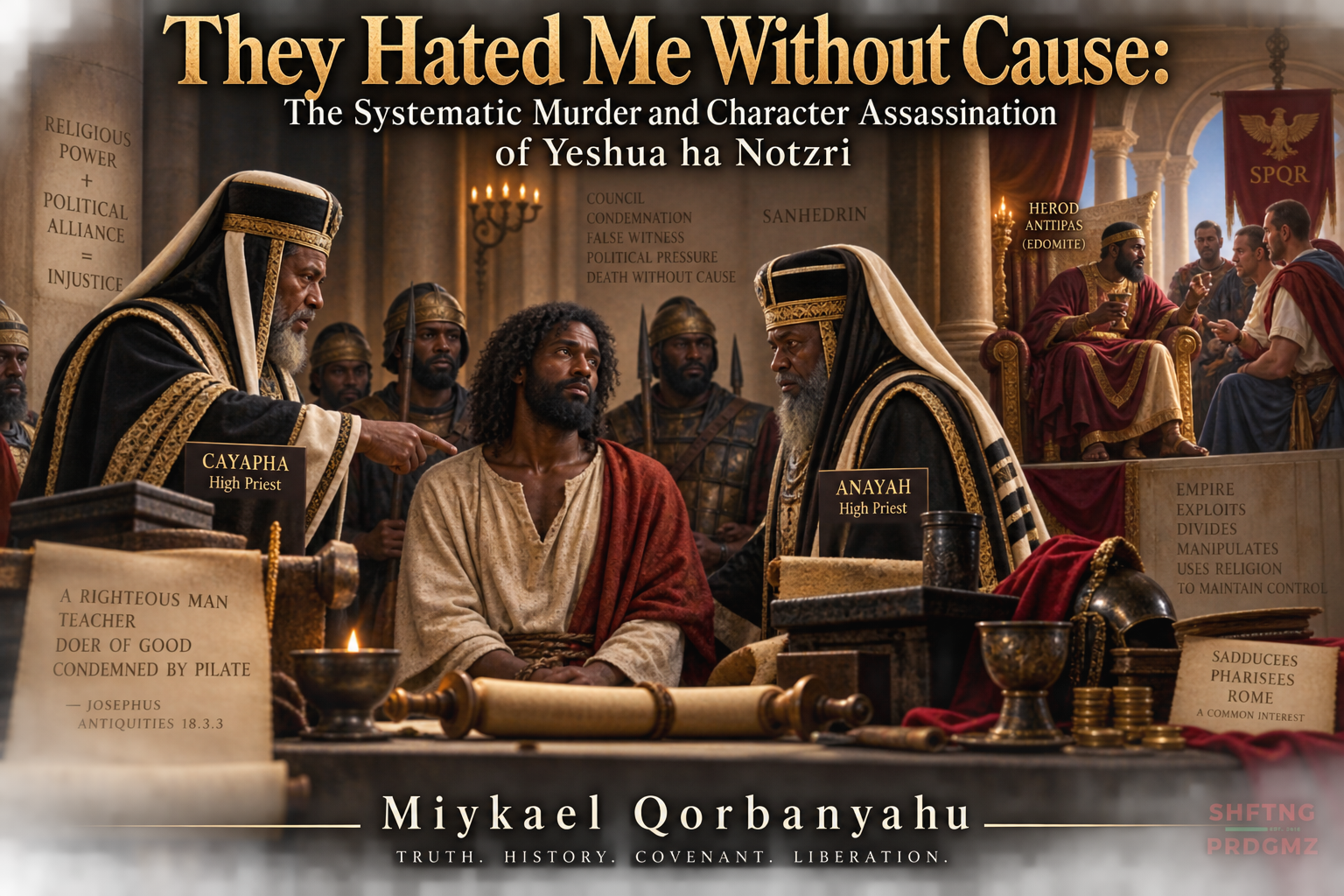
by Miykael Qorbanyahu
___________________________________________________
Remember the word that I said to you, ‘A servant is not greater than his master.’ If they persecuted Me, they shall persecute you too. If they have guarded My Word, they would guard yours too. But all this they shall do to you because of My Name, because they do not know Him who sent Me. If I had not come and spoken to them, they would have no sin, but now they have no excuse for their sin. He who hates Me hates My Father as well. If I did not do among them the works which no one else did, they would have no sin. But now they have both seen and have hated both Me and My Father, but that the word might be filled which was written in their Torah, ‘They hated Me without a cause.’
John 15.22-25
Yeshu came before Yehoshua ben Peraḥya several times and said to him: Accept our, i.e., my, repentance. Yehoshua ben Peraḥya took no notice of him. One day Yehoshua ben Peraḥya was reciting Shema and Yeshu came before him with the same request. Yehoshua ben Peraḥya intended to accept his request, and signaled him with his hand to wait until he completed his prayer. Yeshu did not understand the signal and thought: He is driving me away. He went and stood a brick upright to serve as an idol and he bowed to it. Yehoshua ben Peraḥya then said to Yeshu: Repent. Yeshu said to him: This is the tradition that I received from you: Whoever sins and causes the masses to sin is not given the opportunity to repent. And the Master says: Yeshu performed sorcery, incited Jews to engage in idolatry, and led Israel astray. Had Yehoshua ben Peraḥya not caused him to despair of atonement, he would not have taken the path of evil.
Sanhedrin 107b.15
___________________________________________________
Before I delve into the depths and dialectics of this critical and salvific disquisition, allow me to first give credit where credit is due. Truly, I must give my deepest gratitude and respect to my rabbinic course instructor and brother in faith and culture, Learn Torah Hebrew Academy founder and scholar, Nasi Avdiel ben Lewi. It’s because of his powerful pedagogy and presentations that I’ve recently experienced in class that this article, particularly, was inspired and took shape. It was during one of our rabbinic classes in September of 2026 entitled, Yeshua in the Talmud, where we engaged in critical textual analysis of the writings in the Oral Tradition that spoke of Yeshu ha Notzri that we deconstructed and reconstructed the Talmud’s polemical criticisms and categorical rejections of this historical figure from the early first century in order to demonstrate the claim that this article presents which set me in motion.
With that stated, this writing sets out to prove, through the writings of the Tanak, New Testament/Besorah, literature of the Oral Tradtiion including the Talmud, in light of the historical backdrop that gave rise to the antithetical rabbinic positions taken against the teachings, works and movement of the Nazarene, that Yeshua ben Yoseph bar Miryam of Nazareth is the Messiah prophesied to come.
This declaration, as you will come to see, rests on a historical claim of prophetic fulfillment, and not merely a matter of faith. The record left behind in the Besorah, in Josephus, in the Mishnah and Talmud, and in the wider corpus of Second Temple and early common era writings, all provide various insights on a man whose life, death, and identity forced the political and religious powers of his generation into open conflict. The witness of Yohanan (John) 7.43 tells us that a division came about among the people because of him. To fully comprehend this matter requires a proper account of that conflict by tracing the empires, dynasties, institutions and individuals that contributed to the shaping of Judea across the three centuries preceding his birth.
It was Alexander of Macedonia’s conquest of the Near East in 332 BCE that placed Judea under Greek control for the first time. Upon his death in 323 BCE, his generals divided his empire among themselves, a period historians call the Diadochi wars. Ptolemy I Soter took Egypt and founded the Hellenist Ptolemaic dynasty, which held Judea for roughly a century. Seleucus I Nicator took Syria and Mesopotamia and founded the Seleucid dynasty, which eventually wrested control of Judea from the Ptolemies around 200 BCE. A separate general, Antigonus I Monophthalmus, founded the Antigonid dynasty that ruled Macedonia itself. It should be noted that the Macedonian dynasty never held Judea and stands as a distinct line from any Judean figure who later carried the name Antigonus.
Relative to the conquering of Judea by the Grecians, Seleucid rule brought Judea under Antiochus IV Epiphanes, who reigned from 175-164 BCE. Josephus, in Antiquities of the Jews Book 12, and the books of 1 and 2 Maccabees, describe how Antiochus outlawed Torah observance, desecrated the Temple by erecting an altar to Zeus and sacrificing swine upon it, and triggered the Maccabean revolt under Mattathiyah and his son Judah Maccabee. This revolt succeeded in 164 BCE, and the Hasmonean dynasty that followed ruled Judea as an independent Jewish kingdom for roughly a century, restoring Temple worship and eventually reclaiming both the high priesthood and the royal title.
Hasmonean rule fractured through internal succession disputes between two brothers, Hyrcanus II and Aristobulus II, in the 60s BCE; this civil conflict opened the door for Rome. General Pompey intervened in 63 BCE, entered Jerusalem, and placed Judea under Roman oversight, ending true Jewish political independence. Josephus records this episode in Antiquities Book 14 and Wars of the Jews Book 1.
Antipater the Idumean, Herod’s father, rose to prominence during this period of Hasmonean weakness. Idumea, the biblical Edom, had been forcibly converted to Judaism by the Hasmonean ruler John Hyrcanus generations earlier, meaning Antipater’s family carried Jewish religious identity without descent from Judah. Antipater eventually built an alliance with Julius Caesar, and Josephus records in Antiquities Book 14 that Caesar granted Antipater Roman citizenship and appointed him procurator of Judea in 47 BCE, positioning his sons Herod and Phasael for advancement within the Roman client system.
Mark Antony held power in Rome as one of three men governing the empire following Julius Caesar’s assassination in 44 BCE, alongside Octavian and Lepidus, an arrangement historians call the Second Triumvirate. Antony took control of Rome’s eastern provinces, which placed him in direct authority over Judean affairs, and he formed a political and personal alliance with Cleopatra VII, the last ruler of the Ptolemaic dynasty in Egypt, a connection that sometimes creates confusion between Antony himself and the Ptolemaic line he allied with. Antony never ruled as a Ptolemaic king; he governed as a Roman statesman whose eastern authority brought him into direct dealings with Herod. Octavian governed Rome’s western provinces during this same period and later became sole ruler as Augustus Caesar after defeating Antony at Actium in 31 BCE.
Josephus, in Antiquities Book 14, records that when the Parthian Empire invaded Judea in 40 BCE and installed Antigonus II Mattathias, the last Hasmonean prince, as king and high priest, Herod fled to Rome. There, Antony and Octavian jointly presented Herod’s case before the Senate, which appointed him “King of the Jews” in 40 BCE, a title granted entirely through Roman political calculation rather than covenantal legitimacy. This Antigonus, grandson of Aristobulus II, held no connection to the Macedonian Antigonid dynasty centuries earlier; the shared name reflects common Hellenistic naming conventions rather than any dynastic relation. Meanwhile, Herod spent three years fighting to enforce this Roman grant, finally capturing Jerusalem with Roman legions in 37 BCE and executing Antigonus, ending Hasmonean rule permanently.
Contrary to Herod’s claim to the throne, Genesis 49:10 establishes that “the scepter shall not depart from Judah,” binding legitimate kingship over Israel to Judah’s tribal line, a promise later narrowed to David’s house through the covenant of 2 Samuel 7:12-16. Herod’s Idumean ancestry placed him permanently outside this qualification regardless of the Senate’s decree, a reality that Josephus notes generated persistent resentment among the Judean population, recorded in Antiquities Book 14 and Book 17.
Herod moved decisively to neutralize any threat the priesthood posed to his rule. Josephus records in Antiquities Book 15 that Herod executed most of the remaining Sanhedrin members upon consolidating power and began appointing and removing high priests according to political convenience, stripping the office of its hereditary Zadokite standing. This practice bound the Sadducean priestly aristocracy, who controlled Temple operations and revenue, directly to Herod’s favor and, through him, to Roman tolerance. The Mishnah, in Bava Batra 3b.13-4a.6 and related tractates, preserves memory of high priestly turnover and procedural concerns from this era that reflect the instability this system created.
Josephus, in Antiquities Book 15 and Book 17, records that Herod extended cautious favor to Pharisaic teachers Pollio and Shemiah, sparing them despite their public refusal to swear loyalty oaths to him, while eliminating other perceived threats among the populace and even within his own family. The Pharisaic schools, centered on figures like Hillel and Shammai during this period, retained teaching authority in the synagogues in exchange for political restraint, a arrangement the Mishnah and later Talmudic tractates in Avot preserve through chains of rabbinic transmission that continue without direct confrontation of Herodian legitimacy.
This same leadership, bound to Herod’s throne and Herod’s tolerance, is the very Oral Tradition whose testimony we now turn to examine. Rabbinic writers of the Talmudic period referred to Yeshua as Yeshu ha-Notzri. The designation carries two layers of meaning, marking him geographically as a man from Natzeret, and it echoes the Hebrew word netzer, branch, drawn from Isaiah 11:1’s prophecy that “a branch shall grow out of his roots,” a Messianic image tied to David’s line. The Babylonian Talmud, Sanhedrin 43a, describes his trial and execution, recording a herald calling for forty days before the execution for anyone to come forward in his defense, and naming five disciples who did so: Matai, Nakai, Netzer, Buni, and Todah. Sanhedrin 107b, with its parallel in Sotah 47a, records that Rabbi Yehoshua ben Perachiah excommunicated him, and describes him as one who “practiced sorcery and enticed and led Israel astray.” Torah law applied the term mesith to such a figure, a legal category reserved for someone whose following grew large enough to draw formal concern from religious courts.
A careful textual analysis of Sanhedrin 107b, cited at the introductory quote of this article, requires addressing a chronological difficulty that Nasi Avdiel raised directly during the Yeshua in the Talmud class. Rabbi Yehoshua ben Perachiah served as Nasi of the Sanhedrin alongside Nittai of Arbela, forming the second of the five zugot (pairs) named in Mishnah Avot 1:6, generations before the zug of Hillel and Shammai. The Talmudic account places his flight to Alexandria during the persecution of the Pharisees under King Yannai, meaning Alexander Jannaeus, who reigned from 103 to 76 BCE. This dates ben Perachiah’s active life and his documented conflict with his disciple to the final years of the second century BCE and the early first century BCE.
Yeshua ha-Notzri of Nazareth lived within the commonly accepted range of roughly 4 BCE to 30 CE, placing his adult ministry firmly within the first third of the first century CE. The distance between ben Perachiah’s documented period of activity and Yeshua’s birth spans nearly a century, a gap too wide for the two men to have shared a teacher-disciple relationship as the Sanhedrin 107b narrative describes.
This tension has a straightforward textual resolution once the Talmud’s literary method receives proper attention. Rabbinic literature frequently attaches a well-known name to a narrative slot serving a broader teaching purpose, particularly in haggadic material concerned with the consequences of rejecting rebuke or straying into idolatry. The name “Yeshu” functioned within segments of Talmudic tradition as a recognizable label for the paradigmatic Torah-departing figure, and later transmission appears to have folded an earlier anecdote about a disciple of ben Perachiah into that same label, independent of any claim to align the two men’s actual lifetimes. Peter Schafer’s research in Jesus in the Talmud documents this same pattern of internal chronological inconsistency across the various Yeshu-related passages scattered through different tractates, noting that these accounts do not form one continuous, dated biography.
Sanhedrin 43a and Gittin 57a rest on firmer chronological ground for identifying Yeshua ha-Notzri of Nazareth specifically. Sanhedrin 43a’s trial account, with its named disciples and Roman-era setting, and Gittin 57a’s necromantic inquiry into his fate alongside Titus, both align internally with the first century CE timeframe the Besorah and Josephus independently confirm. Sanhedrin 107b, read with proper attention to its own internal dating, stands as a separate literary tradition concerning ben Perachiah’s disciple, later associated with the name Yeshu through the Talmud’s characteristic method of typological naming rather than through any claim of shared history with the Nazarene teacher executed under Pontius Pilate.
Interestingly, as additionally highlighted by Nasi Avdiel in a recent Learn Torah Hebrew Academy class, Isaiah 53:8 states plainly that Messiah would face judicial injustice: “He was taken from prison and from judgment: and who shall declare his generation?” The Hebrew phrase behind “taken” carries the sense of a forced removal through oppressive legal process, and the verse continues by describing his death “for the transgression of my people,” framing an execution that violates proper judgment while accomplishing a purpose beyond the injustice itself.
The synoptic Evangels record trial proceedings that match this pattern of irregularity in specific, checkable detail. Mark 14:55-59 describes the Sanhedrin seeking testimony against Yeshua and finding that the witnesses contradicted each other, a direct violation of the standard Torah sets for capital testimony in Deuteronomy 17:6, which requires the mouths of two or three witnesses to agree. Matthew 26:59 states outright that the council “sought false witness against Yeshua, to put him to death,” naming the proceeding’s intent before any verdict formed. Luke 22:66 records the trial convening at daybreak, and Mark 14:53 and Matthew 26:57 place an earlier session at night, both details that stand in tension with the Mishnah’s own procedural requirements in Sanhedrin 4:1, which restricts capital cases from being tried at night and requires a second day before a guilty verdict takes effect. Mishnah Sanhedrin 5:5 further specifies that a unanimous verdict for conviction on the same day the trial began renders the verdict invalid, precisely the circumstance the Besorah accounts describe.
The Talmud’s own account in Sanhedrin 43a preserves an awareness that this case carried unusual weight. It records a forty-day public herald preceding the execution, an extraordinary measure the Mishnah does not require for standard capital cases, suggesting later rabbinic memory that something about this particular proceeding demanded more caution than ordinary process, even while affirming the verdict against him. The herald’s very existence testifies that authorities of that era recognized the case as unusual, aligning with Isaiah’s charge that Messiah’s judgment would depart from what justice requires. Isaiah 53:7 adds that he “opened not his mouth” before his accusers, a detail Matthew 26:63 and Mark 14:61 both record directly, describing Yeshua’s silence before the council until the high priest placed him under oath regarding his identity as Messiah.
The Besorah presents Yeshua’s teaching as a direct exposure of the Temple leadership’s condition. He drove out the money changers, declaring that the leadership had turned “a house of prayer” into “a den of thieves” (Matthew 21:13, citing Isaiah 56:7 and Jeremiah 7:11). Matthew 23 records his rebuke of the Pharisaic teachers for tithing precisely while neglecting “the weightier matters of the law: justice, mercy, and faith” (Matthew 23:23). John 8:44 records his direct address to certain religious leaders naming their conduct as departure from Abraham’s example despite their claim to his lineage, telling them that they’re offspring of their father, the devil doing his works. These passages present his conflict with the leadership as grounded in Torah’s own standards for justice and covenant faithfulness, not as rejection of Torah itself, a point he affirms directly in Matthew 5:17.
Herod the Great built the compromised and corrupted priesthood that produced this overreach. He installed and removed high priests as political instruments, ending the succession Torah established for Aharon’s line, and he appointed men from Babylonian and Alexandrian families with no ancestral claim to the office (Antiquities 15.2.4; 15.3.1). Josephus records Herod’s execution of forty-five members of the Sanhedrin who opposed his rule (Antiquities 14.9.4), stripping the body Torah charged with guarding covenant law of any independent voice. This engineered priesthood produced the house of Annas (Anayah), the family holding the high priesthood almost continuously through Yeshua’s lifetime and beyond. Annas examined Yeshua before sending him to Caiaphas (Cayapha) his son-in-law (John 18:13, 24), and Acts 4:6 names Annas, Caiaphas, John, and Alexander together as the ruling priestly kindred who confronted the apostles. The Babylonian Talmud preserves the same verdict from within the rabbinic tradition itself: Pesachim 57a records the lament “Woe is me because of the house of Hanin [Annas], woe is me for their whisperings,” alongside condemnation of the priestly houses for violence and extortion carried out through their own servants, the very practice Yeshua confronted when he drove the money changers from Temple courts these families controlled (Matthew 21:12-13). The rabbinic schools that regrouped at Yavneh after the Temple’s fall carried this inheritance forward, developing under the shadow of the priestly establishment Herod built through appointment rather than covenant succession. That establishment’s grievance against Yeshua’s exposure of its corruption traces a direct line into the polemic later encoded in Oral Law tradition, including material compiled in the Toledot Yeshu.
Josephus, writing under Roman patronage in the late first century, references Yeshua in Antiquities Book 18.3.3, the Testimonium Flavianum, describing him as “a wise man” whom Pilate condemned “at the suggestion of the principal men among us,” a phrase scholars widely accept as authentic even where later Christian scribes appear to have added embellishments to the surrounding text. Josephus also references Yaqob ha Tzaddik, or James the Just, in Antiquities Book 20.9.1, calling him “the brother of Yeshua who was called Messiah,” and records that the high priest Ananayah executed him in 62 CE through an irregular proceeding the Roman governor Albinus considered illegitimate enough to warrant Ananus’s removal from office, a detail confirming that priestly overreach against the Nazarene movement continued into the following generation.
The Didache, likely composed in the late first century, preserves the earliest Nazarene community’s ethical teaching through the framework of “the Two Ways,” life and death, built entirely on Torah ethics regarding honesty, generosity, and sexual conduct, showing a community that understood its teaching as continuous with covenant law rather than departure from it. The Gospel of the Nazarenes, known through fragments preserved by Jerome in his letters and commentaries, presents a Hebrew or Aramaic tradition maintained by Jewish followers of Yeshua who continued Torah observance while affirming his Messianic identity. Epiphanius, in the Panarion, section 29, “Against the Nazarenes,” documents this community directly, describing them as Torah-observant Jews who accepted Yeshua as Messiah, a group Epiphanius treats as a distinct sect that both rabbinic authorities and the wider Roman world regarded with suspicion precisely because it held Torah and Messianic recognition together without contradiction. Irenaeus, in Against Heresies Book 1, chapter 26, and Epiphanius in Panarion 30, describe the related Ebionite community holding a comparable position, affirming Yeshua’s Messianic role while maintaining Torah practice, evidence that his earliest Jewish followers understood no conflict between covenant faithfulness and recognition of his identity.
The Toledot Yeshu tradition, developing from oral material older than its written form and taking shape across Israelite communities between the fifth and tenth centuries, preserves communal memory of Yeshua’s following and his reputation for wonders, framed through a polemical lens shaped by the ongoing competition between Nazarene and rabbinic communities in the centuries following the Temple’s destruction. Scholars studying the Munich Talmud manuscript and related uncensored texts note that these traditions, whatever their polemical framing, consistently affirm the historical reality of his following and influence rather than denying it.
What truly presents a perspective of the spiritual quality of the people Israel is prophetically alluded to in Zechariah 9:9 foretells a king entering Jerusalem “lowly, and riding upon a donkey.” The Babylonian Talmud, Sanhedrin 98a, records Rabbi Alexandri’s teaching in the name of Rabbi Yehoshua ben Levi, explaining that the Messiah arrives “with the clouds of heaven” if Israel merits his coming, and “lowly, and riding upon a donkey” if Israel does not merit it, drawing directly on Daniel 7:13 and Zechariah 9:9 together as two possible modes of Messianic revelation tied to the nation’s spiritual condition. Matthew 21:1-9 records Yeshua’s triumphal entry into Jerusalem precisely in this manner, fulfilling the very condition the oral tradition itself connects to a generation’s unworthiness.
Daniel 9:24-27 sets a prophetic timeline of seventy weeks of years, 490 years total, running from a decree to restore and rebuild Jerusalem until Messiah is “cut off, but not for himself.” Nehemiah 2:1-8 records Artaxerxes issuing this decree in his twentieth year, dated to 445 BCE. Sixty-nine of Daniel’s seventy weeks, 483 years measured in the 360-day prophetic calendar Daniel employs throughout his visions, bring this timeline into the early first century CE, landing within the recorded ministry and death of Yeshua haNotzri. Daniel’s book held central standing within the same schools that trained the priesthood and the Pharisaic teachers of the era, a text the leadership studied and taught rather than a source obscure to them.
The Jerusalem Talmud, in Yoma 39b, and its Babylonian parallel, Yoma 39b record a tradition that four supernatural signs of divine favor over the Temple’s atonement service ceased forty years before the Temple’s destruction in 70 CE, placing the change at approximately 30 CE. The crimson thread tied to the scapegoat on Yom Kippur stopped turning white, a sign tradition read as confirmation that atonement had been accepted. The westernmost lamp of the Menorah stopped burning continuously through the night. The doors of the Temple’s sanctuary began opening by themselves. The lot for HaShem in the Yom Kippur service stopped coming up in the priest’s right hand, the position tradition associated with favorable acceptance. This same rabbinic tradition dates all four changes to the same approximate year, a year matching the timeframe of Yeshua’s death.
Israel’s sages preserved this tradition generations before Christian scholars ever connected it to Yeshua, giving the account an independent witness outside the Besorah. Their timeline places the disruption at the exact hour of the crucifixion, and the Evangels record the Temple veil tearing from top to bottom at that same moment. Rabbinic memory and apostolic testimony agree on this unique single event, each preserved through its own separate channel of transmission. This convergence opens the door to a deeper reading of what happened at the stake, one that Paul develops directly in his letter to the believers in Rome.
Romans 10:4 states that “Messiah is the goal of the Torah unto righteousness to every one who believes,” a phrase better understood as fulfillment and goal rather than termination, since Yeshua himself declares in Matthew 5:17 that he came to fulfill Torah rather than dissolve it. Torah’s entire sacrificial system pointed toward one final atonement it could never fully accomplish through repetition, as Hebrews 10:1-4 argues explicitly. Yeshua’s death, occurring at the precise moment the Temple’s own confirming signs departed, stands as the substance the shadow always pointed toward.
This substance connects to the very beginning of the human story. In my second book, The Pattern of Adam Revealed, I elaborate how Genesis 1:26-28 establishes humanity’s created purpose as bearing Elohim’s image, being fruitful and exercising dominion over self and creation, an authority forfeited because of the fall. This is why humanity, in every following generation, has required restoration.
Psalm 2:6-8 presents Elohim’s anointed King, installed on Zion, granted the nations as an inheritance, a coronation Yeshua’s resurrection and exaltation fulfill directly, as Acts 13:33 applies this psalm to him by name. Zechariah 3 presents Joshua the high priest standing before the Angel of HaShem in filthy garments, accused by the Adversary, and cleansed through a direct act of Elohim’s favor rather than his own merit, a picture of substitutionary atonement granted rather than earned. Zechariah 4 follows immediately with the vision of the golden lampstand fed continuously by olive oil flowing directly from two olive trees without human hands laboring to refill it, a picture of the Spirit’s sustaining power operating apart from human effort, framed by the declaration “not by might, nor by power, but by my Spirit.”
Three centuries of Hellenistic conquest, Hasmonean revolt, and Roman intervention produced the precise conditions of Yeshua’s generation. Antiochus IV’s persecution birthed the Hasmonean state; Hasmonean fracture invited Rome; Rome’s client system installed Antipater’s line; Antony and Octavian’s Senate decree crowned an Edomite king over a throne Torah reserved exclusively for Judah. That exact king reshaped the priesthood into an instrument of his own survival and bound the teaching houses to political silence through calculated favor. It was into this arrangement that a man was born whose teaching, timing, and identity aligned precisely with Daniel’s calculation, Zakaryah’s sign, and Yeshayah’s branch. Josephus records the response of “the principal men,” the Sanhedrin preserves the record of a trial and a herald’s forty-day search for a defense, and the Nazarene, Ebionite, and Toledot Yeshu traditions each preserve, from their differing vantage points, the memory of a following too significant to deny. The Temple’s fall in 70 CE stands clearly as the historical record’s own closing testimony on the corrupted leadership of his day that rejected him.
All of the texts and historical contexts mentioned in this disquisition, indeed, bear witness to the prophetic revelation that Yeshua ben Yoseph bar Miryam ha Notzri is Messiah.
HalleluYaH…
…Amein…
…Selah!
Discover more from SHFTNG PRDGMZ
Subscribe to get the latest posts sent to your email.

