
______________________________________________
[Rabbi Gamliel] used to say: The more flesh, the more worms; The more property, the more anxiety; The more wives, the more witchcraft; The more female slaves, the more lewdness; The more slaves, the more robbery; [But] the more Torah, the more life; The more sitting [in the company of scholars], the more wisdom; The more counsel, the more understanding; The more charity, the more peace. If one acquires a good name, he has acquired something for himself; If one acquires for himself knowledge of Torah,
he has acquired life in the world to come.
Pirke Avot 2.7
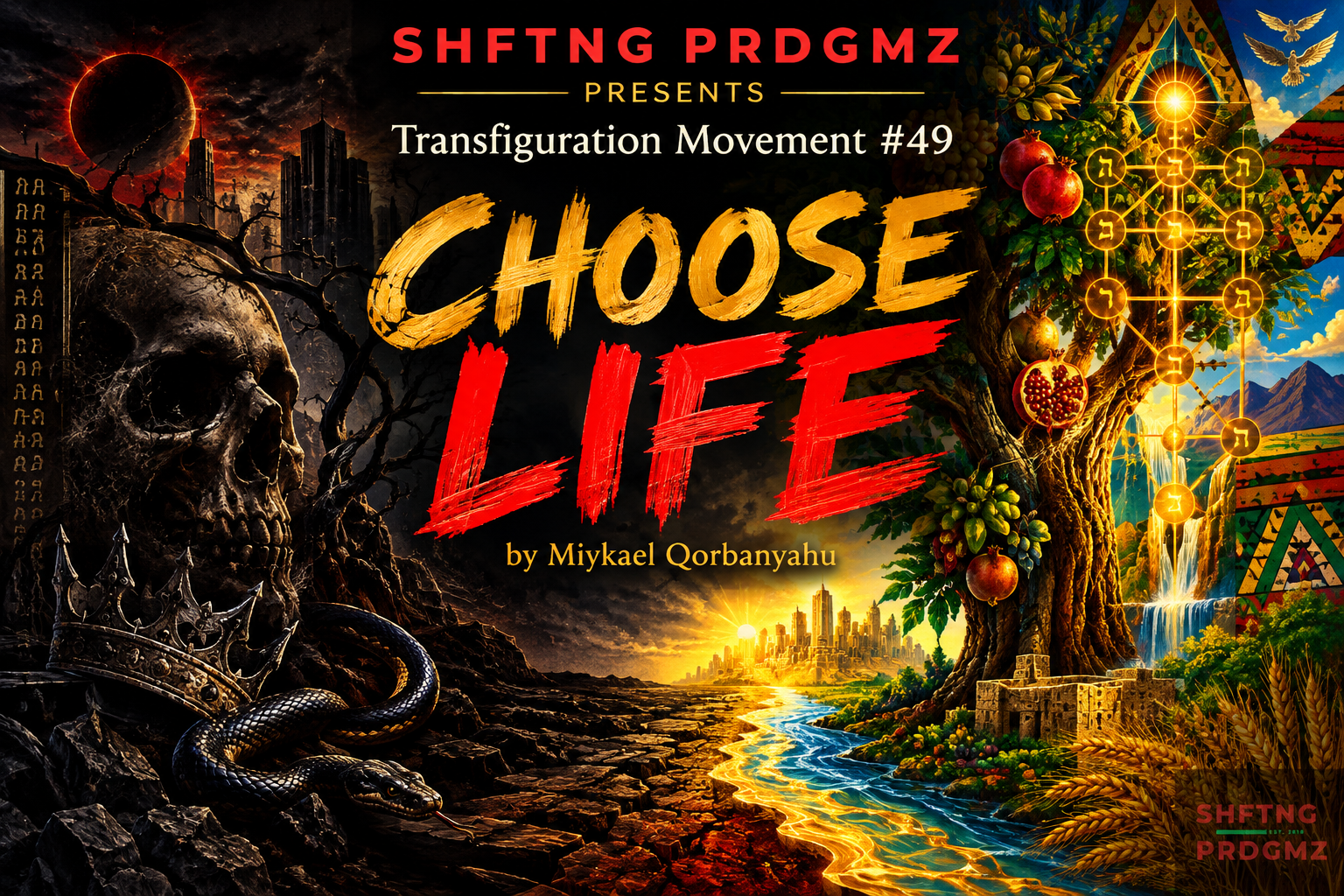
I call heaven and earth to witness against you this day: I have put before you life and death, blessing and curse. Choose life—if you and your offspring would live by loving HaShem your Elohim, by heeding HaShem’s commands, and by holding fast to [HaShem]. For thereby you shall have life and shall long endure upon the soil that GOD swore to your fathers Abraham, Isaac, and Jacob, to give to them.
Deuteronomy 30.18-19
______________________________________________
I remember the summer of ’93 with clarity, even though my vision stayed blurry.
The day after graduation, I lost my virginity and I began smoking cannabis. It was a primer for a season in my life that began a downward spiral into chaos and confusion. And then my college experience.
College had cracked me open in ways I didn’t expect. After losing my virginity, within weeks I was in my first physical relationship. I used to regularly blazing blunts and spliffs with my teammates just outside of our dorm room and I remember when there was a time that it smelled like freedom.
I felt grown.
I felt free.
But my neshama, the soul HaShem breathed into me, sat quiet in the corner of my being, watching a young man trade innocence for carnal experiences and call it growth.
Smoke used stayed in my lungs that summer and I used to stay defiling myself with girls for the first three years of college, and being dear, dumb and blind like I was, I didn’t yet know what smoke was. But now that I know that smoke is what breath becomes when it forgets its Source, my approach to life is entirely different all because of the choices I now make.
Solomon, as the Convener opens his book with the cry,
Vanity of vanities, says the preacher, vanity of vanities; all is vanity
Ecclesiastes 1:2
Interestngly, the Hebrew word used here for vanity is hevel/הֶבֶל; a vapor, a breath that rises from the mouth on a cold morning and is gone. It’s the same name Cain’s brother carried; as Hevel was a life that vanished, and the ground itself testified to it:
The voice of your brother’s blood cries unto me from the ground
Genesis 4:10
Every counterfeit life is a vapor, and back then, I was inhaling one and calling it liberation.
I tell this story because every soul reading or listening to this knows a version of that summer. A moment arrives when the yetzer hara, the evil inclination toward self, whispers that death dressed in pleasure counts as life. We first see this in Genesis 3 when the serpent, the yetzer hara, tells Chawwah,
You shall certainly not die. For Elohim knows that in the day you eat of it your eyes shall be opened, and you shall be like Elohim, knowing good and evil.
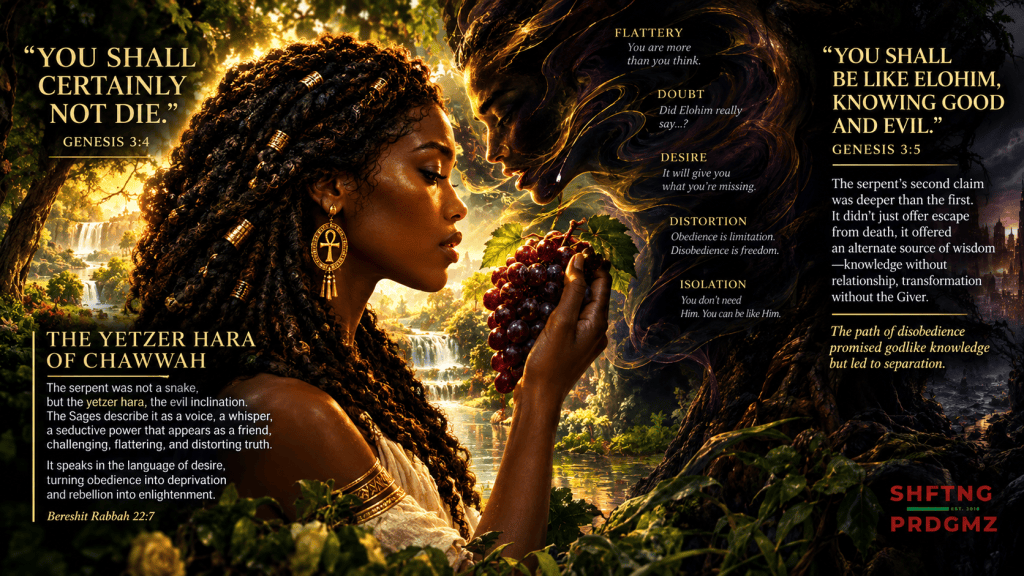
The serpent plants the first seed of this generational pattern directly in the garden. His words to Chawwah carry death disguised as elevation tellig her you shall certainly not die. This statement contradicts the word HaShem already spoke, and the serpent builds his entire strategy on that contradiction, training the human heart to question HaShem’s instruction as the first move toward destruction.
The serpent’s second claim cuts even deeper. He tells her that Elohim withholds something good, that eating the fruit opens her eyes and makes her like Elohim, knowing good and evil. This framing turns obedience into deprivation and rebellion into enlightenment. The serpent offers Elohim-like knowledge through a path that bypasses relationship with the Giver of all knowledge, promising transformation through disobedience rather than communion and faithfulness.
This moment establishes the first instance of entertainment as deception, a shining fruit presented as pleasurable to the eyes and desirable for gaining wisdom. The serpent markets death as growth, exactly the pattern each generation since has inherited and has on repeat for the death spin cycle. Chawwah’s choice in that garden mirrors every choice offered in Deuteronomy 30:19, life framed as loss, death framed as gain, and a soul standing at the crossroads deciding which voice to trust.
And yes, our eyes do open when exposed to sin, just as the serpent said; but they open to shame, fear, and separation, the true fruit of a life built on a counterfeit promise. The garden, therefore, holds the first lesson a generation drowning in illusion still needs: true elevation never grows on a tree planted by deception.
Keeping our purpose in perspective, the sages noticed that when Genesis 2:7 says HaShem formed the man, the Hebrew word vayyitzer carries two yods, they heard in that double lettered yod, the two inclinations that live in every human being from the day of creation (Berakhot 61a). For me, this leads back to the assumed responsibility of fault because none of the girls who came through to see me arrived in my dorm room by accident; I allowed them through my door and entertained them. Unfortunately, many of us have walked through doors just like that in our lives, not knowing that
…her house is the way to Sheol, going down to the chambers of death…
Proverbs 7.27
It is in this spirit that Rav Shaul gave the same warning to Timothy in plain words:
…she that lives in pleasure is dead while she lives…
1 Timothy 5:6.
So, yeah, a person can walk, laugh, and post photographs online about their vain exploits while the neshama sits silent , suffering in the corner.
But the beauty of it is that HaShem never leaves us there; It always calls us back to choice.
This gives all the more meaning to the moment that Moshe stood before Israel in Deuteronomy 30:19 and declared,
I call heaven and earth to witness against you today…
With this pronouncement we find that heaven and earth testify regularly, if we’re paying attention.
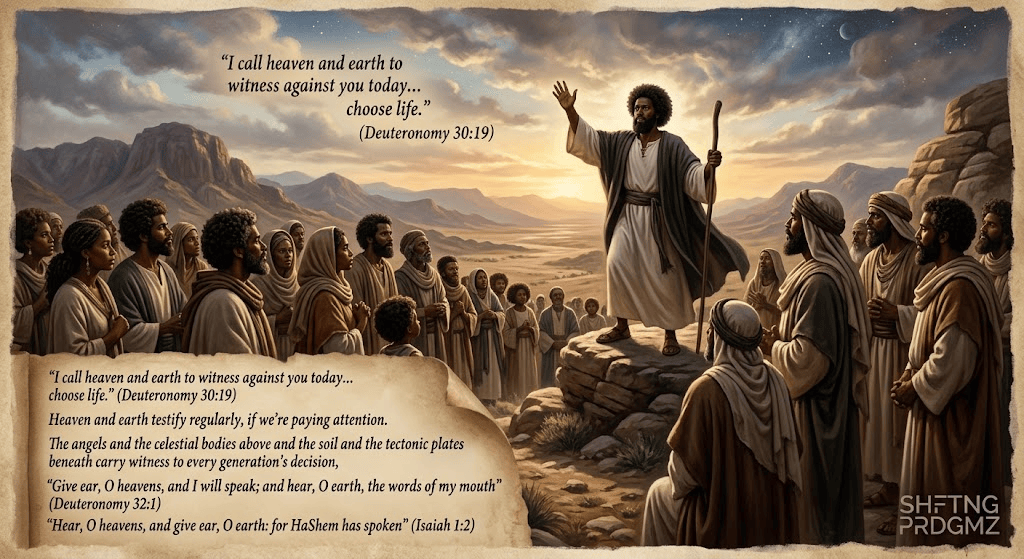
With that, it’s the angels and the celestial bodies above and the soil and the tectonic plates below that carry the witness to every generation’s decision, which is why Moshe opens his final song with the summons,
Give ear, O heavens, and I will speak; and hear, O earth, the words of my mouth
Deuteronomy 32:1
Isaiah later opens his vision with a similar pronouncement:
Hear, O heavens, and give ear, O earth: for HaShem has spoken
Isaiah 1:2
The ground that swallowed Hevel’s blood and swallowed Korah and his band of rebels is the same ground that now listens to us. Deuteronomy 30:15-20 lays the choice bare: life and good, death and evil. Deuteronomy 11:26-28 ties blessing and curse to obedience, passed from father to son, mother to daughter, teacher to student.
This choice never expires.
Every generation stands at the same crossroads Israel stood at in the wilderness.
Joshua stood there with the tribes at Shechem and said,
…Choose for yourselves this day who you will serve…
Joshua 24:15
Eliyahu stood there on Mount Carmel and asked the people,
How long will you hop between two opinions?
1 Kings 18:21
Neither of them offered a third option, because none exists.
The crossroads has two roads, and standing still on it is a decision.
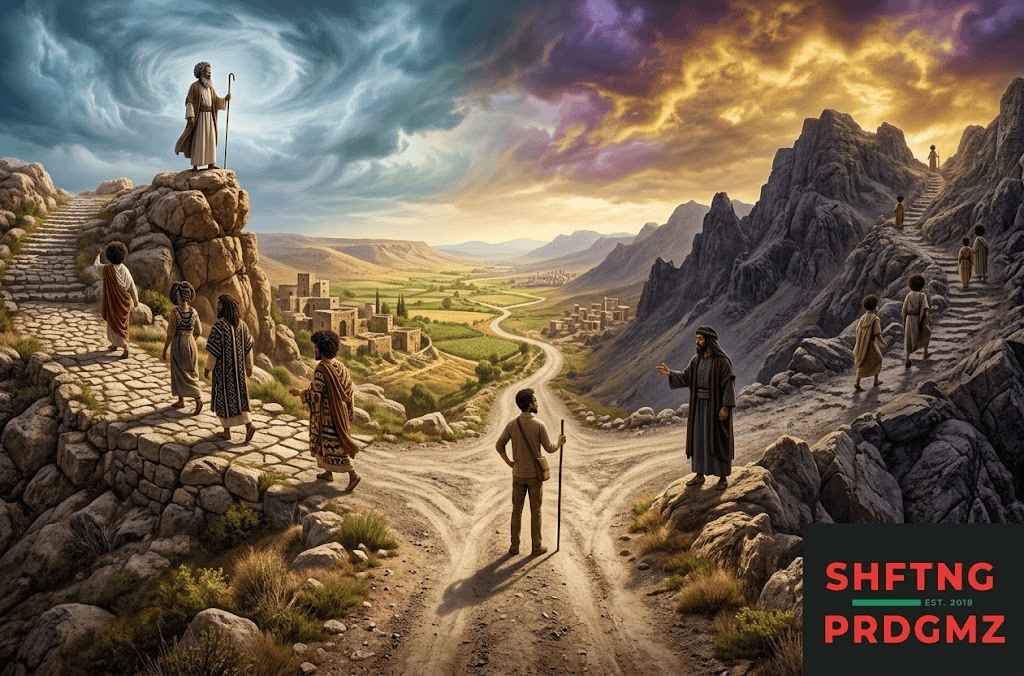
The sages of the Yerushalmi Talmud tell of a parable about this very verse: A father stands with his son before an inheritance and tells the boy to choose a portion for himself, and then the father lays his own hand on the best portion and says, choose this one. That is how HaShem commands the choice; HaShem sets life and death before us, and then, metaphorically, puts Its hand on life. For us, as intelligently designed, the commandment to choose arrives already holding the answer.
Moshe doesn’t leave the answer at the level of command, as three verses later he reveals exactly what life is:
That you may love HaShem your Elohim, and that you may obey his voice, and that you may cleave unto him: for HaShem is your life, and the length of your days
Deuteronomy 30:20
It’s in this that we’re shown choosing life means choosing a Being. The above verse of Deuteronomy identifies HaShem Itself as life, collapsing the distance between the abstract idea of “life” and a direct relationship with a Being. Choosing life, for Israel, means choosing to love, obey, and cling to HaShem as a living Being who holds the fullness of life within Itself.
The Tree of Life in Gan Eden carries this same pattern. The tree stands as a physical sign pointing toward the Source who sustains all existence, a living connection to the Shekinah presence rather than a static reward. Eating from that tree means drawing life from proximity to HaShem Itself, a relationship sustained through faithfulness and nearness rather than through possessing information or power. Selah…
Messianic thought carries this truth into its fullest expression through Yeshua’s declaration in John 14:6:
I am the way, the truth, and the life
HaShem identifies as Life Itself, placing a Being at the center of the choice Moshe set before Israel. John 1:4 reinforces this, stating
In Him was life, and the life was the light of men.
Life flows from union with HaShem as a living Being, carried forward through covenant relationship rather than through adherence to principle alone. This is essential consciousness as it is the covenant that defines that nature of the relationship and the conditions which apply for the purpose of Life being birthed in connection with HaShem.
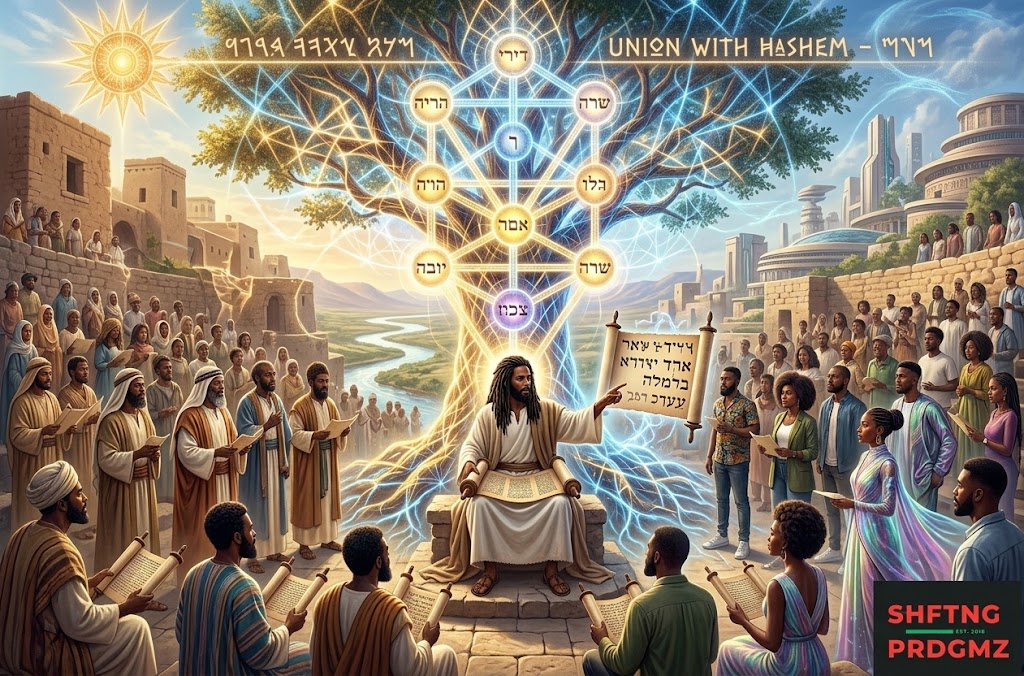
This frame transforms every call to “choose life” throughout Scripture into an invitation toward relationship. Proverbs 8:35 declares whoever finds me finds life, with wisdom personified as a voice calling out to be found and known. As we opened this article referring to the benefits of Torah study taken from Pirkei Avot 2:7 which teaches us that study of Torah multiplies life because study draws the student into deeper communion with the Author of Torah, not merely into accumulation of facts. This translates into taking on the thoughts and ways of HaShem, which equals reflecting the image and likeness of Elohim in which we were created. Rambam explains this in the Mishneh Torah, Hilchot De’ot (Human Disposition) 6.3,
It is a positive commandment to attach [ourselves] to wise men and to their disciples, in order that we may acquire their manners; just as it is said: And to Him shall you cleave, (Deut. 10. 20). Now is it possible for a man to cleave to the Shechinah (the Heavenly Esteem)?—In explanation of the commandment the sages remark; attach yourself to wise men and to their disciples…
As was also stated, a soul that chooses life chooses to walk with HaShem, which is to cling to Yeshua as the embodiment of that life, as revealed in the Song of Songs 3.4 and Ephesians 5.31-32 speaks, and to let every decision flow from nearness and cleaving to El Chayyim, the Living One who holds all existence within Itself.
To be clear, life is not a condition we reach by good behavior; Life, in Its fullest sense, is the One we cleave to. Rav Shaul takes up the same language when he writes,
…Messiah, who is our life…
Colossians 3:4
…and when he explains in Romans 10:6-8 that Moshe’s words about the commandment being near us, in our mouth and in our heart, he describes the Word that came near in the flesh.
Yes, the choice of choosing Life has a face, and Moshe knew we couldn’t make the choice with an unchanged heart. Ten verses earlier in Deuteronomy he promises,
HaShem your Elohim will circumcise your heart, and the heart of your seed, to love HaShem your Elohim with all your heart, and with all your soul, that you may live
Deuteronomy 30:6
Life, therefore, comes through a covenant cut into the heart, and the promise reaches the seed before the seed can speak; this is rebirth! It’s rebirth simply because when one has their heart changed and the Word of HaShem is planted within the believer, they’re no longer who they were prior to the Word taking root in their life; they’re now new creatures in Mashiyach. This is a choice we all must make from the two paths in life that we must make our decision on which one we will embark.
The two roads that I wrote of earlier weren’t invented in the wilderness, they were planted in the garden:
The tree of life also in the midst of the garden, and the tree of knowledge of good and evil
Genesis 2:9
After the fall, Genesis 3.24 tells us that HaShem stationed cherubim and a flaming sword to keep the WAY of the tree of life. Notice the phrase the Torah chooses, it doesn’t call the tree a place, it calls it a derekh, a way, and every later text that speaks of the way of life, from Jeremiah 21:8 to Psalm 16:11, tells us of how Hashem…
…will show me the path of life…
What this describes is us walking back toward that guarded garden.
The earliest Messianic communities knew this. Their first instruction manual, the Didache, opens with the sentence that there are two ways, one of life and one of death, and that a great difference separates them.
There are two ways, one of life and one of death; but a great difference between the two ways. The way of life, then, is this: first, you shall love HaShem who made you; second, your neighbor as yourself; and all things whatsoever you would should not occur to you,
do not also do to another.
Didache 1.1
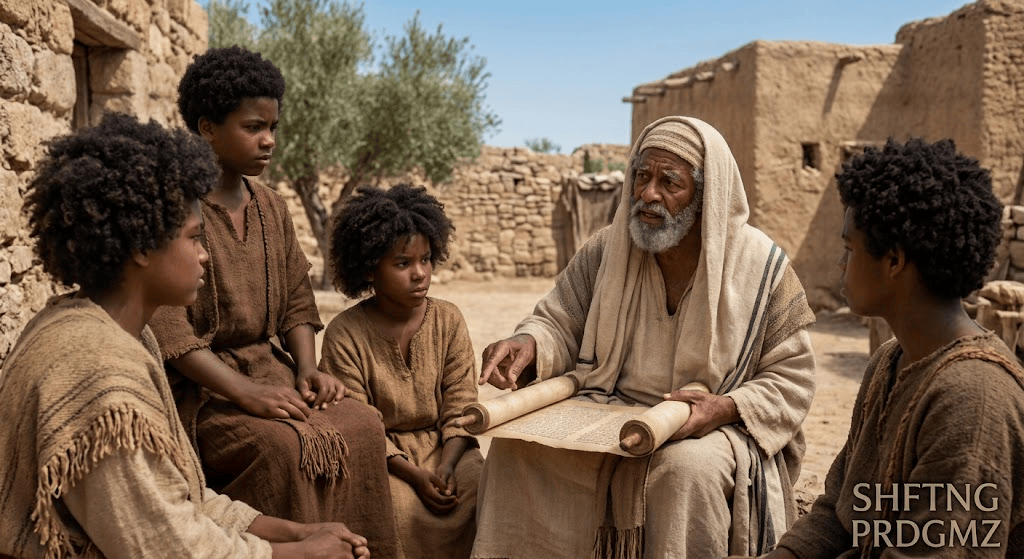
The Sages read the two trees as two ways of seeing the world. The Tree of Knowledge of Good and Evil holds A mixture, truth tangled with falsehood, mercy bleeding into cruelty, light wrapped in husks. The serpent and its seed works only in that mixture. He never offers the woman a lie she can recognize as a lie, he instead offers her a half truth that looks delicious and trustworthy.
The Tree of Life, on the other hand, stands unmixed, and the Zohar locates it in the central pillar of the sefirot, in Tiferet, the beauty that balances Chesed, which is mercy, against Gevurah, or judgment. When Moshe says life and good, death and evil, he is describing the same map from the other side. This is the choice we must all make. What we must know, most importantly, is that the way of life runs down the middle, where mercy and truth meet, and Micah sings the names of the two patriarchs who hold those poles:
…You will perform truth to Jacob, and mercy to Abraham…
Micah 7:20
Messiah Yahoshua ben Yoseph walked into the world as the One who joined them. John 1.14 says He came full of favor and truth, favor being the mercy of Abraham and truth being the beauty of Jacob; this is the Tree of Life walking on two legs through Galilee.
The sages leave one more hint in the Hebrew. The word chai/חַי, life, is written with the letters chet and yod, eight and ten, and adds up to eighteen. Every time an Israelite family gives a gift in multiples of eighteen, they are saying life without speaking the word.
But unfortunately today, I watch a generation rise that inherits more entertainment and less wisdom than any generation before it. Screens form the new altars, and they demand sacrifice; our time and attention and what we pay attention to is everything.
Jeremiah 21:8 names the way of life and the way of death as two roads set before the people, and entertainment today paves the road to death with music, film, and spectacle. The psalmist knew how this works, as he spoke of the idols of the nations, with eyes that cannot see and ears that cannot hear, and then he delivers the sentence that explains every algorithm ever built:
They that make them are like unto them; so is every one that trusts in them
Psalm 115:8
So in effect, we become what we stare at, and the social engineers know that. David resolved to guard his gate when he wrote,
I will set no wicked thing before mine eyes
Psalm 101:3
and Solomon told his son where the battle is won:
Keep your heart with all diligence; for out of it are the issues of life
Proverbs 4:23
Violence streams into young eyes as content, normalized through repetition until death becomes a punchline. Deception spreads through algorithms engineered to feed illusion as truth, training a generation to trust the feed over the Father. Decadence gets filmed, filtered, and celebrated as aspiration, turning excess into an identity rather than a warning sign. Isaiah described this exact inversion:
Woe unto them that call evil good, and good evil; that put darkness for light, and light for darkness
Isaiah 5:20
Hosea named the root of it:
My people are destroyed for lack of knowledge
Hosea 4:6
The destruction is already here, and it is quiet, because it arrives as entertainment.
Notice also what the feed does with our mouths.
Death and life are in the power of the tongue: and they that love it shall eat the fruit thereof
Proverbs 18:21
I stood in that current once, in my dorm room, breathing in smoke and calling it liberation; defiling myself with random girls. But, HaShem’s mercy met me there the same way Ezekiel 18:23 declares:
…I have no pleasure in the death of the wicked,
but that the wicked turn from his way and live…
Ezekiel 33:11 repeat this call, adding the plea of a Father at the end of His patience:
Turn, turn from your evil ways; for why will you die, O house of Israel?
Ezekiel 33:11
A culture drowning in death still floats within reach of His outstretched hand.
The beauty amidst all the ugliness that is in the world today is that despite desensitization to death, mercy doesn’t wait for us to clean ourselves up first. Yahoshua tells of a son who wasted his inheritance and started home with a rehearsed apology, but
when he was yet a great way off, his father saw him, and had compassion, and ran, and fell on his neck, and kissed him
Luke 15:20
The father was running before the son could say a word.
That is the posture of HaShem toward every young man lost in a haze and every woman scrolling at midnight.
The outstretched hand in Ezekiel is already moving toward us.
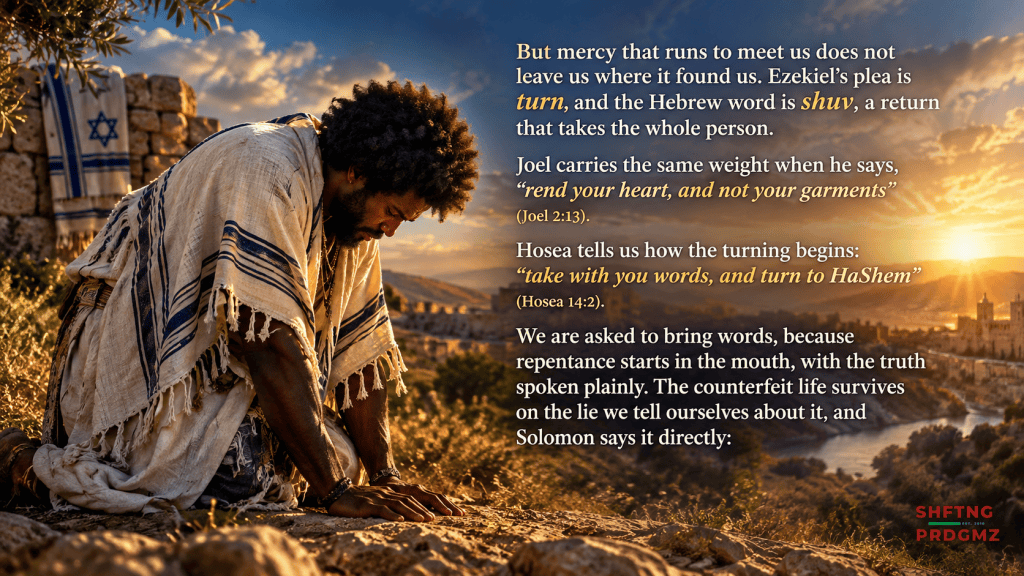
But mercy that runs to meet us doesn’t just leave us where it found us. Ezekiel’s plea is turn, and the Hebrew word is shuv, which gives us the idea of a return that takes the whole person. Joel carries the same weight when he says, rend your heart, and not your garments (Joel 2:13). Hosea tells us how the turning begins: take with you words, and turn to HaShem (Hosea 14:2). We are asked to bring words, because repentance starts in the mouth, with the truth spoken plainly. The counterfeit life survives on the lie we tell ourselves about it, and Solomon says it directly:
He that covers his sins shall not prosper: but whoever confesses and
forsakes them shall have mercy
Proverbs 28:13
That is why the first step is humbler than most people expect. Before any discipline, program, or resolution comes an honest naming. I could not turn from the smoke while I still called it freedom. The serpent’s work is undone the same way it was done, with words, so the road back begins by calling a thing what it is. Here are six steps, and the first is the one I had to take in that dorm room.
1. Seek HaShem and live. Amos 5:4 carries HaShem’s invitation to the house of Israel: “Seek Me and live.” Verse 6 repeats it: “Seek HaShem and live.” Set aside a fixed hour each morning for prayer, so the day begins in His presence.
2. Walk with the wise. Proverbs 13:20 teaches, “He who walks with wise men will be wise.” Ecclesiastes 4:9-10 adds that two are better than one, because one lifts up the other who falls. Hebrews 10:24-25 calls believers to gather and stir one another toward love and good works. Build a circle of brothers who speak truth and hold you to your decision.
3. Welcome correction. Proverbs 10:17 says, “He who heeds instruction is in the way of life.” Proverbs 6:23 declares that “the reproofs of instruction are the way of life.” Invite a teacher or elder to speak into your habits, and receive the word with gratitude.
4. Pursue righteousness and mercy. Proverbs 21:21 promises, “He who follows righteousness and mercy finds life, righteousness, and honor.” Micah 6:8 names the same path: do justly, love mercy, and walk humbly with your Elohim. Serve someone this week who cannot repay you.
5. Keep the Shabbat. Exodus 31:16-17 calls Shabbat a sign between HaShem and Israel for all generations. Isaiah 58:13-14 promises delight in HaShem and an inheritance for those who honor the day. Yeshua declares in Mark 2:27 that Shabbat was made for humanity. Rest one full day each week, and let your body and soul drink from the Source.
6. Present your body and renew your mind. Romans 12:1-2 urges you to offer your body as a living sacrifice and to be transformed by the renewing of your mind. 1 Corinthians 6:19-20 teaches that your body is a temple of the Ruach HaKodesh, bought at a price. Feed your mind with Scripture, and nourish your body with rest, clean food, and movement, so the temple serves its Owner well.
Each step grows from the same root: life flows to the one who draws near to HaShem and lets His Word shape every part of the day.
HaShem did not leave me in that dorm room, instead I was pulled toward the narrow gate and had the Torah and Messiah set before me as the path of life. The summer I thought was my fall became the road HaShem used to teach me how to find the gate for the ones who would come after me. Neither can you know what your wilderness is preparing for you, if you choose life.
Rabbi Yitzchak Luria Ashkenazi, the Arizal, taught that no place in the world is so low that a spark of light cannot be lifted out of it. A generation drowning in death is also a generation sitting on buried light, and our assignment is to say the word that lifts it.
So stand at the crossroads today.
Name the vapor.
Make the choice.
Guard your gate, cleave to Yahoshua, walk the way, and take a child, a student, or a congregation by the hand and lay yours on the best portion. Say to them what HaShem says to us, “choose this one.” He closes the charge with a promise that reaches beyond any single generation: “that you and your offspring may live” (Deuteronomy 30:19).
Your offspring stand watching.
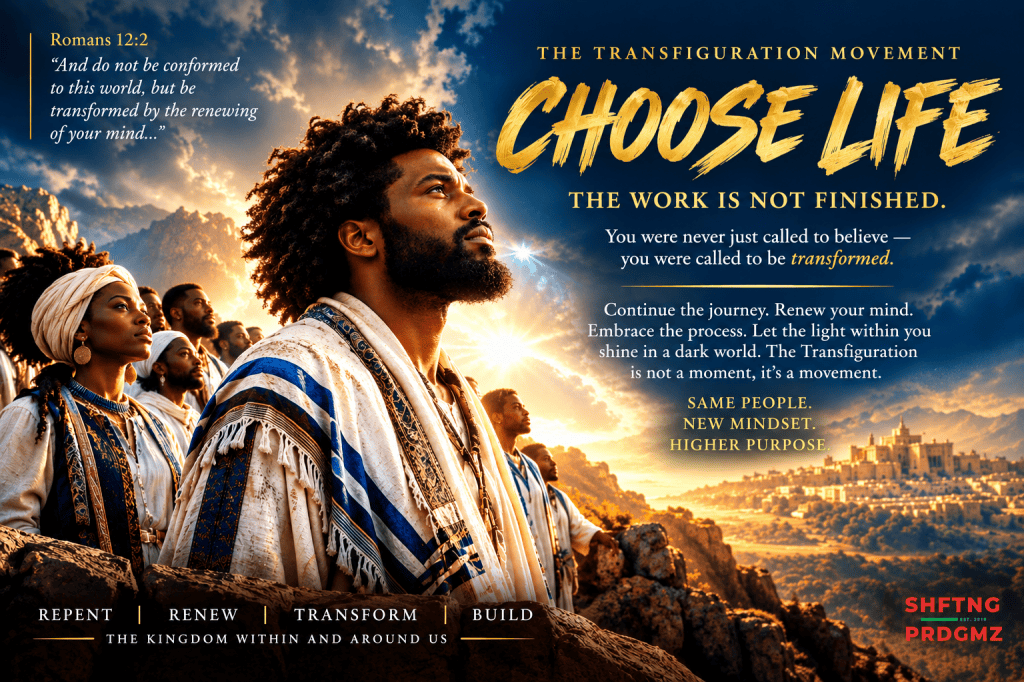
Choose life.
Transfigure.
Selah…
Discover more from SHFTNG PRDGMZ
Subscribe to get the latest posts sent to your email.

