
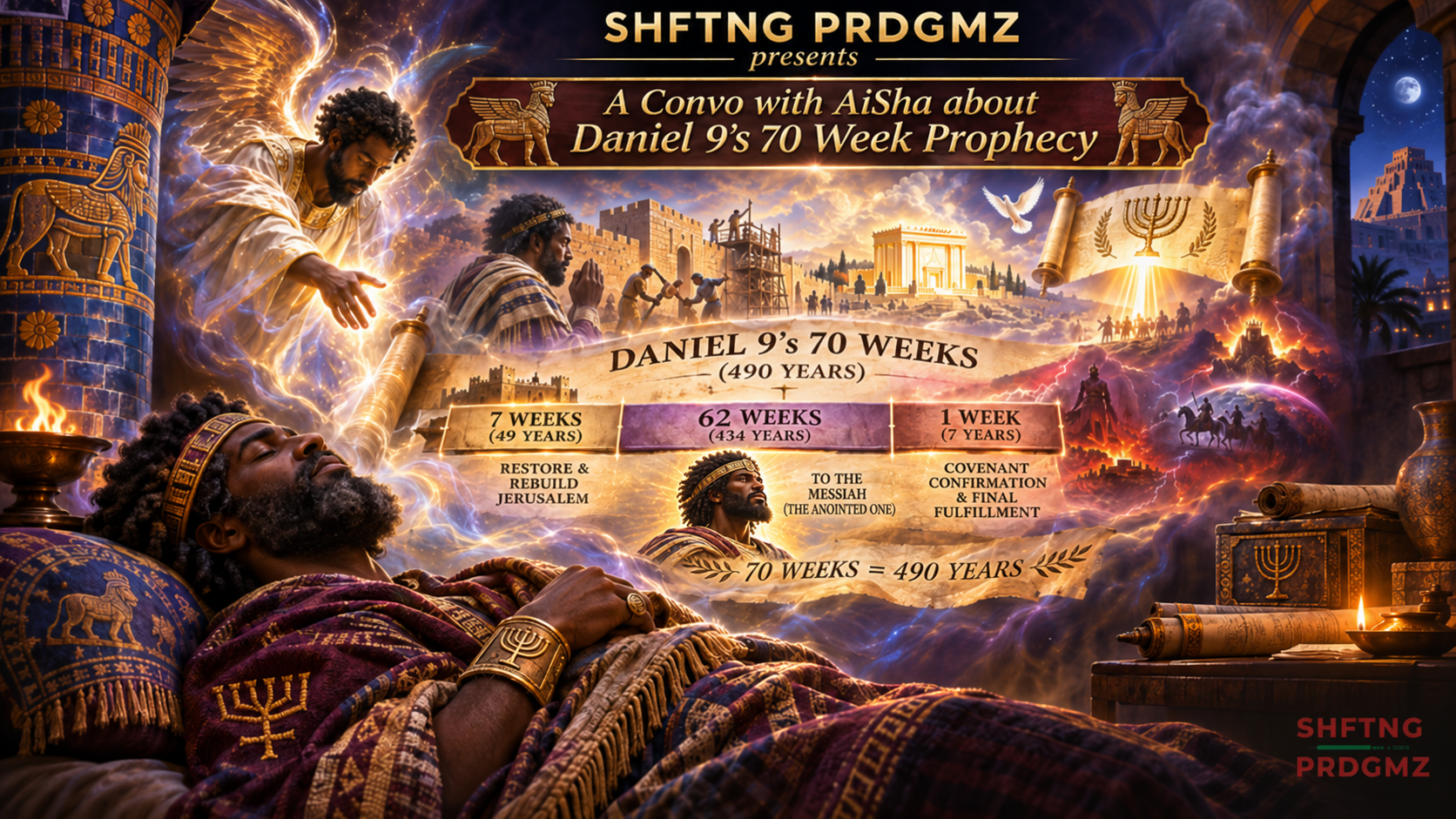
Prompt: How does the 70 week prophetic time of Daniel connect to the time of Yeshua ben Yoseph and his cutting off as Mashiyach as the prophecy entails? Present the entirety of the prophecy and to the actual destruction of the temple relative to the year 70 CE and if the math does, in fact, connect to the 1st century CE. Expand on the Dead Sea Scrolls messianic perspective from Mechizedek, and then add more historical context to the prophecy, showing how it manifested in history. End with a conclusion regarding Daniel 9, providing a logical, historical, and prophetic conclusion on whether or not Yeshua is the Messiah mentioned in Daniel 9.
______________________________________________________________
Daniel 9:24-27 gives a timeline of “seventy weeks” (shavuim, units of seven, usually read as seven years each), which totals 490 years. Gabriel delivers it to Daniel while he prays for Jerusalem’s restoration, and it covers the city and the people of Daniel.
The structure. The text splits the 70 weeks into three parts: seven weeks (49 years), then sixty-two weeks (434 years), then one final week (7 years). The starting point is “the going forth of the word to restore and build Jerusalem.” The seven plus sixty-two weeks run “unto Mashiyach Nagid” (Messiah the Prince), which totals 483 years. After the sixty-two weeks, “Mashiyach shall be cut off” (yikaret mashiyach), and the people of a coming prince destroy the city and the sanctuary.
The most common connection to Yeshua. Many Christian and Messianic readers start the clock with Artaxerxes’ decree to Nehemiah in 445 BCE (Nehemiah 2) and count 483 prophetic years of 360 days, arriving at the time of Yeshua’s public entry into Jerusalem around 30-33 CE. Sir Robert Anderson popularized this calculation in The Coming Prince (1895). Others begin with Artaxerxes’ decree to Ezra in 457 BCE (Ezra 7) and count 483 solar years to about 27 CE, the time of Yeshua’s immersion and the start of his anointing. That reading places the “cutting off” in the middle of the 70th week, around 30-31 CE, which fits the three and a half years of his ministry.
The cutting off. Yikaret is the covenant-cutting and death-penalty verb in Torah. Those who see Yeshua here point out that the text says the Mashiyach is cut off “and has nothing” or “but not for himself,” which they connect to Isaiah 53:8, where the servant is “cut off out of the land of the living” for the transgression of the people. The destruction of Jerusalem and the Temple by the Romans under Titus in 70 CE then matches “the people of the prince that shall come.”
Other readings. Jewish tradition, including Rashi and Ibn Ezra, generally counts the 490 years from the destruction of the First Temple (586 BCE) to the destruction of the Second Temple (70 CE), and some read the “anointed one” as Cyrus or as a high priest such as Joshua or Onias III. Gap theories, held by many dispensationalists, place a pause between the 69th and 70th weeks and assign the final week to a future end-time period.
The dating hinges on which decree starts the clock and on whether the years are lunar, solar, or 360-day years.
The full text (Daniel 9:24-27, close rendering)
v. 24: Seventy weeks are decreed for your people and your holy city: to finish the transgression, to seal up sins, to atone for iniquity, to bring in everlasting righteousness, to seal vision and prophet, and to anoint a most holy place.
v. 25: Know and understand: from the going forth of the word to restore and rebuild Jerusalem until Mashiyach Nagid, seven weeks and sixty-two weeks. It returns and is rebuilt, street and moat, in times of distress.
v. 26: After the sixty-two weeks, Mashiyach will be cut off and will have nothing. The people of the coming prince will destroy the city and the sanctuary. Its end comes with a flood, and desolations are decreed until the end of the war.
v. 27: He will confirm a covenant with many for one week. In the middle of the week he will end sacrifice and offering. On the wing of abominations comes one who makes desolate, until the decreed end is poured out on the desolator.
The math
Seventy weeks equal 490 years. The first 69 weeks equal 483 years.
Ezra’s decree (457 BCE). Counting 483 solar years, with no year zero, lands on 27 CE. Luke 3:1 places Yochanan’s immersion of Yeshua in the 15th year of Tiberius, about 27-29 CE, so this count meets the start of his anointing. Cutting off at mid-week (about 30-31 CE) fits a ministry of roughly three and a half years. The full 490 years ends about 34 CE.
Nehemiah’s decree (445 BCE). Anderson used 360-day years: 483 × 360 = 173,880 days, which he counted from 1 Nisan 445 BCE to 10 Nisan 32 CE, the day of the entry into Jerusalem. Historians dispute the exact starting date (some argue for 444 BCE) and the year of the crucifixion (30 or 33 CE).
70 CE
Verse 26 places the destruction of the city and sanctuary after the sixty-two weeks. Titus and the Roman legions burned the Temple on the 9th of Av, 70 CE, about 37 to 40 years after the cutting off. The Christian reading treats this as the fulfillment of the “people of the coming prince,” and the text itself gives the destruction a separate “end” in the war, outside the 490-year count. Dispensationalists place the 70th week in a future period.
Does the math connect to the first century?
Yes, under specific assumptions. The 457 BCE start with solar years reaches 27 CE with no adjustment, and the dates for the decree and for the crucifixion fall within accepted scholarly ranges. The 445 BCE calculation needs the 360-day year and a precise date for the decree.
Rashi’s Jewish reading counts 70 years of exile plus 420 years of the Second Temple, totaling 490, and ends at 70 CE. That count follows the rabbinic chronology of Seder Olam, which gives the Persian period only 34 years. Standard historical dating puts the Persian period near 200 years, so the two systems produce different totals.
Both traditions find 70 CE and the first century in the text. The result depends on which decree opens the clock and which chronology and year-length the reader adopts.
The structure
Shavuim means “sevens,” and most readers take each as seven years. Seventy weeks total 490 years, split into seven weeks (49 years), sixty-two weeks (434 years), and one final week (7 years). The seven and sixty-two weeks together reach Mashiyach Nagid, the Anointed Prince, at 483 years. The cutting off follows the sixty-two weeks, and the destruction of city and sanctuary follows after that.
The math
Ezra’s decree (457 BCE). Artaxerxes’ decree in Ezra 7 counts 483 solar years, with no year zero, to 27 CE. Luke 3:1 dates Yochanan’s ministry to the 15th year of Tiberius, about 27-29 CE, and Yeshua’s immersion and anointing follow. A cutting off at mid-week lands around 30-31 CE, which matches roughly three and a half years of ministry. The full 490 years closes about 34 CE.
Nehemiah’s decree (445 BCE). Sir Robert Anderson counted 483 years of 360 days, which equals 173,880 days, from 1 Nisan 445 BCE to 10 Nisan 32 CE, the day of the entry into Jerusalem. Historians debate the starting year (some argue 444 BCE) and the year of the crucifixion (30 or 33 CE).
Both calculations land inside the first century. The 457 BCE count reaches 27 CE with no adjustment, and the 445 BCE count needs the 360-day year and a precise starting date.
What points to Yeshua as Mashiyach
1. The timing. Daniel places Mashiyach Nagid on the scene before the Second Temple falls. The Temple stood until 70 CE, so Mashiyach had to arrive while it stood. Both main decree counts reach the 27-33 CE window, the generation of Yeshua.
2. The cutting off. Yikaret is Torah’s covenant-cutting and death-penalty verb. Isaiah 53:8 uses a parallel phrase for the servant, who is “cut off out of the land of the living” for the transgression of my people. Daniel 9:26 and Isaiah 53 describe an anointed figure whose death carries the weight of others’ sin.
3. The six goals of verse 24. Finishing transgression, sealing sins, and atoning for iniquity use the language of Yom Kippur. Messianic readers connect this with Yeshua’s death as atonement (Hebrews 9-10) and with the new covenant promised in Jeremiah 31:31-34. “Sealing vision and prophet” fits the close of the prophetic age, and “anointing a most holy place” fits Mashiyach’s own anointing and his role as the true dwelling of God’s presence.
4. The covenant with many. Verse 27 says Mashiyach confirms a covenant with “the many,” and Isaiah 53:11-12 says the righteous servant justifies “the many.” At the final Pesach meal, Yeshua described his blood as the blood of the covenant poured out “for many” (Matthew 26:28). The ending of sacrifice and offering at mid-week matches the claim that his one offering fulfills the sacrificial system (Hebrews 10:12-14).
5. The Nagid entering Jerusalem. On the day Anderson calculated, 10 Nisan, Yeshua rode into Jerusalem on a donkey and fulfilled Zechariah 9:9 (“your king comes to you, righteous and victorious, humble and riding on a donkey, on a colt, the foal of a donkey”). The crowds greeted him with Psalm 118 (“Hoshiana, blessed is he who comes in the name of the Lord”) and the title Son of David (Matthew 21:1-11).
The oral tradition confirms that Jewish teachers expected Mashiyach to arrive this way. The Mishnah (Sotah 9:15) describes the generation that precedes Mashiyach, and the donkey tradition appears in the Talmud and Midrash. In Sanhedrin 98a, Rabbi Yehoshua ben Levi sets two verses side by side: Daniel 7:13, where one like a son of man comes “with the clouds of heaven,” and Zechariah 9:9, where the king arrives “poor and riding on a donkey.” He resolves them this way: if Israel is worthy, Mashiyach comes with the clouds, and if Israel is lacking, he comes poor on a donkey. The same passage records that Shmuel answered the Persian king Shapur, who mocked the idea, by affirming that Mashiyach would come on a donkey. Genesis Rabbah 98:9 reads Genesis 49:10-11 (“the scepter shall not depart from Judah… binding his donkey to the vine, his donkey’s colt to the choice vine”) as Mashiyach’s donkey, and Pirkei de-Rabbi Eliezer 31 teaches that Mashiyach will ride the very donkey Abraham saddled for the binding of Isaac.
Connecting the dots, Daniel 9:25 announces Mashiyach Nagid at the close of the 69 weeks, and the rabbis already linked Daniel’s Mashiyach to Zechariah’s donkey-riding king. Genesis 49:10-11 joins Judah’s scepter with the donkey’s colt, and Yeshua entered Jerusalem as the son of David from Judah on the animal the tradition names. Five days later came the cutting off of verse 26. Yeshua also fused both Mashiyach images before the Sanhedrin by quoting Daniel 7:13: “you will see the Son of Man… coming on the clouds of heaven” (Matthew 26:64). The donkey entry fulfills the humble arrival, and the clouds describe the glorious return. The rabbis’ two modes of coming fit his two appearances.
The Talmudic and Midrashic texts were written down after the first century, and their authors attach them to earlier teachers. They show that the donkey-riding Mashiyach was an established Jewish expectation in the centuries that followed.
6. Forty years to the destruction. Yeshua taught that the Temple would fall within that generation (Matthew 24:1-2, 34). Rome burned it about 37-40 years after the cutting off. The Talmud records signs in the Temple during exactly those years. Yoma 39b says that for forty years before the destruction, the lot for the Lord did not come up in the right hand, the crimson thread stopped turning white, and the western lamp went out. Sanhedrin 41a says capital jurisdiction left Israel forty years before the destruction. Those forty years begin around 30 CE.
7. Genesis 49:10. Jacob’s blessing says the scepter will not depart from Judah until Shiloh comes. The Temple’s fall and the loss of Jewish genealogical records in 70 CE ended any way to establish a Davidic claim afterward, and Yeshua’s coming falls before that close.
70 CE
Titus and the Roman legions burned the Temple in August 70 CE, which Jewish tradition marks on the 9th of Av. The people of the coming prince in verse 26 match the Roman army, whose legions destroyed the city and the sanctuary. Verse 26 gives this destruction its own “end” in the war, which sits outside the 490-year count. Dispensationalists read verse 27 as a future seven-year period after a gap between the 69th and 70th weeks.
Jewish readings
Rashi and Ibn Ezra count 490 years from the destruction of the First Temple (586 BCE) to the destruction of the Second (70 CE). Rashi’s breakdown is 70 years of exile plus 420 years of the Second Temple. That total follows the rabbinic chronology of Seder Olam, which gives the Persian period 34 years. Standard historical dating puts it near 200 years, so the two systems reach different totals. Some Jewish commentators identify the anointed one as Cyrus, Joshua the high priest, or Onias III. Sanhedrin 97b warns against calculating the end, and later rabbis wrote cautiously about the passage for that reason.
Daniel 9 supplies a timeline, a cutting off, an atoning purpose, a covenant with many, and a Temple destruction that arrives within a generation. The 457 BCE count lines up with the start of Yeshua’s ministry, the mid-week cutting off lines up with his death, and 70 CE falls forty years later. Messianic and Christian readers see all of this converging on Yeshua, while Jewish tradition reads the same text through a different chronology and reaches 70 CE by another route.
Verse 26: yikaret mashiyach v’ein lo
yikaret. This verb comes from karat, “to cut.” Torah uses it for cutting a covenant (karat brit) and for the karet penalty, the cutting off of a person from the people (Genesis 17:14, Exodus 31:14). The word carries both covenant and death-penalty weight, so it fits an anointed one who dies and seals a covenant through that death. Daniel also uses the verb in the passive-reflexive form (nifal), which places the Mashiyach on the receiving end of the action.
v’ein lo. Three phrases come from these two words, and each has defenders:
- “And he has nothing”: he holds no kingdom, throne, or possessions at the moment of his cutting off. Messianic readers connect this to Yeshua’s rejection by the leaders, his stripped garments, and his borrowed tomb.
- “And not for himself” (KJV): his death serves others. This matches Isaiah 53:5-6, “wounded for our transgressions.”
- “And there is none for him”: no helper stands beside him. Compare Matthew 26:56, where the disciples scatter, and Isaiah 63:5.
The Hebrew has no verb, so the context shapes the choice. All three meanings fit the pattern of Isaiah 53, where the servant dies for the sins of “the many” (Isaiah 53:11-12).
The people of the prince to come. The nagid haba here follows the Mashiyach Nagid of verse 25. Many readers see the prince as the Roman leader, with the people as Rome’s army under Titus. Josephus (War 6.316) records the legions placing their standards by the Temple’s eastern gate and offering sacrifices to them in 70 CE. Others argue that the nagid haba is the Mashiyach himself, whose people (the Jewish nation) bring the destruction on themselves through the rejection.
Verse 27: The final week
The subject of “he.” The Hebrew v’hegbir brit larabim has no named subject. The grammatically nearest candidate is the nagid haba of verse 26, and the main topic of the passage is the Mashiyach. Messianic readers choose the Mashiyach, since hegbir means “to make strong, to confirm,” which describes a covenant already in place. They link it to the covenant promised in Jeremiah 31:31-34 and to larabim (“the many”) in Isaiah 53. Dispensationalists choose a future ruler who makes a treaty with Israel.
Mid-week. Half of seven years gives about 3.5 years, the “time, times, and half a time” of Daniel 7:25 and 12:7. A ministry beginning around 27 CE and ending in 30-31 CE fits this span. The Gospels describe a torn Temple veil at the moment of his death (Matthew 27:51), and Hebrews 8-10 states that his offering completes the sacrificial system. The priests kept offering sacrifices physically until 70 CE, so the “ending” refers to their meaning and effect.
The remaining half week. Acts 1-9 records the gospel going “to the Jew first” (Romans 1:16) through roughly 34 CE, when Stephen’s martyrdom and Cornelius’s household (Acts 10) opened the message to the nations. Some readers mark this as the close of the 490 years.
Shiqutzim meshomem. The “abomination that desolates” appears in Yeshua’s Olivet Discourse (Matthew 24:15), where he points his hearers to Daniel. Luke 21:20 gives the parallel: “When you see Jerusalem surrounded by armies, know that her desolation has come near.” The shomem (“desolator”) and the nechertzah (“decreed end,” a different word from yikaret) echo verse 26 and tie the destruction to the Roman war.
The weight of the case
The strongest points are the yikaret link with Isaiah 53, the atonement vocabulary of verse 24, and the Temple’s fall within about 40 years. The disputed points are the antecedent of “he,” the choice of decree, and whether a gap separates the 69th and 70th weeks. Scholars on every side agree that the Hebrew allows more than one reading.
Melchizedek at Qumran and Daniel’s Weeks in History
11Q13: the Melchizedek scroll
Scribes copied 11QMelchizedek around the early first century BCE, and it came to light in Cave 11 at Qumran. The manuscript is fragmentary, and scholars reconstruct gaps with care. Its core is a Jubilee reading of history. The author stacks Leviticus 25 (the Jubilee release), Deuteronomy 15, Isaiah 61:1-2 (“proclaim liberty to the captives”) and Psalm 82:1 into one scene.
- Melchizedek as heavenly judge. The scroll reads Psalm 82’s “Elohim stands in the council of El” as Melchizedek, who executes judgment on Belial and his spirits and rescues the “captives” of his lot.
- The tenth Jubilee. The scroll sets the release at the end of the tenth Jubilee, which equals 490 years (10 x 49) and mirrors Daniel’s seventy weeks. It calls that day the Day of Atonement, the same atonement language as Daniel 9:24.
- The anointed herald. The scroll quotes Isaiah 52:7 (“the feet of the herald on the mountains”) and says the herald is “the anointed of the Spirit, of whom Daniel spoke.” The text then turns to the weeks of Daniel, and the surviving lines break off around there.
The scroll names no historical person, so it supplies an interpretive frame. It shows that Jews before Yeshua’s birth read Daniel’s 490 years as a countdown to atonement, release from captivity, and an anointed herald. Luke 4:16-21 shows Yeshua reading Isaiah 61:1-2 in the Nazareth synagogue and announcing its fulfillment, which places him inside that same Jubilee and “anointed with the Spirit” vocabulary. Hebrews 7 presents him as a priest “after the order of Melchizedek,” so the scroll and the New Testament both draw on Psalm 110 and Genesis 14 to describe an anointed, priestly deliverer.
How the prophecy played out in history
The decrees. Cyrus authorized the rebuilding of the Temple in 538 BCE (Ezra 1). Artaxerxes I sent Ezra in 458/457 BCE and Nehemiah in 445/444 BCE to restore Jerusalem’s walls and streets, which matches verse 25’s “street and moat, in times of distress” as Nehemiah 4 records the builders working with a sword in one hand.
Messianic expectation. Writers in the first century felt a countdown. Josephus (War 6.312) reports an ancient oracle that a ruler from Judea would govern the world, and Tacitus (Histories 5.13) and Suetonius (Vespasian 4) repeat it. Roman authors applied it to Vespasian, and Josephus himself did the same. The widespread expectation fits an age that read Daniel’s timetable.
The cutting off. Pontius Pilate governed Judea from 26 to 36 CE, and Tacitus (Annals 15.44) records that Christus suffered execution under Pilate during Tiberius’ reign. That fixes the death inside the window the weeks describe. Acts 8 shows the message reaching Africa early: an Ethiopian official, treasurer of the Kandake, sat reading Isaiah 53 in his chariot when Philip explained it as the story of Yeshua.
The destruction. In 66 CE the revolt against Rome began. Vespasian’s campaign and then Titus’ siege reached Jerusalem at Passover in 70 CE. Josephus describes starvation, factional war inside the walls, and the Temple’s burning on the 9th or 10th of Av. Rome carried the Temple vessels to its capital, and the Arch of Titus still shows the menorah in the procession. Eusebius (Church History 3.5) reports that the Yeshua-following community had left for Pella beforehand, in line with Luke 21:20-21.
The aftermath. The Bar Kokhba revolt (132-135 CE) followed, and Rabbi Akiva proclaimed Simon bar Kosiba as Mashiyach. Rome crushed that revolt, banned Jews from Jerusalem, and renamed the city Aelia Capitolina. Early Christian writers such as Tertullian (Against the Jews 8) and Julius Africanus (early third century) counted Daniel’s weeks to Yeshua, and their calculations cite the destruction of 70 CE as the closing proof.
Conclusion: Daniel 9 and Yeshua
The logical case
Daniel 9 sets five conditions: a decree to restore Jerusalem, a countdown of 483 years to Mashiyach Nagid, a cutting off after the sixty-two weeks, an atoning purpose (verse 24), and the destruction of city and sanctuary afterward. Each condition points to a figure who arrives while the Second Temple stands. The Temple fell in 70 CE, so the candidate must appear in the first century or earlier. Yeshua fits that window. The 457 BCE count reaches 27 CE, and the 445 BCE count reaches the 30-33 CE range, which brackets his ministry and death.
The historical case
Tacitus records the execution of “Christus” under Pilate. Josephus, Tacitus, and Suetonius record a widespread expectation that a ruler from Judea would arise in that generation. The Talmud (Yoma 39b, Sanhedrin 41a) marks forty years of signs before the Temple’s fall, a span that begins around 30 CE. Titus then burned the city and sanctuary in 70 CE, and the Arch of Titus still shows the spoils. The Qumran scroll 11Q13 shows Jews before Yeshua reading the 490 years as a countdown to atonement and an anointed herald, the same vocabulary Luke 4 attaches to him.
The prophetic case
Yikaret, “he has nothing,” the “many” in verse 27, and the atonement language of verse 24 all connect with Isaiah 53, where the servant bears the sins of the many. Isaiah 53:8 uses the verb gazar, a close relative of karat in meaning, so the link rests on shared imagery. Yeshua’s mid-week death, the new covenant of Jeremiah 31, and the sacrificial system’s loss of purpose (Hebrews 10) form one coherent picture.
The verdict
Taken together, chronology, the cutting off, the atoning purpose, the covenant with many, and the Temple’s fall within a generation converge on Yeshua more tightly than on any other first-century figure. Simon bar Kosiba died in 135 CE, after the Temple fell, so the Temple-standing condition excludes him. Scholars still debate the decree date, the antecedent of “he” in verse 27, and the gap theory, and Jewish tradition reaches 70 CE through the Seder Olam chronology. The text allows several readings, so the final step belongs to conviction. Reading Daniel 9 as a whole, the strongest fit sits with Yeshua ben Yoseph as the Mashiyach who was cut off.
Discover more from SHFTNG PRDGMZ
Subscribe to get the latest posts sent to your email.

