
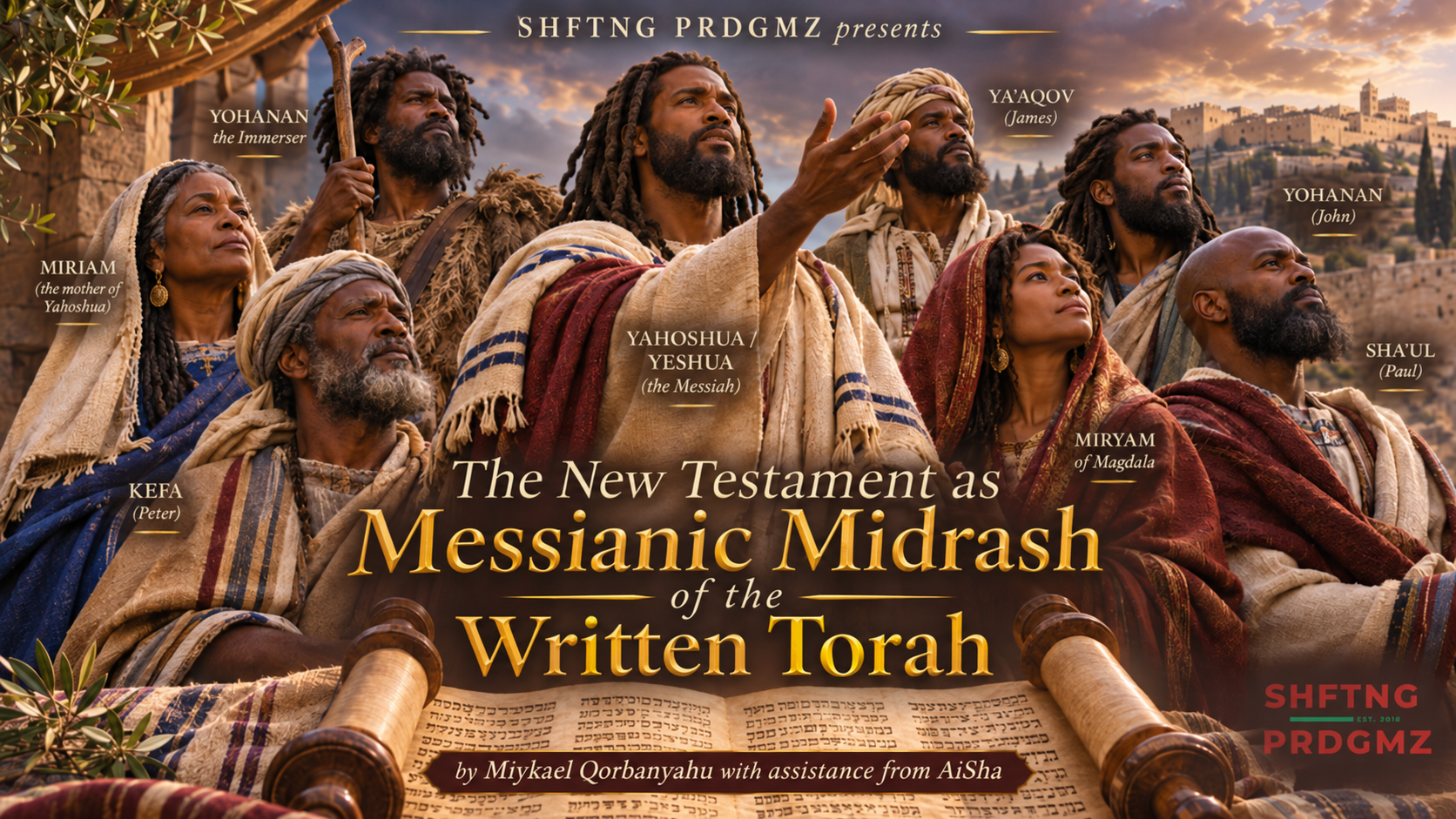
A Torah-based perspective about the New Testament as an inquiry to AiSha
Central thesis: The writings of the Brit Chadashah, the New Testament, or Besorah ha Torah (meaning the Good News; from here forward called Besorah) should be examined within Israel’s interpretive world of the Second Temple period, not exclusively through the lens of later Christian replacement theology. The Besorah repeatedly interprets Torah (Law), Nevi’im (Prophets), and Ketuvim (writings) through methods that also appear in Israel’s rabbinic literature.
The strongest argument is not that the Besorah and the Talmud teach identical theology. Rather, the Besorah participates in the Hebrew and Israel’s world of Scripture, interpretation, halakhic reasoning, covenant, and Messianic expectation.
An important historical distinction strengthens this argument: the Besorah writings predate the final compilation of both the Jerusalem and Babylonian Talmudim. Their parallels are therefore better presented as evidence of shared and developing Israel’s interpretive traditions, not proof that the Besorah copied the completed Shnei HaTalmudim .
The presentation will distinguish three questions:
- Historical: Did these writings originate within a recognizably Israel’s religious and intellectual environment?
- Textual: Do their language, arguments, and rhetorical methods reveal Hebrew and Aramaic foundations, even where the surviving text is Greek?
- Theological: Can the New Testament’s Messianic interpretation of Torah be defended through Scripture and reasoned dialogue without asking the listener to accept its authority beforehand?
This approach makes room for agreement on historical evidence while leaving the disputed question of Messianic authority open for careful examination.
Question 1: Did the Besorah originate within a recognizably Israelite religious and intellectual environment?
Historical evidence: Strong
Answer: Yes. The historical and literary evidence strongly supports placing the earliest Messianic movement within the diverse Israelite world of the Second Temple period. Its central figures, principal Scriptures, debates over Torah, expectations of redemption, and earliest communities were deeply connected to Israelite religious life.
A. Historical evidence independent of Besorah authority
First, the Hebrew historian Flavius Josephus provides external corroboration.
In Antiquities of the Jews 20.200, written around 93–94 CE, Josephus identifies Ya’aqob (James) as the brother of Yeshua, who was called Messiah, and describes his execution around 62 CE.
Most scholars accept this passage as authentic. Josephus presents James in a Israelite political and religious setting, alongside disputes involving priestly authorities and observers of the Law. It provides historically valuable corroboration for the existence of a Israelite figure and movement associated with Yeshua, although it does not prove Yeshua’s Messianic identity.
Second, Sha’ul’s earliest letters demonstrate his Hebrew covenantal identity.
In writings generally dated to the middle of the first century, Sha’ul identifies himself as an Israelite, a descendant of Abraham, and a member of the tribe of Benjamin (Romans 11:1). He also identifies himself with the Pharisaic tradition (Philippians 3:5; Galatians 1:13–14).
These are firsthand literary claims from a central figure in the movement, rather than later Christian descriptions of him.
Furthermore, Acts 21:20–26 portrays Israelite believers in Yeshua as zealous for Torah. Although Acts is not independent verification of every detail, the passage is important evidence for how an early Messianic author understood the Jerusalem community.
Third, the Dead Sea Scrolls establish that interpreting Scripture through contemporary communal and redemptive events was already a Israelite practice.
The Habakkuk Pesher (1QpHab) interprets ancient prophetic writings in relationship to the author’s community, its opponents, and its Teacher of Righteousness. Scholarly analysis shows that its interpretive techniques draw on multiple biblical passages and inherited Hebrew modes of exegesis.
Consequently, when Matthew interprets Hosea 11:1 in relation to Yeshua (Matthew 2:15), the technique has a recognizable Hebrew counterpart. Its particular interpretation remains debatable, but the method is not foreign to Second Temple Judaism.
B. The strongest internal evidence: Hebrew legal argumentation
Consider Matthew 19:3–9.
The Pharisees challenge Yeshua on whether divorce is permissible for any cause. This strongly resembles the dispute between Beit Hillel and Beit Shammai concerning Deuteronomy 24:1, preserved in Mishnah Gittin 9:10.
Beit Hillel interpreted the grounds for divorce more broadly, while Beit Shammai insisted on a restrictive interpretation. Yeshua responds by going behind the divorce regulation to Genesis 1:27 and 2:24.
This is a distinctly Torah-centered form of argument: one Torah passage is interpreted by reference to another, with attention to the underlying covenantal purpose of marriage.
His conclusion is not identical in every respect to either rabbinic school’s later recorded position. What is historically significant is that the question, legal method, and Scriptural framework belong to the same Israelite intellectual world.
C. The chronological relationship to the Shnei HaTalmudim
The Besorah writings were composed in the first and early second centuries, whereas the Mishnah was redacted around 200 CE. The Jerusalem Talmud developed into its compiled form primarily in late antiquity, and the Babylonian Talmud underwent compilation and redaction over subsequent centuries.
This means the Besorah cannot be described literally as a commentary on the already-completed Jerusalem or Babylonian Talmud. More accurately, it provides an early witness to Israelite arguments, traditions, and interpretive practices that sometimes appear in later rabbinic literature.
Conclusion to Question 1
The historically defensible conclusion is that the Besorah preserves forms of intra-Hebrew discourse, even though its books also reflect developing communities and debates involving non-Jews.
A skeptic need not believe in Yeshua to recognize that his teachings, as presented in these texts, engage the same Torah, covenantal categories, and interpretive questions that animated other Hebrew schools.
Discussion challenge: If the Besorah employs recognizable Hebrew legal and interpretive methods, should it be evaluated first as a Hebrew text on its own terms, rather than rejected solely because later Christianity adopted it?
Question 2: Does the Besorah’s language, arguments, and rhetorical methods reveal Hebrew and Aramaic foundations, even where the surviving text is Greek?
Answer: Yes, strongly, provided we distinguish a Hebrew linguistic and intellectual foundation from proof of original Hebrew composition.
The Besorah demonstrates extensive use of Hebrew Scripture, Semitic expressions, Hebrew rhetorical techniques, and interpretive methods. Yet the surviving early manuscript evidence is Greek, and much of the Besorah was likely originally composed in Greek.
A Messianic argument does not need to deny that distinction.
A. Historical testimony for Hebrew composition
An important ancient witness is Papias of Hierapolis, writing in the early second century. His remarks survive through Eusebius, Ecclesiastical History 3.39.16.
Papias states that Matthew compiled the logia in the Hebrew dialect or language, which others interpreted or translated as they were able. This is genuine early testimony for a Hebrew-language or Hebrew-style Matthean tradition.
However, three questions remain unsettled: whether logia means sayings or a complete Gospel, whether Hebrew means Hebrew or Aramaic, and whether Papias is referring to the canonical Greek Matthew.
Modern scholarship generally considers canonical Matthew to have been composed in Greek, especially given its literary use of Greek Mark. The extant ancient manuscripts also favor a Greek textual transmission: for example, Papyrus 46, containing Pauline writings and dated to around 200 CE, is Greek.
The later Shem-Tob Hebrew Matthew is historically interesting, but its claim to preserve an ancient Hebrew original is disputed, with published scholarship arguing for a medieval Latin textual source.
Messianic conclusion: We can confidently argue for the Besorah’s Hebraic foundations; a claim that every Besorah book was originally written in Hebrew goes further than the surviving evidence permits.
B. Textual example: Matthew 1:21 and Hebrew wordplay
HEBREW NAME
יֵשׁוּעַ
Yeshua
HEBREW VERB
יוֹשִׁיעַ
Yoshia — he will save
Matthew 1:21 connects the name of Yeshua with the action of saving his people from their sins.
The correspondence between the Hebrew name and the verb yoshia makes the explanation particularly meaningful in Hebrew. The passage is therefore a strong example of Semitic linguistic thought underlying the narrative.
This wordplay does not prove that Matthew was originally written in Hebrew: a bilingual author could preserve or reconstruct it in Greek. It does, however, substantiate the Hebrew conceptual foundation of the passage.
C. Hebrew and Aramaic speech preserved in Greek
The Witnesses preserve untranslated or transliterated Semitic expressions, sometimes accompanied by Greek explanations:
- Mark 5:41 — Talitha koum, an Aramaic expression.
- Mark 7:34 — Ephphatha, meaning be opened.
- Mark 14:36 — Abba, father.
- John 20:16 — Rabbouni, teacher.
- Mark 7:11 — Korban, an offering dedicated to Elohim.
These examples show that the evangelists preserved linguistic features of the environment in which their narratives were set.
More importantly, these expressions are embedded within the actual halakhic and covenantal questions the writings address.
D. Rhetorical criticism: The Besorah’s Hebrew interpretive methods
Hebrew interpretation involves more than literal explanation. It can employ mashal (parable), qal va-chomer (reasoning from lesser to greater), typology, thematic interpretation, and the application of earlier Scripture to present circumstances. The chart below provides us with examples of exegetical methodologies.
| Method | New Testament example | Torah and rabbinic connection |
| Qal va-chomer | John 7:22–23: circumcision on Shabbat is compared with making a person whole | Leviticus 12:3; Bavli Shabbat 132a |
| Halakhic dispute | Matthew 19:3–9: grounds for divorce | Deuteronomy 24:1; Mishnah Gittin 9:10 |
| Typological interpretation | Matthew 2:15 applies Hosea 11:1 to Yeshua | The original Hosea passage concerns Israel; Matthew reuses the Exodus pattern |
| Torah exposition | Romans 10:6–10 reinterprets the nearness of the covenantal word | Deuteronomy 30:11–14 |
| Priestly typology | Hebrews 7 interprets Melchizedek in a Messianic framework | Genesis 14:18–20; Psalm 110:4 |
These are examples of Hebrew-style exegesis, not evidence that the Shnei HaTalmudim endorsed each interpretation.
The strongest case: Yohanan 7:22–23
Yeshua’s argument is that circumcision may take place on Shabbat without violating Torah; therefore, healing a whole person on Shabbat should not automatically be condemned.
This is an argument from the accepted case to the disputed case, using qal va-chomer reasoning.
The Babylonian Talmud, Shabbat 132a, discusses the precedence of eighth-day circumcision over Shabbat restrictions. Jerusalem Talmud Yevamot 8:1 also preserves discussion of circumcision overriding Shabbat in appropriate circumstances.
A published rhetorical analysis specifically identifies the qal va-chomer structure in Yohanan 7:22–23 and places it within Israelite halakhic reasoning.
This is significant because Yeshua’s argument presupposes the continuing validity of Torah. He is debating how commandments relate to one another, rather than claiming that Shabbat no longer matters.
The reasoning itself can be examined independently of whether the listener accepts the Gospel as Scripture.
E. Support from both Talmudic traditions: Pikuach nefesh
The principle of pikuach nefesh, preservation of human life, is particularly helpful.
The Jerusalem Talmud, Yoma 8:5, emphasizes the urgency of acting when life is endangered. The Babylonian Talmud, Yoma 85b, develops arguments that saving human life takes priority over ordinary Shabbat restrictions, including an interpretation of Leviticus 18:5: the commandments are given so human beings may live.
Compare these principles with Matthew 12:11–12 and Mark 3:1–5, where Yeshua reasons about doing good and healing on Shabbat.
There is an important qualification: the Witness healings are not always cases of immediate mortal danger, so pikuach nefesh does not settle every disagreement. Nevertheless, the rhetorical resemblance is substantial. All these discussions ask how Torah’s commandments express the preservation of life and human dignity.
Conclusion to Question 2
The strongest defensible statement is:
The Besorah is a corpus of primarily Greek-transmitted Israelite and early Messianic writings that frequently preserve Hebrew and Aramaic language, Hebrew Scriptural reasoning, and interpretive practices comparable to those preserved in rabbinic literature.
Its Greek textual form does not erase its Hebrew foundations, just as Greek-language Hebrew writings by Philo and Josephus are not thereby excluded from Israelite intellectual history.
Discussion challenge: If Greek-language writings by Israelite authors can preserve genuine Israelite theology and Scriptural interpretation, why should the Besorah be denied consideration as Hebrew literature solely because its earliest surviving witnesses are Greek?
Question 3: Can the Besorah’s Messianic interpretation of Torah be defended through Scripture and reasoned dialogue without first assuming its authority?
Answer: Yes. A coherent Messianic defense can begin entirely with the Written Torah and the Prophets, then evaluate the Besorah as an interpretation of those earlier Scriptures. That argument is stronger when it acknowledges genuine disagreements about fulfillment, covenant, and halakhah.
The essential principle is that Torah establishes the criteria by which a Messianic claim must be tested; the Messianic claim cannot simply establish its own criteria.
A. Torah itself provides the standard for testing Messianic claims
Deuteronomy 13:1–5 teaches that extraordinary signs do not justify abandoning allegiance to HaShem or following other elohim. Deuteronomy 18:15–22 provides criteria concerning the prophet whom Elohim raises up and the reliability of prophetic claims.
Isaiah 8:20 likewise directs attention to the Torah and the testimony.
These passages establish a compelling starting point for a skeptical listener: one should not be asked to abandon the Written Torah in order to recognize a supposed fulfillment of it.
From a Torah-based Messianic perspective, Yeshua must therefore be examined in terms of covenantal fidelity, his teaching about HaShem, his interpretation of the commandments, and the prophetic expectations associated with the Messiah.
B. The New Covenant originates in the TaNaK, not the New Testament
One of the strongest connections is Jeremiah 31:31–34.
JEREMIAH 31:31–34
בְּרִית חֲדָשָׁה
Brit Chadashah — New Covenant
The prophet announces a New Covenant with the House of Israel and the House of Judah, characterized by HaShem’s instruction being placed within the people and written upon their hearts.
This passage establishes several crucial elements.
First, the New Covenant is initiated by HaShem.
Second, its explicitly named recipients are Israel and Judah.
Third, the covenant involves the internalization of HaShem’s Torah, not a declaration that covenantal righteousness is irrelevant.
Jeremiah 31:35–37 continues by affirming the enduring identity of Israel before HaShem.
The Hebrew vocabulary is revealing:
- בְּרִית — Berit: Covenant.
- חֲדָשָׁה — Chadashah: New.
- תּוֹרָה — Torah: Divine instruction, which HaShem promises to inscribe upon the heart.
Ezekiel 36:26–27 provides an additional witness: HaShem promises a new heart and spirit, enabling the people to walk in His statutes and observe His judgments.
Deuteronomy 30:6 had already anticipated the circumcision of the heart, and Deuteronomy 30:11–14 describes the covenantal word as near to Israel, within reach of the mouth and heart.
The Messianic interpretation is that these promises describe a movement from external covenantal obligation toward transformed internal covenantal faithfulness, not the cancellation of the Torah itself.
That is the theological relationship Paul develops when he interprets Deuteronomy 30 in Romans 10:6–10.
C. Yeshua’s teaching can be examined as Torah interpretation
Matthew 5:17–19 is a central passage.
Yeshua expressly denies coming to abolish the Torah or the Prophets and instead describes his mission through the language of fulfillment.
The Greek verb plēroō, used in Matthew 5:17, can convey bringing something to fullness or completion. Its meaning must be determined from the passage and Matthew’s broader theology; it cannot automatically be reduced either to abolishing Torah or to merely repeating existing interpretations.
Verses 18–19 emphasize the seriousness of even small commandments. This provides strong internal evidence that Matthew presents Yeshua as a teacher who affirms the authority of Torah.
Romans 3:31 reinforces this by stating that faith does not nullify the Law but establishes it. Romans 7:12 describes the Law as holy, with its commandments holy, righteous, and good.
These are significant passages for a Torah-centered Messianic defense.
D. The Shema is central to Yeshua’s theology
In Mark 12:28–34, Yeshua is asked which commandment is foremost.
His answer begins with Deuteronomy 6:4–5, the Shema, followed by Leviticus 19:18 concerning love of one’s neighbor.
This is particularly important because the Shema remains foundational to Israelite worship and theology.
Mishnah Berakhot 2:2 speaks of accepting the yoke of the Kingdom of Heaven before the yoke of the commandments. In the Babylonian Talmud, Shabbat 31a, Hillel describes the ethical treatment of one’s neighbor as a foundational expression of Torah and encourages continued study.
The parallels do not erase differences between Yeshua and the rabbis. They demonstrate that the summaries of Torah’s ethical and spiritual meaning belong to a shared Hebrew interpretive tradition.
From a Messianic perspective, this establishes an important foundation: the worship of HaShem alone is not displaced by the teaching of Yeshua. Rather, the Gospels present his central commandments as love for HaShem and neighbor.
E. The prophetic case for Messianic fulfillment
The Messianic argument becomes more substantial when it examines the following passages together rather than relying upon isolated prooftexts.
| TaNaK passage | Prophetic theme | Messianic interpretation |
| Deuteronomy 18:15–19 | A prophet raised up among Israel | Acts 3:22–26 identifies Yeshua with this prophetic expectation |
| 2 Samuel 7:12–16 | Enduring Davidic kingship | Luke 1:32–33 presents Yeshua as heir to David’s throne |
| Isaiah 11:1–10 | Righteous Davidic ruler, justice and peace | Romans 15:12 applies the root of Jesse imagery to Yeshua |
| Isaiah 52:13–53:12 | The suffering Servant | Acts 8:30–35 and 1 Peter 2:21–25 apply the passage to Yeshua |
| Zechariah 9:9 | The humble king entering Jerusalem | Matthew 21:4–9 applies this imagery to Yeshua |
| Psalm 110:1–4 | Royal rule and Melchizedekian priesthood | Hebrews 5–7 develops a Messianic priestly interpretation |
These texts provide a cumulative theological argument: the Besorah authors connect Yeshua to established Scriptural themes involving prophecy, kingship, suffering, covenant, and redemption.
However, a skeptic can legitimately dispute these identifications. For example, Isaiah 53 has interpretations that identify the Servant with Israel or a representative of Israel. Isaiah 11’s vision of worldwide peace has also not yet been realized in its entirety.
The Messianic response commonly appeals to a sequence involving suffering, vindication, and future consummation. That is a theological interpretation to be argued from the texts, not a historical fact established simply by citing them.
F. Difficult passages must be addressed, not avoided
A compelling case needs to acknowledge places where Besorah writings appear to diverge from traditional Israelite halakhah.
Galatians 3–5 debates Torah, circumcision, and covenant membership. Hebrews 7–10 describes changes associated with priesthood and covenant, including language about the former covenant becoming obsolete. Mark 7:19 is frequently understood as indicating that foods have been declared clean.
These passages require careful exegesis.
A Messianic interpretation may distinguish between Torah’s enduring moral and covenantal principles, the specific obligations of Israelites and Gentiles, and the transformation of priestly or sacrificial arrangements. However, the Greek wording and historical context must be examined individually rather than assuming every apparent contradiction disappears.
The strongest Torah-based defense is one that permits the Written Torah to challenge interpretations of the Besorah, including familiar Christian interpretations.
This also means that recognizing the Hebrew character of the Besorah does not require claiming that rabbinic Judaism accepted Yeshua as Messiah. The historical Israelite rejection of that claim is a genuine theological disagreement.
Conclusion to Question 3
The cumulative Messianic case rests on the claim that the Besorah authors understood Yeshua as bringing Israel’s covenantal hopes toward fulfillment through repentance, Torah-shaped righteousness, redemption, and the promised renewal of the heart.
That interpretation can be presented and tested using Torah and the Prophets before any appeal to the Besorah’s authority.
It remains a Messianic reading, not an uncontested conclusion that every reader of the TaNaK must accept.
In light of this perspective, it would behoove us to ask ourselves the question if Jeremiah and Ezekiel describe a renewed covenant that inscribes Torah upon the heart, what criteria should determine whether a proposed Messianic interpretation advances that promise or contradicts it?
Selah.
Three conclusions and their evidentiary strength
Historical origins: Strong evidence
The Besorah arose within and in conversation with the Israelite religious world of the Second Temple era.
Hebraic foundations: Strong evidence
Its language, interpretive methods, and rhetorical structures contain substantial Hebrew and Semitic features, even though a Hebrew original for the entire corpus is unproven.
Messianic fulfillment: A reasoned theological case
The Besorah offers a detailed Messianic interpretation of Torah and the Prophets, however, the reality does present that its theological conclusions remain disputable and require separate examination.
The closing proposition is this:
If the Written Torah remains our foundational witness, and the Prophets establish the expectations of covenantal redemption, then the Besorah‘s claims should be evaluated through those earlier witnesses, using the same seriousness, textual discipline, and openness to argument that characterize genuine Torah study.
That is a Torah-based invitation to examine the Besorah as Messianic interpretation rather than to accept it merely on institutional or ecclesiastical authority.
Selah…
Discover more from SHFTNG PRDGMZ
Subscribe to get the latest posts sent to your email.

