
by Miykael Qorbanyahu
Let me open with a correction, because honest scholarship starts there. In a recent conversation between Village of Truth and Beit Mashiyach about the New Testament and Hebrew literature, I mistakenly tied the 5,500-year prophecy of Messiah’s coming to the Oral Law. I can admit that I honestly tripped on that one. The rabbinic clock is the teaching of the School of Elijah: 2,000 years of tohu (desolation), 2,000 years of Torah, and 2,000 years of the Messianic age (Sanhedrin 97a). The 5,500-year figure lives in the Adam literature from the Early Messianic Ethiopic Assembly, and Daniel’s 70 weeks (Daniel 9:24-27) stand on their own as biblical prophecy. Once I set those three streams in their proper channels, the real story got richer, and I want to walk you through it with me right here, right now.
For background purposes first, Mishnah Avot 1:1 opens with a shalshelet, a chain: Moshe received Torah at Sinai, handed it to Yehoshua, who handed it to the elders, then the prophets, then the Men of the Great Assembly. Rabbinic tradition holds that the Written Torah and the Oral Torah left Sinai together, and that every generation of sages added its own layer of interpretation inside that one stream. Yeshua and his talmidim lived inside that world. They argued over Scripture, read the prophets for messianic hints, and shared the conviction that history moves in ordered ages toward redemption, a week of millennia heading for the Shabbat of the world.
The Septuagint’s chronology put a number on that conviction. Early “Christian” chronographers such as Julius Africanus counted roughly 5,500 years from creation to the Messiah, and the figure traveled with the churches. The tradition and the number grow from the same soil, and that soil is Hebrew thought.
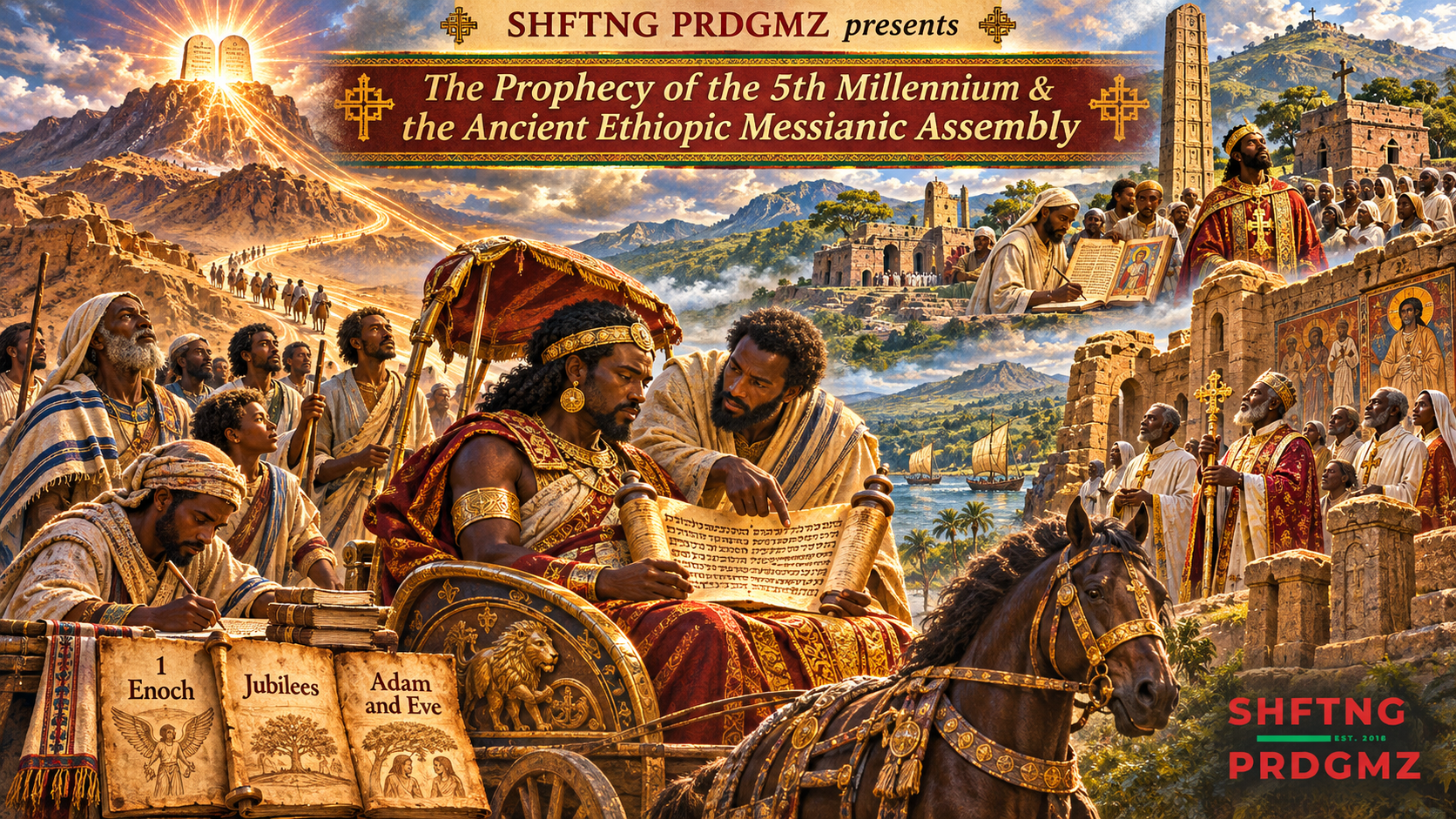
There’s a crucial connection that takes place in the Apostolic Scriptures that connects this dot with precision. In Acts 8, a high official of the Kandake, the queen of Kush, rides home from Jerusalem after worshipping, more than likely, during Shavuot, with the Isaiah scroll open in his lap. He reads Isaiah 53, and Philip runs alongside the chariot and opens the scroll for the official through Yeshua. In the language of PaRDeS, Philip carried him from peshat (the plain text) into remez (the hint) and derash (the unfolding), and the sod (the hidden depth) came alive in that desert conversation.
I want to place the history carefully here. Acts says Kush, the Nubian kingdom centered on Meroë, and the title Kandake belongs to its queens. The Aksumite kingdom in the Ethiopian highlands comes into view later, and Frumentius brought King Ezana to the faith in the 4th century. The Ethiopian Orthodox Tewahedo Church remembers the official as the first fruit of its own church, and that memory is a living tradition that deserves respect. Historians have no document that links Philip’s roadside teaching to an unbroken line of Aksumite teachers, so I hold the connection as the church’s own memory of its origins.
Whatever name the earliest believers carried, the Ethiopian assembly that took shape was a Hebrew-shaped community. Its scribes copied Ge’ez versions of 1 Enoch, Jubilees (Kufale), and the Octateuch (Orit), or the Torah and the first three book of the Prophets. Its calendar kept Sabbath observance, its believers practiced circumcision, and its tables followed food laws drawn from Leviticus. The Kebra Nagast tells the story of Sheba and Solomon and links the royal line to Israel.
The Ethiopian assembly also built its own oral chain. In its traditional schools, the Andemta commentary tradition passes down the interpretation of Scripture by voice, teacher to student, over generations. That oral commentary works the same way the rabbinic chain works: a text stands at the center, and a line of teachers surrounds it with meaning. The assembly later gathered legal rulings in the Fetha Nagast, and I read that as the Ethiopian counterpart to halakha, a body of practice that answers how a community lives out Scripture day by day.
The Ethiopian Jewish community, the Beta Israel, developed a parallel path. They kept the Orit, observed Sabbath, and shaped their own priestly and monastic customs and festivals such as the Sigd. Both communities show the same instinct that Avot 1:1 describes: a people receives a text, surrounds it with living interpretation, and hands it on.
The First Book of Adam and Eve is aggadah in the classic sense, narrative that deepens the story of Genesis. It follows Adam and Eve out of Eden to the Cave of Treasures, records their repentance, and holds HaShem’s promise that 5,500 years would pass before the Anointed One came to redeem them. It places Adam’s burial at the center of the earth, and it sends the gifts of gold, frankincense, and myrrh forward to the Magi. The Ge’ez text reached Ethiopia through Arabic, with roots in the Syriac Cave of Treasures, which scholars place in Upper Mesopotamia around 600 CE. Tradition credited Ephrem of Edessa, and modern analysis points to a Syrian Jacobite author. Goetze proposed a Jewish-Christian root for parts of the Cave of Treasures, which gives a fair bridge to the Hebrew thread, and scholars still debate that question.
Ethiopian scribes guarded these stories for centuries. They copied them letter by letter and handed them down with the care of a Torah scroll.
I see three witnesses standing together: the 5,500-year promise in the Adam literature, the Isaiah 53 scroll in the Kushite official’s chariot, and an African assembly that carried Hebrew Scripture, Hebrew categories of thought, and its own chain of oral teaching for nearly two thousand years. Each one points toward the Anointed One whom Hebrew Scripture announced and the African assembly proclaimed. The archaeology confirms that the assembly existed and flourished, and the manuscripts show what it believed. Together they make a strong case that the New Testament message grew out of Hebrew literature and found a home in Africa early.
Selah.
Discover more from SHFTNG PRDGMZ
Subscribe to get the latest posts sent to your email.

